

When we talk about electrical power quality, what we’re really asking is: how clean and stable is the power flowing into your facility? Think of it as a measure of how well the voltage, frequency, and waveform match the ideal standard. For any industrial operation, high-quality power isn't a luxury; it's the bedrock of reliability and equipment longevity.
Understanding Electrical Power Quality and Why It Matters
Imagine your facility's power supply is like the fuel for a high-performance engine. With clean, stable fuel, that engine purrs. But if the fuel is dirty or contaminated, the engine will sputter, stall, and eventually sustain serious damage. Electrical power quality is no different—it's the invisible force that keeps sensitive, expensive industrial machinery running just the way it was designed to.
Perfect power really comes down to three things:
- Stable Voltage: The power holds a consistent voltage level without any major dips (sags) or spikes (swells).
- Steady Frequency: The alternating current cycles at a constant rate, which is almost always 50 or 60 Hz.
- Pure Sine Waveform: The shape of the AC wave is a perfect, smooth curve, free from any distortion.
When all three of these conditions are met, your equipment just works. When they're not, the fallout can be both immediate and expensive.
The Hidden Costs of Poor Power
Letting power quality slide is a costly gamble. Any deviation from that ideal power profile introduces real risks that hit your bottom line hard. These issues often pop up as mysterious equipment failures that are a nightmare to diagnose. To get a better handle on the systems at play, it's helpful to review some foundational electrical principles that govern how all this works.
For instance, a tiny voltage sag lasting less than a second can be enough to trip a variable frequency drive, bringing an entire production line to a standstill. In the same way, harmonic distortions can cause motors and transformers to run hot, drastically shortening their lifespan while wasting energy.
The true cost of poor power quality isn't just the price of a replacement part. It's the slow, steady financial bleed from unplanned downtime, wasted energy, lost productivity, and equipment that fails years before it should.
Ultimately, getting a grip on power quality is more than just a maintenance chore. It's a core business strategy for protecting high-value assets, guaranteeing operational uptime, and safeguarding your profits. In today's industrial plants, clean power is simply a non-negotiable requirement for hitting peak performance.
The Usual Suspects: Common Power Quality Problems
In a perfect world, the power coming from the utility would be a flawless, consistent sine wave. But inside a busy industrial plant, that’s rarely the case. The electricity feeding your critical equipment is constantly being pushed and pulled by different forces, creating disturbances that can wreak havoc.
Think of it like the water pressure in your facility. You expect it to be steady, but what happens when a massive valve opens somewhere else? The pressure drops. What if a pump suddenly shuts off? You get a surge. Electrical disturbances work in a very similar way, and understanding these common culprits is the first step to protecting your operations.
Each disturbance messes with the clean power your equipment was designed to run on, leading to everything from simple malfunctions to catastrophic, premature failures.
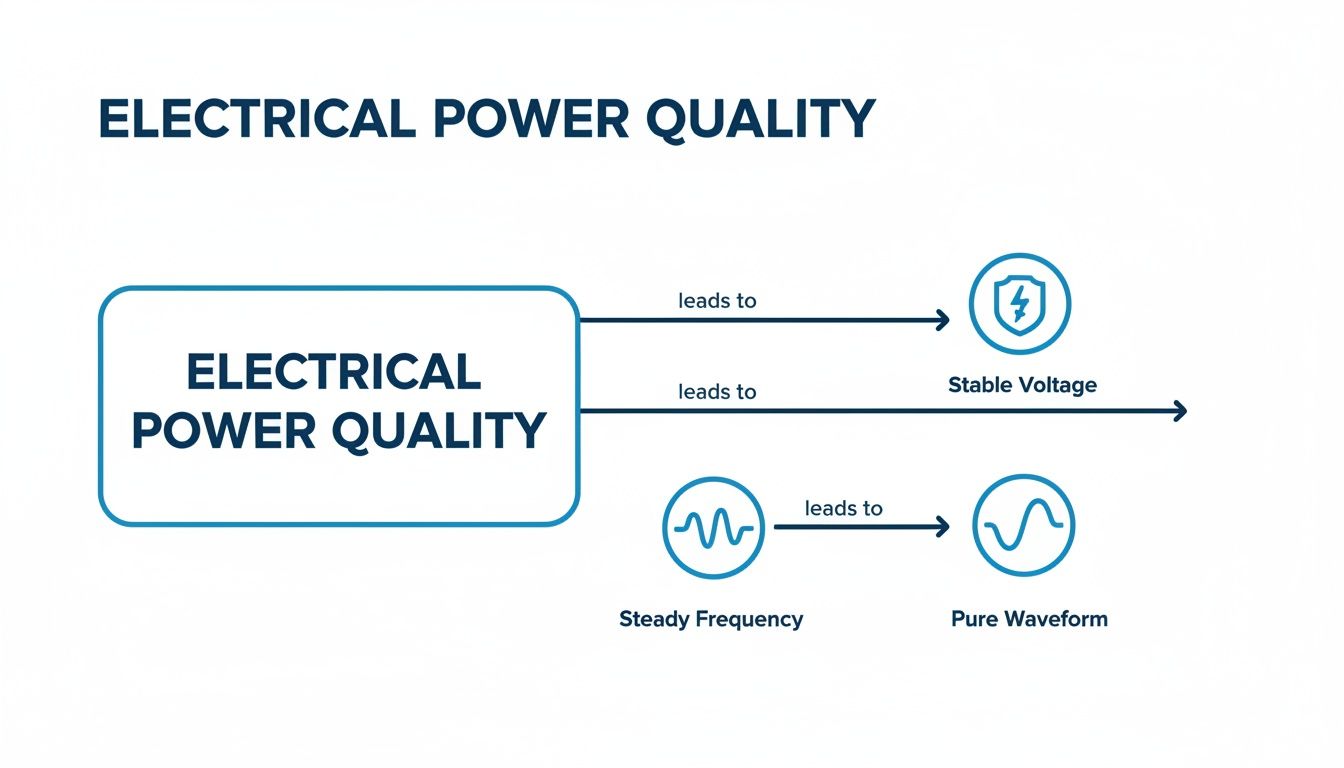
As you can see, great power quality is a balancing act between stable voltage, a rock-steady frequency, and a pure, undistorted waveform. When one of these gets knocked out of balance, you have a problem.
Voltage Sags And Swells
These are two sides of the same coin and are all about the magnitude of the voltage.
A voltage sag (sometimes called a brownout) is a brief but sharp drop in voltage. It’s the most common power quality issue out there. The classic cause? Kicking on a massive motor. That initial inrush of current needed to get it spinning can momentarily pull the system voltage down for everyone on the same circuit.
A voltage swell, its opposite, is a brief spike in voltage. While less frequent, swells can be brutal. They often happen when a huge electrical load suddenly shuts down, causing the system voltage to jump up unexpectedly.
Don’t underestimate the impact of a short event. A sag that lasts for just a few cycles—literally fractions of a second—is more than enough to trip a sensitive PLC, shut down a production line, and cost you thousands in downtime.
Transients And Harmonics
If sags and swells are about the level of voltage, transients and harmonics are about corrupting its shape.
A transient is an incredibly fast, high-energy burst of voltage. Picture it as a tiny lightning strike happening right inside your electrical system. They can be triggered by actual lightning, utility switching operations miles away, or even something as simple as static discharge. These spikes are assassins, capable of frying sensitive electronic components in an instant.
Harmonics, on the other hand, are a more sinister, persistent problem. They are extra, unwanted frequencies that piggyback on the main 60 Hz power supply, essentially polluting it. The biggest offenders are modern "non-linear" loads like variable frequency drives (VFDs) and even large-scale LED lighting systems. Learning the fundamentals of how these work, like these variable frequency drive basics, makes it clear why they are such a major source of harmonic distortion.
The best way to think of harmonics is as "dirty power." This distortion makes the pure sine wave jagged and inefficient. This dirty power forces motors and transformers to work harder and run hotter, which wastes energy and dramatically shortens their lifespan. High harmonic levels are a notorious cause of overheating neutral wires and nuisance circuit breaker trips.
To help you get a handle on these invisible threats, it helps to see their common causes and the damage they do all in one place.
Quick Guide to Power Quality Disturbances and Their Effects
This table is a great starting point for connecting a symptom you're seeing on the plant floor back to a potential root cause in your electrical system.
| Disturbance Type | Common Industrial Causes | Typical Impact on Equipment |
|---|---|---|
| Voltage Sags | Large motor startups, utility faults, arc welders | Process interruptions, PLC and drive trips, data loss |
| Voltage Swells | Sudden large load shutdown, capacitor bank switching | Damage to electronics, insulation breakdown, lighting failure |
| Transients | Lightning strikes, utility grid switching, static discharge | Instant destruction of sensitive components, data corruption |
| Harmonics | VFDs, LED lighting, switch-mode power supplies | Overheating of motors and transformers, breaker tripping |
| Voltage Unbalance | Unevenly distributed single-phase loads, faulty wiring | Motor overheating and premature failure, increased energy loss |
| Poor Power Factor | Inductive loads like lightly loaded motors | Higher electricity bills, reduced system capacity, voltage drops |
| Flicker | Arc furnaces, large motor cycling, welders | Visual irritation, potential malfunction of sensitive controls |
When a machine mysteriously faults out or an entire process line comes to a screeching halt for no apparent reason, this is your go-to reference. It helps you start asking the right questions and narrow down the likely electrical culprit.
Other Key Disturbances
A few other persistent issues can chip away at your power quality and cause headaches.
- Voltage Unbalance: In a three-phase system, you want all three voltage phases to be equal. When they aren't, you have an unbalance. It’s like trying to run with one leg doing all the work—it’s wildly inefficient and causes immense strain. This condition makes three-phase motors run hot, vibrate, and fail long before their time.
- Poor Power Factor: This is a measure of how efficiently your facility is using electricity. A low power factor means you're drawing more current from the utility than you are actually using to do work. This translates directly to higher utility bills for power you aren't even using and puts extra stress on your entire electrical system.
- Flicker: This is a rapid, often annoying, pulsing in your lighting caused by voltage fluctuations. While it might seem like a minor issue, flicker is often a symptom of a much larger voltage stability problem that could be affecting more sensitive and expensive equipment.
How Renewables Are Changing Grid Stability
The global shift toward renewable energy isn't just an environmental headline; it's fundamentally changing the behavior of the electrical grid that powers your facility. For generations, industrial plants have been built on the assumption of a stable power grid, one anchored by the predictable, spinning generators of traditional power plants. That bedrock of stability is now shifting.
Unlike coal or gas, renewable sources like wind and solar are inherently intermittent. The sun goes behind a cloud, the wind dies down. This variability introduces a new kind of volatility to the grid. What was once a steady, reliable flow of power is now prone to more frequent fluctuations, creating a whole new set of power quality challenges for sensitive industrial machinery.
This isn't some far-off problem. The grid is becoming less robust, more susceptible to the kinds of disturbances that can bring your production line to a grinding halt with little to no warning.
The Disappearance of Grid Inertia
The core of the issue is the loss of grid inertia. Picture the old power grid as a massive, heavy flywheel. The combined rotating mass of all the giant turbines in traditional power plants gave the system immense physical inertia. If a sudden fault occurred or a large motor kicked on, this "flywheel effect" smoothed out the disturbance, keeping the grid's frequency stable while other controls kicked in.
Renewable sources don't work that way. Solar panels and wind turbines use electronic inverters to generate AC power. There's no heavy, spinning mass to act as a shock absorber. As more of these inverter-based resources replace old-school generators, the grid loses its natural stabilizing force.
Without that built-in flywheel, the grid becomes more brittle. Small events that were once absorbed without a ripple can now trigger rapid, severe swings in frequency and voltage, directly compromising the power quality feeding your plant.
This loss of inertia makes your facility far more vulnerable to sags, swells, and frequency deviations that can trip variable frequency drives, shut down PLCs, and damage sensitive control circuits. As a result, many facilities are now looking inward for solutions, and it's worth understanding how microgrid control systems can create a localized island of stability.
Global Symptoms with Local Impacts
We're already seeing the symptoms of this new grid reality play out across the globe. Take the strange phenomenon of negative electricity pricing. In the first half of 2025, major European markets like Germany and Spain saw negative prices during 8-9% of wholesale hours. That’s a huge jump from just 4-5% in 2024.
This happens when sunny, windy conditions flood the grid with more power than it can use, forcing producers to actually pay to get rid of their excess electricity. You can dig deeper into these trends in the IEA's mid-year electricity report.
For an industrial plant manager, these market quirks are a red flag. They signal a grid where supply and demand are frequently out of balance—the perfect breeding ground for the voltage and frequency volatility that puts your equipment at risk. The predictable grid of the past is gone, replaced by a much more dynamic system that demands proactive power quality management.
Getting a Handle on Power Quality: Standards and Measurement
To get a grip on power quality, you need a solid rulebook. Without one, you’d have electrical chaos, with every piece of equipment playing by its own rules. Key standards give us a common language, setting clear limits for disturbances and making sure all the gear in your plant can play nicely together on the same electrical system.
These aren't just academic guidelines; they're the practical tools of the trade for engineers and facility managers. They give you the benchmarks you need to diagnose problems, specify new equipment, and hold your utility and vendors accountable. Understanding them turns power quality from a fuzzy concept into something you can actually measure and manage.
At the end of the day, the goal is simple: make sure one device’s electrical noise doesn't knock another one offline.
The Key Standards You Need to Know
In the world of power quality, two major families of standards run the show. They come from different places, but they both work toward creating a stable, predictable electrical environment for everything plugged in.
- IEEE 519 (Recommended Practice for Harmonic Control): In North America, this is the big one for managing harmonic distortion. It lays out specific limits on how much harmonic "gunk" your facility is allowed to dump back onto the utility grid. Think of it as a good neighbor policy for electricity, keeping your plant's VFDs and other non-linear loads from polluting the power for everyone else.
- IEC 61000 Series (Electromagnetic Compatibility): This is a huge, comprehensive family of international standards covering all things related to electromagnetic compatibility (EMC). It touches on everything from voltage sags and flicker to harmonics and transients, providing a complete framework for how equipment should behave and how much disturbance it can handle.
These standards are a two-way street. They don't just limit the electrical pollution a device can create; they also define the level of disturbance a device has to withstand without failing. We call this immunity.
This dual approach is absolutely critical. It means when you buy a new piece of equipment that's compliant, you can be reasonably sure it won't just trip or fail the first time it sees a voltage dip in a typical industrial setting.
The Tools of the Trade
You can't fix what you can't see. Pinpointing and solving power quality problems requires specialized tools that can capture lightning-fast electrical events that your standard multimeter would miss entirely.
The workhorse for this job is the power quality analyzer. This isn't your average meter; it's more like a high-speed camera for your electrical system. It records incredibly detailed data on voltage, current, harmonics, transients, and a whole lot more. The best part is that modern analyzers can log this data for days or even weeks, which is perfect for catching those frustrating, intermittent faults that never seem to happen when you're looking.
With renewables forecasted to generate 35% of the world's electricity by 2025, this kind of detailed monitoring is more important than ever. The inherent variability of wind and solar introduces new power quality challenges, making precise measurement essential for maintaining grid stability. You can dig deeper into how renewables are changing the game in this WEF report on the future of electricity.
Where to Look and What to Look For
Getting good data is all about putting your analyzer in the right spot. The most important place to start is the Point of Common Coupling (PCC)—that’s the spot where your facility’s electrical system connects to the utility grid. Measuring here is the first step in figuring out if a problem is homegrown or if it's coming from your utility.
Once you’re hooked up, here are the key things to watch for to get a clear picture of your plant's electrical health:
- Voltage Sags and Swells: Keep an eye on the size and duration of any voltage dips or spikes. This data is gold when you're trying to correlate them with random equipment trips.
- Total Harmonic Distortion (THD): You'll want to measure both voltage and current THD. High current THD usually points a finger at polluting equipment inside your plant, while high voltage THD often means the problem is with the supply coming from the utility.
- Power Factor: Monitoring your power factor helps you spot inefficiencies that are costing you money in utility penalties and eating up your system's capacity.
- Transients: Capturing these ultra-fast spikes is crucial for diagnosing those mysterious, unexplained failures of sensitive electronics.
When you bring together the right standards, tools, and a smart measurement strategy, you can build a truly effective monitoring program. This proactive approach lets you get ahead of problems, moving from just reacting to failures to actually predicting and preventing them. That’s how you keep a facility running smoothly and efficiently.
A Practical Workflow for Troubleshooting Power Issues
When a critical piece of equipment suddenly trips or a process grinds to a halt for no apparent reason, the hunt for the root cause is on. Instead of just guessing, a systematic workflow can turn you into an effective power quality detective, helping you connect vague symptoms to a clear diagnosis. A structured approach not only saves time but also prevents the costly mistake of replacing perfectly good parts and gets your operations back online faster.
This isn't about getting bogged down in complex theory. It’s a practical game plan for finding the real culprit behind your electrical power quality problems. By following these logical steps, you can move from a hunch to a verified solution, whether the issue is inside your plant or coming from the utility grid.

Step 1: Start with the Symptoms
Before you even think about grabbing a meter, put on your investigator's hat. The first move is to gather intelligence by talking to the operators and maintenance staff who deal with the problem every day. Their on-the-ground observations are invaluable clues.
Your goal here is to build a detailed problem profile. Ask targeted questions to get the full story:
- What exactly happens? Does a drive trip on a specific fault? Do the lights flicker? Does a PLC reboot itself?
- When does it happen? Is it completely random, or does it seem to happen at a specific time of day, during a particular shift, or only when certain machines are running?
- Where does it happen? Is the issue hitting a single machine, one circuit, or an entire section of the plant?
This initial fact-finding is critical. For instance, if a variable frequency drive (VFD) trips every morning right around 8:05 AM, it’s a strong hint that the problem is tied to a scheduled event, like a large HVAC unit or air compressor kicking on.
Step 2: Conduct a Visual System Inspection
Once you have a clear picture of the symptoms, it's time for a hands-on walk-through. You'd be surprised how many power quality issues are rooted in simple, observable installation problems. This visual check can often uncover the "smoking gun" without needing any complex measurements.
Look for obvious signs of trouble in the electrical distribution system feeding the affected equipment.
Pay close attention to things like loose connections, signs of overheating (discoloration on wires or terminals), improper grounding, or sensitive control wires running right alongside high-power motor leads. A thermal imager can be your best friend here, quickly revealing hotspots that signal a poor connection under load.
This physical inspection helps you either find the cause directly or at least rule out common installation errors before you move on to more advanced diagnostics.
Step 3: Capture Data with a Power Quality Analyzer
If the visual inspection comes up empty, it's time to bring in the specialized tools. The next step is to install a power quality analyzer at a strategic point—typically at the input terminals of the troubled equipment or the upstream distribution panel.
The key isn't just hooking it up; it's about setting it up to catch the specific events you're hunting for.
- Set the Thresholds: Configure the analyzer to trigger a recording whenever it detects a disturbance that matches your symptoms. This could be a voltage sag dipping below 90% of nominal or a transient spike shooting above a certain level.
- Log Data Over Time: Don't just watch it for an hour. Let the analyzer run for several days, or even a week. This is absolutely essential for catching those frustrating, intermittent problems that never seem to happen when you're looking.
- Correlate Events: After you capture a disturbance, the final piece of the puzzle is to correlate the timestamp of that electrical event with the equipment’s own fault log.
When you can definitively show that a VFD tripped at the exact moment the analyzer recorded a major voltage sag, you've found your root cause. This kind of data-driven evidence replaces guesswork with certainty, allowing you to confidently choose and implement the right fix.
Implementing Effective Mitigation Technologies
Once you’ve diagnosed a power quality problem, the real work begins: putting a solution in place. Knowing you have an issue is one thing, but fixing it requires picking the right tool for the job and installing it where it will do the most good. This is how you turn raw diagnostic data into real-world improvements in reliability and equipment lifespan.
Think of it like being a doctor for your electrical system. You wouldn't prescribe the same medicine for a headache and a broken bone. In the same way, you can't use a surge protector to fix harmonic distortion. Matching the solution to the specific disturbance is the key to a smart, effective investment in your facility’s electrical power quality.

Solutions for Harmonic Distortion
Harmonics are a tricky problem, often created by the very equipment that makes a modern plant efficient—like variable frequency drives (VFDs). The goal here is to filter out that "dirty power" before it wreaks havoc on everything else.
-
Passive Harmonic Filters: These are the classic, battle-tested workhorses. A passive filter is basically a tuned circuit of inductors and capacitors designed to trap a specific harmonic frequency. It acts like a drain, shunting that unwanted energy away from the rest of your system. They're cost-effective and incredibly reliable, especially when you're dealing with a single, dominant harmonic like the 5th harmonic from a standard six-pulse VFD.
-
Active Harmonic Filters: If a passive filter is a simple drain, an active filter is a high-tech, noise-canceling headphone for your power system. It actively monitors the line in real-time and injects an equal and opposite current to perfectly cancel out harmonic distortion. This makes them fantastic for cleaning up complex, ever-changing harmonic profiles from multiple non-linear loads. You can dive deeper into how these are applied in guides covering harmonic filters for VFDs.
Taming Transients with Surge Protection
Transients are the silent assassins of the power quality world. These split-second voltage spikes can destroy sensitive electronics in an instant. Your defense is a layered strategy using Surge Protective Devices (SPDs).
An SPD acts like a pressure relief valve for electricity. Under normal voltage conditions, it just sits there. But the moment it senses a dangerous spike, it instantly diverts that excess energy safely to the ground, protecting all the equipment downstream.
A common mistake is just slapping one SPD at the main service entrance and calling it a day. A truly robust strategy uses a cascaded system: a heavy-duty SPD at the main panel, smaller ones at key distribution panels, and finally, point-of-use devices for your most critical or sensitive equipment.
Correcting Voltage Sags and Interruptions
Voltage sags are far and away the most common culprit behind production downtime. Protecting against them means having a way to fill in the missing energy when the voltage dips.
-
Uninterruptible Power Supply (UPS): A UPS is the ultimate line of defense against sags and total blackouts. It uses batteries to provide a seamless, instantaneous supply of clean power the moment the utility feed falters. While they are non-negotiable for critical control systems like PLCs and servers, trying to back up every large motor with a UPS is usually not a practical option financially.
-
Dynamic Voltage Restorer (DVR): Think of a DVR as a lightning-fast voltage regulator. Instead of relying on batteries for long-term power, a DVR monitors incoming voltage and can inject precisely the right amount of voltage to "fill the gap" during a sag. This makes it an incredibly effective way to protect an entire process line or facility from the short-duration sags that cause most equipment to trip.
Choosing the Right Installation Point
Where you install a solution is just as important as what you install. The decision really comes down to whether you're trying to fix a problem at its source or protect your whole facility from the outside world.
- At the Load: Installing a filter or SPD right at a specific machine is perfect for containing a problem at its source or protecting a single, high-value asset.
- At the Panel: Placing mitigation gear at a distribution panel allows you to protect a whole group of circuits or machines in a more cost-effective way.
- At the Service Entrance: For facility-wide protection against external threats like utility surges or poor incoming power, a solution installed at the main electrical entrance is the only way to go.
By carefully diagnosing the problem, understanding the tools at your disposal, and strategically picking the installation spot, you can build a solid defense against power quality disturbances. This proactive approach keeps your equipment running reliably, helps it last longer, and ultimately keeps your operation productive and profitable.
Answering Your Top Power Quality Questions
Even after you get the hang of diagnostics and mitigation, some fundamental questions about power quality pop up again and again. Getting these core concepts straight is key to keeping any industrial operation running reliably and efficiently. Let's tackle a few of the most common ones.
Power Quality vs. Reliability: What's the Difference?
It’s easy to mix these two up, but they describe very different things.
Power reliability is a simple, binary question: is the power on or off? It’s all about uptime. Power quality, on the other hand, is about the condition of that power when it’s on. You can have 100% reliability with the lights always on, but still have abysmal quality that silently wreaks havoc on your equipment.
Think of it like this: reliability is having water flow to your house. Quality is making sure that water is clean, free of contaminants, and at the right pressure. You wouldn't want to drink gritty water, and your sensitive electronics don't want to "drink" dirty power.
Are Power Issues Always the Utility's Fault?
It's a common assumption, but the answer is a firm no. While problems from the grid certainly happen, a huge number of power quality issues actually start inside your own four walls.
Experience in the field, backed by industry studies, shows that internal equipment is often the real culprit. Big motor starts, arc welders, and especially the variable frequency drives (VFDs) that are so common today are major sources of disturbances like voltage dips and harmonic distortion. That’s why you can't just blame the utility; a proper analysis is the only way to find the true source.
What's the Most Common Power Quality Problem?
Hands down, voltage sags are the most frequent and costly disturbance for industrial plants.
A sag can be incredibly brief—lasting just a few cycles, or mere fractions of a second. But that’s often more than enough to trip sensitive drives, PLCs, and control systems. When that happens, an entire production line can grind to a halt, leading to immediate downtime and very real financial losses.
At E & I Sales, we live and breathe this stuff. We specialize in diagnosing and solving complex power quality challenges with engineered, UL-listed control panels and complete system integration. From the first measurement to the final commissioning, our team delivers the expertise you need to keep your operations running without a hitch.
Explore our custom control and integration services at E & I Sales to see how we can help.