When we talk about electrical substation maintenance, we're talking about the nuts and bolts of keeping the power grid reliable, safe, and efficient. It's a hands-on discipline that involves inspecting, testing, and servicing every last component in a substation. This isn't just about ticking boxes on a checklist; it's a vital investment in keeping the lights on.
Why Modern Substation Maintenance is So Critical
Let's be real—substation maintenance can sometimes be seen as just another operational expense. But for any facility relying on high-voltage power, it’s the absolute foundation of reliability. The old "run-it-till-it-breaks" mentality is a recipe for disaster. In today's world, downtime can easily cost millions and introduce serious safety hazards.
A smart, strategic maintenance program turns that cost into an investment. It’s about more than just going through the motions; it’s about understanding what it truly takes to keep your most critical infrastructure humming.
Shifting from Reactive to Proactive
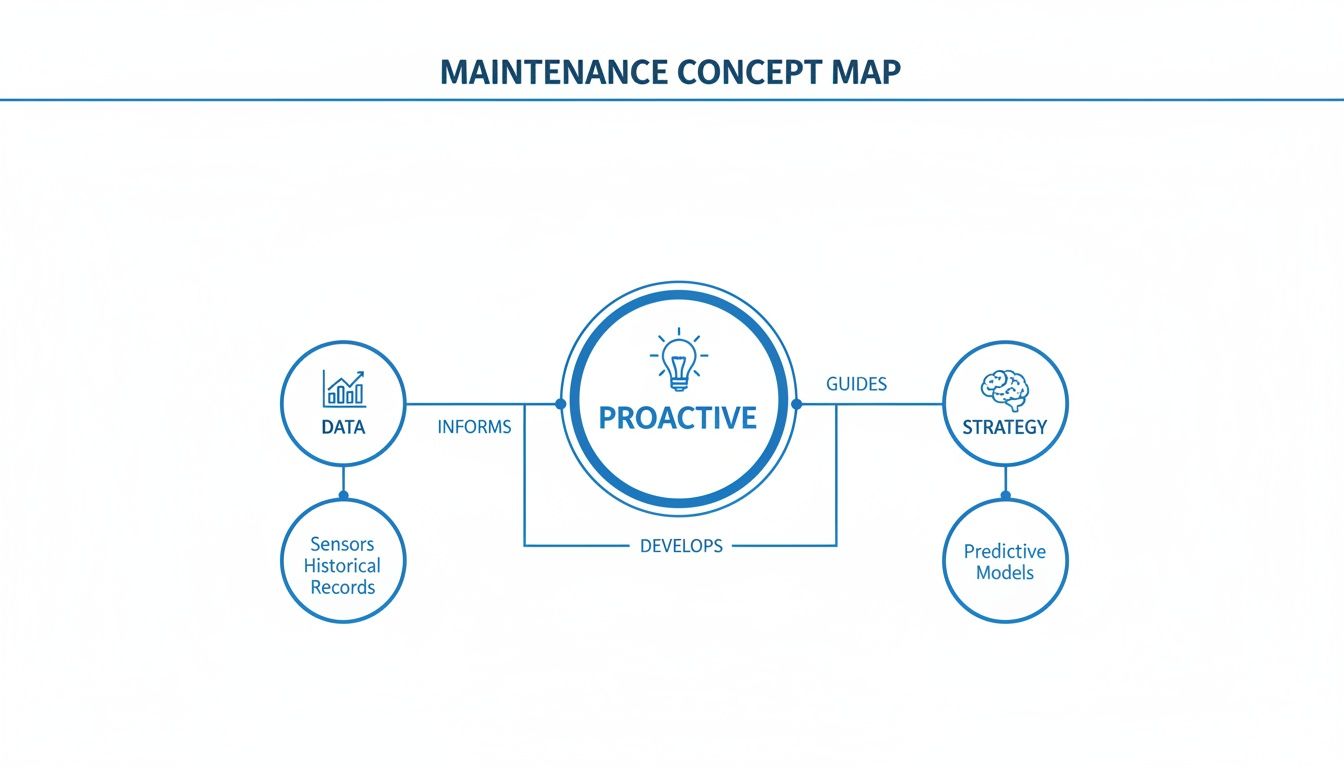
The biggest change in modern substation maintenance is the move away from a reactive model. Instead of waiting for a circuit breaker to trip or a transformer to fail, a well-designed program spots trouble long before it can cause an outage.
This proactive approach pays off in several huge ways:
A Safer Work Environment: A well-maintained substation is a safer one. Catching things like failing insulation or a hot connection early on drastically cuts the risk of catastrophic failures like an arc flash.
Maximum Uptime: A planned maintenance shutdown is always better than an emergency outage. Scheduling your work keeps your operations online when it counts.
Longer Equipment Life: Transformers, switchgear, and breakers are massive capital investments. Proper maintenance helps you squeeze every bit of operational life out of them.
Staying Compliant: Good maintenance practices and meticulous documentation are non-negotiable for meeting industry standards and avoiding fines.
The real goal here is to manage your assets intelligently instead of just lurching from one emergency to the next. When you combine solid planning with modern predictive tools, you can handle the challenges of aging equipment and rising energy demands without breaking a sweat.
A Market Driven by Necessity
This focus on robust maintenance isn't just a good idea; it's a global trend. The market for substation maintenance is on track to hit nearly USD 67.09 billion by 2032, a boom driven by aging infrastructure and the world's growing appetite for electricity. This shows a clear industry-wide understanding that proactive care is the key to grid stability.
Thinking about the principles of enterprise fleet maintenance can be incredibly helpful here; managing a complex substation has a lot in common with managing a large fleet of critical assets. Of course, getting things right from the start prevents a lot of headaches down the road, which is why a solid foundation in electrical substation design is so important. This guide will give you a practical roadmap for doing just that.
Getting the Plan Right: Safety in High-Voltage Environments
In a high-voltage substation, there are no do-overs. One small mistake can have massive consequences. That’s why, before a single tool comes out of the truck, every action is governed by meticulous planning and an unwavering focus on safety. This isn't just about checking boxes; it’s a systematic approach to controlling extreme hazards.
Every job starts with a rock-solid work plan. Think of it as the mission briefing. It lays out the scope of work, identifies the exact equipment involved, and details the sequence of every task. This forces the crew to think through potential problems before they happen, making sure everyone—from the senior engineer to the newest apprentice—is on the same page.
A huge piece of this puzzle is coordinating scheduled outages. This means talking to system operators and any facilities that will be affected. It's more than just a courtesy; it's essential for maintaining grid stability and preventing any nasty surprises.
Mastering Lockout/Tagout (LOTO)
The absolute bedrock of electrical safety during any maintenance job is the Lockout/Tagout (LOTO) procedure. Inside a substation, LOTO isn't just about flipping a switch. It's a formal, verifiable process to completely isolate equipment from every possible energy source, rendering it inert before anyone gets near it.
The process sounds simple, but it demands absolute discipline.
Isolate and De-energize: The first move is to formally open all disconnects for the circuit or equipment you're working on. This physically severs its connection to the grid.
Lock and Tag: Every single person working on the job places their personal lock and tag on the isolating device. The lock makes it physically impossible to re-energize the equipment, and the tag tells everyone who is working on it.
Verify Zero Energy: This is the step you can't afford to get wrong. After applying locks, a qualified person must use a properly rated voltage detector to test the conductors. You need to confirm there is absolutely no voltage present. Only then is the equipment safe to touch.
Never assume a circuit is dead just because a breaker is open. A common and deadly mistake is failing to test. Verification isn't optional—it's what separates a routine job from a career-ending (or life-ending) accident.
Cutting corners on LOTO is a recipe for disaster. Imagine a crew overlooks a secondary power feed. A technician, believing the equipment is safely de-energized, makes contact right as that back-feed lights up the circuit. The result is a devastating arc flash or electrocution.
The Pre-Job Briefing: Your Final Check
Right before the work starts, the entire crew gathers for a pre-job safety briefing, often called a "tailgate talk." This isn't a formality; it's the final, critical checkpoint for the whole team.
Here, the supervisor walks everyone through the work plan, double-checks the LOTO setup, and highlights the specific hazards for the day's tasks. It’s also the time for anyone to ask questions or voice concerns. No question is a dumb one here.
Beyond the immediate shock hazards, a solid understanding of chemical safety in the workplace is vital. Substations are full of hazardous materials, from dielectric fluids in transformers to SF6 gas in circuit breakers.
A good briefing makes sure every crew member walks away knowing:
The precise boundaries of the work zone.
The minimum approach distances to any nearby energized equipment.
The exact Personal Protective Equipment (PPE) required for the job.
The emergency response plan, including the location of first aid and fire suppression gear.
This disciplined approach transforms a dangerous environment into a controlled, manageable workspace. It’s how we ensure every substation maintenance job gets done right—and everyone goes home safe.
Inspecting and Testing Critical Substation Components
Once the paperwork is done and the safety protocols are locked in, it’s time to get hands-on. This is where the real work of substation maintenance happens, moving from planning to practical diagnostics on the gear that keeps the lights on. The mission isn't just about running a battery of tests; it's about knowing how to interpret the results and what they're telling you about the health of your equipment.
Think of it this way: every piece of equipment in a substation is constantly telling a story about its condition. You just need to know how to listen. The right diagnostic tests are your translator, revealing hidden stresses and potential failure points long before they turn into a full-blown outage.
Decoding Transformer Health Through Analysis
Transformers are the heart of any substation, and their health is everything. A quick visual check might spot an oil leak or a cracked bushing, but the most important clues are hidden inside the tank. That’s where Dissolved Gas Analysis (DGA) and power factor testing come in.
DGA is essentially a blood test for your transformer. As the internal insulating oil and paper degrade under heat and electrical stress, they release specific gases. By taking an oil sample and analyzing it, we can diagnose developing problems with stunning accuracy.
For instance, finding high levels of acetylene (C2H2) is a major red flag; it almost always points to high-energy arcing, a serious fault that requires immediate action. On the other hand, a spike in methane (CH4) and ethane (C2H6) usually suggests a thermal fault or "hot spot" somewhere in the windings. Knowing these gas relationships helps you pinpoint the type and severity of an internal problem.
One of the biggest mistakes I see is when technicians focus on a single gas value. A truly skilled analyst looks at the ratios between different gases, using tools like the Duval Triangle method to get the full picture. A slight rise in hydrogen might not seem like a big deal, but if it's coupled with rising methane, you could be looking at a corona or partial discharge issue.
Power factor testing (also called Tan Delta testing) is all about checking the integrity of the transformer's insulation. A brand-new, perfect insulator would have a power factor of zero. Over time, as insulation ages and absorbs moisture, it becomes less effective, and that power factor number creeps up. A slow, steady increase over the years is normal, but a sudden jump from one test to the next is a serious warning sign of contamination or insulation breakdown.
Essential Substation Component Testing Schedule
To keep things running smoothly, you need a consistent testing rhythm. Sticking to a schedule ensures you catch problems early and can plan for repairs instead of reacting to failures. Here’s a sample schedule covering the foundational tests for your most critical assets.
Component
Test/Inspection
Recommended Frequency
Purpose
Power Transformer
Dissolved Gas Analysis (DGA)
Annually
Detects internal faults like arcing and overheating.
Power Transformer
Power Factor / Tan Delta
Every 3-5 years
Assesses the quality and integrity of the insulation system.
Circuit Breaker
Timing Test
Every 5-6 years
Ensures contacts open and close within spec to clear faults.
Circuit Breaker
SF6 Gas Analysis
Annually
Checks for purity, moisture, and byproducts in SF6 breakers.
Switchgear
Insulation Resistance Test
Every 2-3 years
Verifies insulation integrity to prevent shorts and faults.
Protective Relay
Functional Trip Test
Every 3-5 years
Confirms the entire protection scheme operates as designed.
Grounding System
Fall-of-Potential Test
Every 3-5 years
Measures grid resistance to ensure effective fault clearing.
This schedule provides a solid baseline, but always adjust it based on the age of your equipment, its specific operating conditions, and any manufacturer recommendations.
Ensuring Circuit Breakers Can Perform Under Pressure
Circuit breakers are your first line of defense. Their job is to interrupt massive fault currents in the blink of an eye, so there’s absolutely no room for error. Our testing focuses on making sure they can do their job perfectly when called upon.
A timing test is non-negotiable. This test measures the exact time it takes for the breaker's contacts to open and close after getting a signal. If a breaker is too slow, it won't clear a fault fast enough, which can lead to catastrophic damage to other equipment.
The results need to show all three phases operating in near-perfect sync. If one phase lags behind the others—a problem we call "pole disagreement"—it can create dangerous system imbalances. For a closer look at the mechanics, you can learn more about the demands placed on a medium voltage circuit breaker.
For breakers that use Sulfur Hexafluoride (SF6) gas to insulate and extinguish arcs, regular gas analysis is mandatory. This testing looks for three key things:
SF6 Purity: Contaminants can compromise the gas’s dielectric strength.
Moisture Content: Moisture is the ultimate enemy of SF6, leading to corrosive byproducts that can destroy internal parts and cause flashovers.
Decomposition Products: Finding arc byproducts tells you how hard the breaker has been working and can signal internal arcing issues.
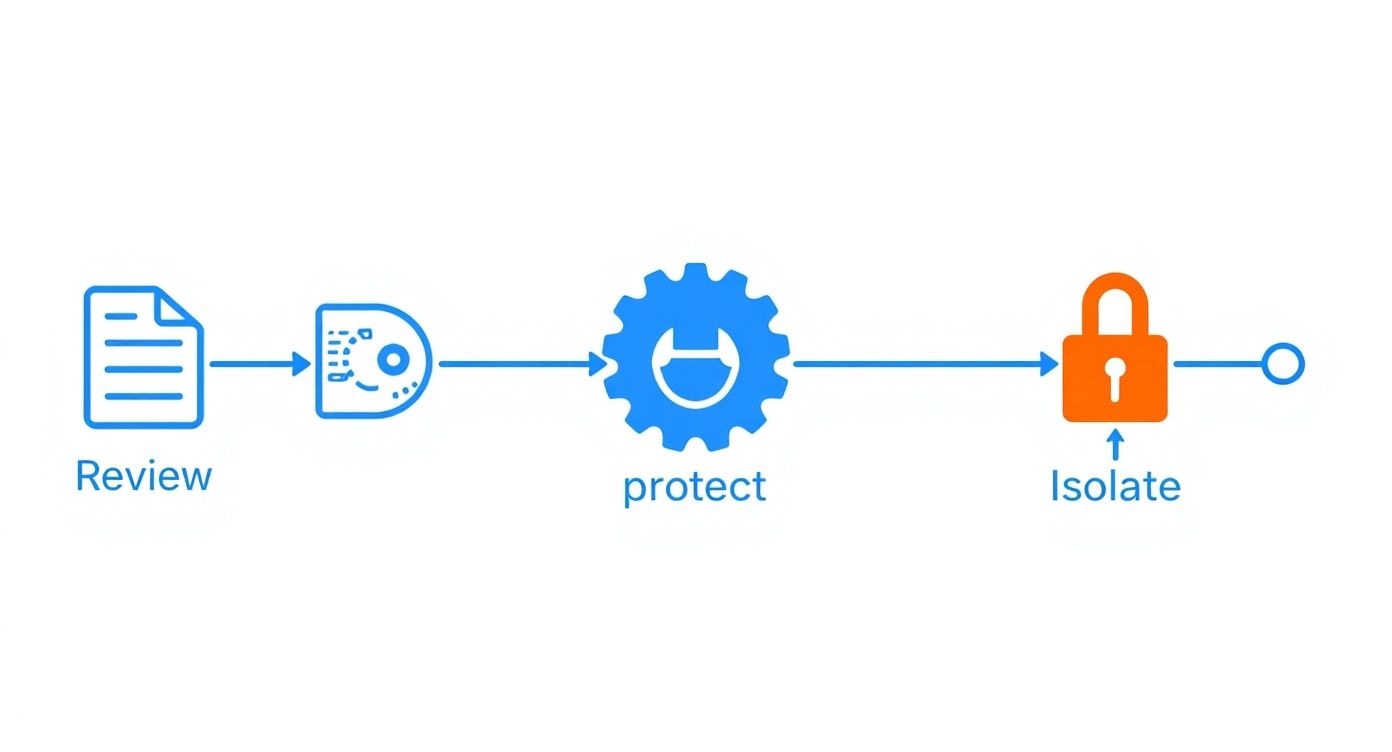
This basic safety workflow is a reminder of the critical steps that must happen before any tools come out.
The flowchart drives home the point that verification isn't just a final checkbox—it's a crucial step that confirms your planning and de-energization were successful.
Validating Switchgear and Protective Relays
Switchgear and protective relays are the brains of the operation. The relays are the detectives that spot a fault, and the switchgear is the muscle that acts on their commands. Testing makes sure this critical communication chain is rock-solid.
An insulation resistance test (you’ll often hear it called a "Megger" test) is a fundamental check for switchgear. By applying a DC voltage, we can measure the insulation's resistance. A low reading is a bad sign, suggesting moisture, dirt, or damage that could easily lead to a fault.
The functional trip test is the final exam for the whole protection system. We use a special test set to inject current or voltage into a relay, simulating a real fault. This confirms the entire sequence works:
The relay correctly identifies the simulated fault.
Its internal logic works as programmed.
It sends a trip signal to the right circuit breaker.
The breaker gets the signal and opens successfully.
This complete end-to-end test gives you confidence that your primary defense mechanism will work flawlessly during a real event, with every component doing its job in a fraction of a second.
Using Predictive Technologies to Prevent Failures
This is where modern maintenance programs really start to pull ahead of the pack—by moving beyond a simple calendar schedule. While preventive maintenance is your foundation, a truly bulletproof strategy involves listening to what your equipment is telling you in real-time. That's the whole idea behind predictive maintenance (PdM). It’s a condition-based approach that uses some pretty impressive tech to spot failures long before they happen.
Think of it this way: instead of overhauling a circuit breaker every five years just because the schedule says so, PdM might show you that particular breaker is in fantastic shape and can easily go another two. At the same time, it could flag a newer asset that’s already showing subtle signs of stress. This lets you point your budget, time, and crew precisely where they’re needed most, preventing both catastrophic failures and a whole lot of unnecessary work.
Infrared Thermography: Seeing Heat Signatures
One of the most powerful and accessible tools in any technician's kit is infrared (IR) thermography. Every electrical component gives off some heat during normal operation, but excessive heat is almost always a five-alarm fire in the making. An IR camera makes this thermal energy visible, uncovering problems you’d never spot with the naked eye.
A loose bus connection, an overloaded fuse clip, or a tiny internal flaw in a transformer bushing will all pop as a clear "hot spot" on a thermal scan. I've seen it countless times—a routine scan of an outdoor switchyard shows one phase of a disconnect switch glowing way hotter than the other two. That’s an immediate red flag for high resistance, probably from a bad connection or corrosion. Just like that, you've identified a future failure point you can schedule for repair during the next planned outage.
The real magic of thermography is in the data you collect over time. A single hot spot is a concern, sure. But seeing that same spot get progressively hotter over several quarterly inspections? That’s the hard data you need to justify an immediate, targeted repair.
Ultrasonic and Acoustic Analysis: Hearing Trouble
Not all impending failures generate heat or are visible. Some create distinct sounds, often at frequencies so high you’d never hear them. This is where ultrasonic and acoustic analysis becomes an essential part of a complete electrical substation maintenance program.
Specialized ultrasonic detectors are tuned to pick up the unique high-frequency noises produced by issues like:
Corona Discharge: The ionization of air around a high-voltage conductor, often due to a sharp edge or contamination. It’s a low-level problem, but it’s a clear sign that your insulation is starting to break down.
Tracking: This is more serious. It happens when a small current leaks across an insulator's surface, creating a carbonized path that can eventually lead to a full-on flashover.
Arcing: A severe discharge where current jumps across a gap. If you detect this, a critical failure is right around the corner.
A technician with an ultrasonic gun can walk through a noisy switchyard and pinpoint the exact insulator or bushing that's producing corona. It's an incredibly precise way to target cleaning or replacement before the problem can escalate.
For digging deep into the health of your high-voltage insulation systems, Partial Discharge (PD) analysis is the gold standard. A partial discharge is a tiny electrical spark that doesn't completely bridge the gap between conductors. It's like a cancer inside the insulation; these small events slowly eat away at the material until it can no longer handle the electrical stress, leading to a sudden, catastrophic failure.
PD testing uses highly sensitive sensors to detect the ultrasonic emissions or high-frequency pulses from these tiny sparks. By analyzing the patterns and intensity, engineers can figure out the location and severity of the defect. This technology is your early warning system for problems buried deep inside a transformer or switchgear, giving you the time to plan a repair long before it fails without any warning.
This proactive mindset is at the core of how the industry is evolving. In fact, utilities that have fully embraced predictive maintenance have seen forced outage reductions of nearly 30% in a single year. The goal is to shift entirely from a time-based schedule to a condition-based one. For a deeper dive, check out our guide on applying predictive maintenance for manufacturing.
By layering these technologies, you build a complete, detailed picture of asset health. It ensures your electrical substation maintenance efforts aren't just efficient—they're incredibly effective.
Mastering Documentation and Compliance Reporting
In high-voltage work, there's a saying: the job isn't done until the paperwork is. All the expert maintenance in the world doesn't mean much without the records to back it up. Meticulous documentation is what turns your team's hard work from a one-time fix into a goldmine of data for future planning, trend analysis, and staying on the right side of the regulators.
If you don't have a detailed paper trail, you're flying blind. You lose the ability to spot a failing piece of equipment before it blows, you can't justify budget requests for that new breaker, and you have no way to prove due diligence if something goes wrong. Good reporting is both your operational memory and your legal shield.
Building a Report That Actually Tells a Story
A truly useful report is so much more than a checked box. It needs to tell the complete story of the job, giving context to the data. Any technician, engineer, or auditor should be able to pick it up years from now and understand exactly what happened.
Your documentation needs to capture a few non-negotiables:
Equipment ID: Get specific. Serial number, manufacturer, model, and its exact location in the yard. No room for ambiguity.
Test Results: Log all the numbers. For a transformer, that means the power factor readings, every DGA result, and the winding resistance for each phase.
As-Found & As-Left Conditions: This is where the story comes to life. Describe the "before" and "after." For instance: "As-found: 'B' phase connection on Switch SW-101 showed a 35°C temperature rise on the thermal scan. As-left: Connection cleaned and re-torqued to spec; thermal scan now shows a delta of less than 2°C."
Who and When: Record the crew who did the work and the exact date and time. It’s all about accountability.
This is the level of detail that separates amateur hour from professional asset management.
Staying Bulletproof with Industry Standards
Let's be clear: thorough documentation isn't just a good idea, it's a requirement.
Organizations like the North American Electric Reliability Corporation (NERC) have incredibly strict requirements for record-keeping, especially for anything touching the Bulk Electric System. Failing a NERC audit because your paperwork is sloppy can lead to fines that will make your eyes water.
The same goes for safety. Following NFPA 70E, the Standard for Electrical Safety in the Workplace, is more than just wearing the right gear. It demands documentation of your safety program, your arc flash studies, and employee training. Your maintenance reports are the proof that you're actively managing these risks, not just talking about them.
Think of your reports as evidence. They prove you have a systematic, professional approach to substation maintenance. In an audit or a safety investigation, that evidence is invaluable. Well-kept records show you aren't just reacting to problems—you're proactively preventing them.
Turning Raw Data into Smart Decisions
The real magic of great documentation happens over time. When you can analyze records stretching back months or years, you stop being a reactive repair crew and start becoming a strategic asset management team.
With consistent data, you can:
Spot Failure Trends: Are you constantly finding moisture in the same model of circuit breaker? Historical data makes that pattern jump off the page, pointing to a potential design flaw or a bad batch of seals.
Justify Upgrades: When you need to replace that aging transformer, a thick file of reports showing rising gassing trends and a steadily degrading power factor is a much more powerful argument than just saying, "It's old."
Optimize Your PM Schedule: Maybe your records show that a certain bank of switches is in perfect condition year after year. That data gives you the confidence to safely extend their maintenance intervals and shift your limited resources to more problematic equipment.
Good documentation closes the loop. It ensures that every single task, every test, and every hour spent in the yard contributes to a safer, more reliable grid.
Common Questions from the Field
Even with the best plan in hand, questions always pop up on the ground. Over the years, I've heard many of the same ones from plant managers and technicians alike. Let's tackle a few of the most common ones you'll likely run into.
What’s the Real Difference Between Preventive and Predictive Maintenance?
This is a big one, and it gets to the heart of modern maintenance strategy. Think of Preventive Maintenance (PM) as your calendar-based work. It’s like changing your car’s oil every 5,000 miles. For a substation, that might mean an annual visual inspection or testing transformer oil every three years, regardless of how the gear is performing.
Predictive Maintenance (PdM), on the other hand, is all about condition. It’s like checking your tire pressure before a long trip because the sensor told you to. We use tools like infrared cameras, ultrasonic testers, and oil analysis to listen to what the equipment is telling us. PdM lets you fix things right before they break, not just because the calendar says so.
Honestly, the best programs use a mix of both. PM sets the foundation, but PdM is what lets you truly optimize your time and budget, moving from a "just-in-case" to a "just-in-time" mindset.
How Often Do We Really Need a Full Substation Shutdown?
There’s no magic number here, but a solid rule of thumb for a major maintenance outage is every 3 to 5 years. That’s the window most facilities need to get in there and do the deep cleaning, testing, and repairs you just can't do with the power on.
Of course, some things can change that timeline:
Age of the Gear: If you're working with older, legacy equipment, you might be looking at a shutdown every 1 to 2 years to keep it reliable.
How Critical Is It?: A substation feeding a hospital or a non-stop manufacturing line? You'll want shorter intervals. The cost of an outage is just too high to risk it.
The Environment: Is your sub sitting in the salty ocean air, near a chemical plant, or in a super humid area? All that grime and corrosion means you'll need to get in there and clean it more often.
A good PdM program can give you the data to justify stretching those intervals out a bit, but that 3-to-5-year cycle is a proven starting point.
What's the Most Critical Safety Gear for Substation Work?
PPE is non-negotiable, period. But when you’re dealing with the twin threats of shock and arc flash, some items are literally the difference between going home and not.
Here’s the absolute must-have, life-saving gear:
Arc-Rated (AR) Clothing: This isn't your standard FR gear. AR clothing is built to self-extinguish and not melt to your skin in an arc flash. Make sure the rating matches the hazard level you're working in.
Voltage-Rated Gloves with Leather Protectors: Your hands are your first line of defense against shock. Inspect them for any pinholes before every single use.
Hard Hat with an Arc-Rated Face Shield: Protects your head from impacts and your face from the blast of heat and molten metal.
Dielectric Safety Boots: This is your insulation from the ground, giving you another critical layer of protection from shock.
Beyond the gear you wear, always have your insulated hot sticks, a reliable voltage tester to prove a de-energized state, and portable grounding equipment ready to go.
Can We Do Any Maintenance While the Substation Is Hot?
The short answer is yes—but very, very little. Non-invasive tasks like taking thermal images with an IR camera, doing ultrasonic scans, or just performing a visual inspection from a safe distance are often done live. These are tasks where you aren't crossing approach boundaries or making contact.
The moment a panel door needs to open or a tool needs to touch a component, the game changes. That kind of energized work is incredibly risky and requires a mountain of precautions: specialized training, an energized work permit, and following NFPA 70E to the letter. For everyone's safety, the best practice is always the simplest one: de-energize before you do any hands-on work.
At E & I Sales, we provide the engineered components and system integration expertise to support your maintenance and upgrade projects. From medium-voltage switchgear to custom control panels, our solutions are designed for reliability and safety. Let us help you keep your critical infrastructure running at its best. https://eandisales.com
At its core, electrical maintenance is all about the systematic inspection, testing, and upkeep of a facility's electrical backbone. This isn't just about fixing things when they break; it's a proactive strategy to guarantee safety, boost reliability, and keep operations running smoothly. Think of it as moving beyond simple, reactive repairs to the strategic management of your most critical electrical assets. For any business where power is mission-critical, this is a core function, not an afterthought.
Understanding Your Facility's Electrical Health
Picture your facility's electrical system as its central nervous system. It's an intricate network that powers every single critical function, from the production lines on the floor to the servers humming away in the data center. Just like with your own health, ignoring the small warning signs or skipping routine check-ups can lead to a sudden, catastrophic, and very expensive emergency.
This is exactly where professional electrical maintenance services come in, shifting the whole conversation from an operational expense to a fundamental business strategy. The mission is simple but vital: keep your critical assets running at peak performance and stop failures before they ever happen. It’s the difference between a scheduled, low-cost tune-up and a frantic, high-cost emergency room visit for your most important equipment.
The High Cost of a Reactive Approach
Waiting for something to break is a gamble most industrial facilities simply can't afford to take. Unplanned downtime doesn't just stop production; it kicks off a disastrous domino effect of financial and operational problems. Every single minute a critical motor or control panel is offline translates directly into lost revenue, missed deadlines, and real damage to your brand's reputation.
This reactive, "fix-it-when-it-fails" model is a recipe for trouble, often leading to:
Greater Repair Costs: Emergency repairs almost always cost more. You're paying for overtime labor, expedited parts shipping, and the disruption of immediate, unplanned interventions.
Safety Hazards: Failing electrical components are a primary cause of workplace accidents, including devastating arc flash incidents and electrical fires that put your people in danger.
Reduced Equipment Lifespan: Running equipment to the point of failure causes massive wear and tear, forcing you into premature and costly replacements you hadn't budgeted for.
Proactive electrical maintenance transforms facility management from a constant state of fire-fighting to one of strategic oversight and control. It brings the predictability you need to budget effectively and operate safely.
The industrial sector gets it, which is why it accounts for a massive 37% of the electrical services market share. This demand is fueled by ever-increasing automation, heavy machinery, and the non-negotiable need for an uninterrupted power supply.
More recently, the explosion of AI-powered data centers has become a huge driver, generating 27% of new demand as companies scramble to upgrade their power distribution and cooling systems to handle the intense computing loads. You can discover more about these market trends and see how they're reshaping industrial electrical needs.
A Roadmap to Electrical Reliability
Building a truly resilient electrical system requires a maintenance plan that anticipates and addresses all the different ways things can go wrong. This guide will walk you through the essential maintenance philosophies that form the bedrock of a solid program. We'll break down the specific strategies—preventive, predictive, and corrective—that empower plant managers and operators to protect their assets, guarantee uptime, and ultimately, drive profitability.
Exploring Different Electrical Maintenance Strategies
Choosing the right approach to electrical maintenance is a lot like planning a trip. You wouldn't use a city map for a cross-country trek, and a one-size-fits-all plan is just as useless for a complex industrial facility. The strategy you land on determines whether you’re proactively steering toward peak reliability or just waiting for the next breakdown on the side of the road.
Getting a handle on the different philosophies is the first real step toward building a program that actually protects your assets and your bottom line. Each one strikes a unique balance between cost, effort, and risk. Let's break down the four main approaches to see how they fit into a bulletproof electrical wellness plan.
Preventive Maintenance: The Scheduled Oil Change
Preventive maintenance (PM) is the most familiar strategy out there. Think of it as the scheduled oil changes and tire rotations for your car. These are routine, time-based tasks done on a fixed schedule to cut down the chances of a failure. The goal is straightforward: fix known potential problems before they have a chance to cause a shutdown.
This approach runs like clockwork—daily, weekly, monthly, or annually—no matter what condition the equipment is actually in. For example, a PM plan might mandate that a motor's bearings get greased every three months or a switchgear's connections get torqued once a year. While it’s a massive improvement over doing nothing, its biggest flaw is that you can end up wasting time and money working on perfectly healthy equipment. You can get a head start on structuring these tasks with a good preventive maintenance schedule template.
Predictive Maintenance: The Expert Mechanic's Ear
Predictive maintenance (PdM) is a much smarter, condition-based game. Imagine a master mechanic who doesn't just change your oil on schedule but first listens to the engine, checks the fluids, and looks for subtle signs of wear. That's PdM in a nutshell—it uses advanced monitoring tools to "listen" for the faint whispers that signal future trouble in your electrical systems.
Instead of a calendar, PdM runs on data. Technicians use tools like infrared thermography to spot hot spots on connections, vibration analysis to detect bearing wear in motors, and oil analysis to check the health of transformers. Work is only done when the data says a problem is on the horizon.
This data-first approach enables "just-in-time" maintenance, focusing resources exactly where they're needed and stopping failures with incredible accuracy.
Corrective Maintenance: The Roadside Tow Truck
Corrective maintenance, often called reactive or breakdown maintenance, is the simplest (and most dangerous) strategy: wait for it to break, then fix it. This is the tow truck you call when your car is already smoking on the side of the highway. There’s zero planning, just pure reaction.
For non-critical equipment, this might seem cheap upfront, but it's by far the most expensive and disruptive approach for essential assets. A single failed motor on a production line can bring the entire plant to a standstill for hours or days, racking up financial losses that dwarf the cost of any proactive plan. Emergency repairs almost always mean overtime labor, rush shipping for parts, and the risk of secondary damage to other components.
Reliability-Centered Maintenance: The Custom-Built Itinerary
Reliability-Centered Maintenance (RCM) isn’t just a single tactic; it's a complete strategic framework. It’s like creating a custom travel itinerary that uses different modes of transport—flights for long hauls, scenic trains for the countryside, and walking for city exploring—all based on what’s most critical and efficient for the journey.
RCM starts by analyzing each piece of equipment to understand its function, how it can fail, and what the consequences of that failure would be. From there, it assigns the smartest maintenance strategy for the job.
Critical Assets: A vital production motor gets the full predictive maintenance treatment.
Important but Redundant Systems: A backup pump might be put on a simple preventive schedule.
Non-Essential Components: A light fixture in a storage closet? It's left to corrective maintenance.
This intelligent, blended approach makes sure maintenance resources are spent where they matter most, pushing plant reliability to the max while cutting out unnecessary costs. When putting these strategies into practice, a well-structured maintenance plan template is essential for documenting and executing your tailored approach effectively.
To help you decide, here’s a quick rundown of how these four strategies stack up against each other.
Comparing Electrical Maintenance Strategies
Maintenance Type
Core Principle
Best For
Key Benefit
Preventive
Time-based actions on a fixed schedule.
Standard equipment with known failure patterns.
Simple to implement, reduces obvious failures.
Predictive
Condition-based actions triggered by data.
Critical, complex assets where failure is costly.
Prevents failures, optimizes resource use.
Corrective
Run-to-failure; fix it after it breaks.
Non-essential, low-cost, redundant items.
Lowest upfront cost (but highest failure cost).
Reliability-Centered
A strategic mix based on asset criticality.
Entire facilities aiming for optimal reliability & cost.
Maximizes overall plant performance and efficiency.
Ultimately, by combining these different philosophies, a facility can build a truly resilient, efficient, and cost-effective operational environment.
Essential Tools and Testing Methods That Prevent Failure
To truly get ahead of equipment failure, you have to stop reacting and start predicting. This shift requires the right diagnostic tools—specialized methods that act like an advanced medical screening for your electrical assets. They let seasoned technicians see invisible problems and hear the faintest whispers of component wear long before they can cause a catastrophic shutdown.
Effective predictive maintenance is all about gathering the right data. By moving beyond simple visual checks, teams can diagnose the health of motors, switchgear, and transformers with incredible precision. This allows maintenance to be scheduled with surgical accuracy, saving time, slashing costs, and preventing the massive disruption of unplanned downtime.
The diagram below shows where these advanced methods fit into the big picture. It’s a hierarchy of maintenance strategies, demonstrating how predictive techniques are a cornerstone of a robust Reliability-Centered Maintenance (RCM) program.
As you can see, while fixing things after they break (corrective) is the baseline, it's the proactive pillars—preventive and predictive—that support a truly strategic RCM approach.
Infrared Thermography: The Electrical MRI
One of the most powerful tools in any technician's bag is infrared (IR) thermography. Think of it as giving your electrical systems an MRI scan. It creates a visual map of heat, instantly showing you "fevers" in components that look perfectly normal to the naked eye. These hot spots are the classic tell-tale sign of a problem brewing.
Loose connections, overloaded circuits, and failing components all generate excess heat before they give up completely. An IR scan can pinpoint these exact locations in panels, motor control centers, and switchgear, allowing for targeted, efficient repairs. A regular thermographic survey is one of the single fastest and most effective ways to prevent electrical fires and major equipment failures.
Vibration Analysis: The Motor Stethoscope
For anything that spins—motors, pumps, fans—vibration analysis acts like a stethoscope. Every piece of machinery has a unique vibration "signature" when it's running smoothly. As parts like bearings, gears, or shafts begin to wear down, that signature changes in subtle but perfectly measurable ways.
Skilled technicians use specialized sensors to capture this data and interpret it. It allows them to spot issues like:
Bearing Wear: The most common cause of motor failure, easily identified by its distinct vibration pattern.
Misalignment: When a motor and the machine it drives aren't perfectly lined up, it creates stress that vibration analysis can spot immediately.
Imbalance: Problems with fan blades or rotors cause a detectable wobble that signals a need for rebalancing before something gives way.
Catching these issues early prevents catastrophic mechanical failures that can destroy an expensive motor and grind production to a halt for days.
Oil Analysis and Circuit Breaker Testing
Beyond heat and vibration, a few other specialized tests provide critical health data for your most valuable assets. These are essential for maintaining the core of your power distribution system, especially in large-scale industrial plants.
Transformer Oil Analysis is like a blood test for your transformers. A small sample of the insulating oil is sent to a lab to be checked for dissolved gases, moisture, and dielectric strength. The results reveal the internal health of the transformer, flagging things like internal arcing or insulation breakdown long before they lead to a major outage.
Circuit Breaker Injection Testing is about making sure your primary safety devices will actually do their job when you need them most. This test involves sending a simulated fault current through a breaker to verify that it trips within the manufacturer's specified time. It confirms that your last line of defense against a catastrophic overcurrent is ready and waiting.
The market certainly reflects the growing importance of these services. The global substation maintenance market, currently valued at $42.89 billion, is projected to nearly double to $84.95 billion by 2034. This boom is driven by major grid reliability upgrades worldwide. You can explore detailed insights into the substation maintenance market for a deeper dive.
By combining these advanced testing methods, a comprehensive electrical maintenance program moves far beyond guesswork. It provides actionable intelligence, enabling you to manage assets based on their actual condition, not just a date on a calendar.
How to Navigate Critical Safety and Compliance Standards
Trying to untangle the web of regulations for industrial electrical work can feel overwhelming. But these standards are far from being just bureaucratic red tape. They are the actual blueprints for a safe, reliable, and legally compliant operation.
Think of them as the common language spoken between your facility, your maintenance team, and even your insurance provider. Everyone is on the same page, and everyone is protected.
Following these standards is the bedrock of any serious electrical maintenance services program. It's a direct path to cutting operational risk, keeping your people out of harm's way, and proving you're committed to quality. This isn't about box-ticking; it's about building a genuine culture of safety that lets plant managers sleep at night.
The Cornerstone of Electrical Workplace Safety: NFPA 70E
When it comes to electrical safety in the workplace, the National Fire Protection Association's NFPA 70E is the undisputed heavyweight champion. Its entire mission is to shield workers from the devastating risks of electric shock, electrocution, and arc flash. This isn't just a rulebook; it's a field guide for building a safety program from the ground up.
NFPA 70E gets specific about:
Safe Work Practices: It details the step-by-step procedures for de-energizing equipment and confirming an electrically safe work condition before a single tool is picked up.
Arc Flash Risk Assessment: The standard requires facilities to identify arc flash hazards, calculate their potential intensity, and clearly label equipment with warning information. For a deeper dive, check out our guide to arc flash hazard analysis.
Personal Protective Equipment (PPE): It lays out exactly what kind of flame-resistant clothing and protective gear are needed for the specific level of hazard present.
Adhering to NFPA 70E isn't optional—it’s how you protect your people. It forces a fundamental shift from reacting to accidents to proactively designing them out of the system.
Setting the Bar for Equipment Maintenance: IEEE Standards
While NFPA 70E is all about protecting people, the Institute of Electrical and Electronics Engineers (IEEE) provides the technical playbook for maintaining the equipment itself. These aren't laws, but rather consensus-based best practices written by the industry's top experts.
The IEEE Std 3007 series, for instance, gives incredibly detailed guidance on maintaining industrial power systems. These are the "how-to" manuals for properly testing and servicing everything from your medium-voltage switchgear and transformers to motors and cables. Following IEEE standards means your maintenance is effective, consistent, and grounded in solid engineering.
UL Standards as a Mark of Quality and Safety
Finally, UL (Underwriters Laboratories) standards act as the baseline for equipment quality. When you see that UL mark on a control panel, breaker, or motor, it means it has been independently tested and certified to meet tough safety and performance criteria.
For any facility manager, insisting on UL-listed components is the first step in building a truly reliable electrical system. It gives you a baseline guarantee that the gear you're installing is free from known hazards and built to perform. When your maintenance partner uses UL-approved parts for repairs, they are preserving the integrity and safety rating of your entire system.
Measuring the ROI of Your Maintenance Program
So, how do you prove that your maintenance budget is a strategic investment and not just another line-item expense? For plant managers and engineers, justifying the cost of proactive electrical maintenance services is a constant battle. The trick is to shift the conversation from cost to value by showing a clear, compelling Return on Investment (ROI).
This isn't about fuzzy, abstract benefits. It's about hard numbers that speak the language of business. By tracking the right metrics and putting a dollar figure on the failures you've prevented, you can build an undeniable case for your program.
Key Performance Indicators That Tell the Story
Before you can even think about calculating ROI, you need data. Key Performance Indicators (KPIs) are the vital signs of your equipment's health and your maintenance program's effectiveness. They provide the cold, hard evidence needed to show progress and defend your strategy.
Two of the most powerful metrics you can track in any industrial facility are:
Mean Time Between Failures (MTBF): This is just a fancy way of saying, "How long does a piece of equipment run before it breaks?" A rising MTBF is a direct signal that your maintenance efforts are working, extending equipment life and stopping breakdowns before they happen.
Overall Equipment Effectiveness (OEE): This one gives you the big picture. OEE looks at three things—availability (uptime), performance (speed), and quality (good parts)—to give you a single score for your productivity. Proactive maintenance directly pumps up that OEE score by crushing downtime and keeping machines running as they should.
Tracking these KPIs transforms maintenance from a perceived "cost center" into a real driver of operational excellence.
The Simple Formula for Calculating Maintenance ROI
Once your KPIs are providing the necessary context, you can calculate the direct financial return of your program. The formula is refreshingly simple, but don't let that fool you—it's incredibly powerful.
ROI = (Cost of Downtime Avoided – Cost of Maintenance) / Cost of Maintenance
What this formula does is frame your maintenance spending against the catastrophic losses it prevents. To use it, you first have to get a real handle on the true cost of unplanned downtime. That includes lost production, labor costs for an idle team, and even potential penalties for missing deadlines.
It's no surprise that the demand for reliable operations is fueling market growth. The electrical services market was valued at $773.3 billion and is expected to hit $1,117.67 billion by 2034. The repair and maintenance segment is actually seeing the fastest growth, which just underscores how critical these specialized services are for keeping facilities running.
A Real-World ROI Example
Let's put this into practice. Imagine a manufacturing line that brings in $20,000 per hour in revenue. During a routine predictive maintenance check, a technician spots the early signs of bearing wear on a critical drive motor.
Cost of Proactive Maintenance: A technician spends four hours replacing the bearings during a planned shutdown. The total cost, including labor and parts, comes out to $2,500.
Cost of Failure (Downtime Avoided): If that bearing had failed catastrophically during a production run, it would have caused an estimated eight hours of unplanned downtime. That's $160,000 in lost revenue right there. Add another $15,000 for emergency repairs, a brand-new motor, and fixing collateral damage. The total cost of that single failure would have been a staggering $175,000.
Now, let's plug these numbers back into our ROI formula:
ROI = ($175,000 – $2,500) / $2,500 = 69
This means for every single dollar spent on proactive maintenance, the facility got a $69 return. That's the kind of clear, quantifiable result that justifies any maintenance budget. When you focus on the data, you prove that skilled electrical maintenance isn’t a cost—it’s one of the best investments you can possibly make in your facility's future. For more on these techniques, check out our deep dive on predictive maintenance for manufacturing.
Choosing the Right Electrical Maintenance Partner
Picking a provider for your plant's electrical maintenance is one of the most critical decisions you'll make. This isn't just about hiring another contractor; it's about finding a genuine partner who acts as a seamless extension of your own team. The right choice brings stability and compliance, while the wrong one can inject risk and chaos into your operations.
It's tempting to focus on the price tag, but you have to look past the initial bid. A lowball offer might seem attractive, but it often hides a lack of real-world experience, flimsy safety protocols, or an inability to give your facility the deep support it actually needs. The real goal is to find a partner who delivers long-term value, not just a quick, cheap fix.
Verifying Core Competencies and Experience
The first thing you need to do when vetting a potential partner is to dig into their qualifications and on-the-floor experience. Don't just take their word for it. Ask for concrete proof of their expertise, especially with the specific types of industrial equipment you rely on every day.
A solid evaluation should always cover these points:
Certifications and Licensing: Are their electricians state-licensed? That’s the bare minimum. For specialized predictive work, you need to see certifications in things like thermography (e.g., Level I or II Certified Thermographer) or vibration analysis.
Direct Equipment Experience: You need to know if they have a documented history with your specific models of MV switchgear, motor control centers, or PLCs. Ask them for case studies or, even better, let you talk to a reference from a facility with a similar setup.
Comprehensive Reporting: A top-tier partner doesn’t just fix things; they document everything. They should provide detailed reports after every service call, complete with thermographic images, test results, and crystal-clear recommendations. This paper trail is invaluable for compliance and for tracking the health of your equipment over time.
Assessing Safety Programs and Business Acumen
A potential partner's commitment to safety is completely non-negotiable. Frankly, it’s a direct reflection of their overall professionalism. A well-documented, robust safety program is a clear sign that they value their people, your people, and your facility. Insist on seeing their written safety plan, paying close attention to how they adhere to NFPA 70E standards for electrical workplace safety.
The quality of a provider's safety culture is often the best predictor of their overall work quality. A team that cuts corners on safety will likely cut corners on technical execution as well.
It's also smart to look at how they run their business. How do they find new clients? It might seem unrelated, but a company that invests in effective digital marketing strategies for electricians shows they're proactive and building a stable, growing business. By focusing on these crucial areas—hard technical skills, documented safety, and a healthy business—you can find a maintenance partner who will truly protect your assets and help you hit your operational goals.
Have Questions? We Have Answers.
Even with a solid plan, you're bound to have a few questions when setting up an electrical maintenance services program. Here are some of the most common things we hear from plant managers and engineers, along with some straight answers.
How Often Should We Be Doing This?
There's no magic number here—it all comes down to your equipment's age, how hard it works, and how critical it is to your operation.
A great place to start is the guidance from NFPA 70B. It generally recommends annual check-ups for the big stuff, like your switchgear and transformers. But think of that as a baseline, not a rule.
A one-size-fits-all schedule just doesn't cut it in the real world. That crucial motor on your main production line? It might need quarterly predictive checks with vibration analysis to stay ahead of trouble. On the other hand, less critical gear might be perfectly fine with a simple annual inspection. A good partner will help you map this out based on what you actually have on the floor.
What's the Difference Between Maintenance and Testing?
It's a great question. Think of it like a doctor's visit: testing is the diagnosis, and maintenance is the treatment. You need both for a healthy system.
Maintenance is the hands-on work. It’s about cleaning components, torquing connections, and lubricating moving parts. This is the "doing" part of the job.
Testing is the data-gathering part. This is where we use specialized tools—like infrared cameras or circuit breaker testers—to get a clear picture of your equipment's health. It tells us what to do and where to focus our efforts.
They work hand-in-glove. For instance, a thermographic test might flag a hot, loose connection. The hands-on maintenance is then tightening that connection to fix the problem before it becomes a failure.
Can This Proactive Stuff Really Save Us Money?
Absolutely. It feels like another line item on the budget, but proactive maintenance pays for itself by helping you dodge the massive costs of unplanned downtime and emergency calls.
Fixing a minor issue like a loose connection during a scheduled visit might cost a few hundred dollars. It's planned, it's efficient, and it's done.
But if you let that same loose connection fail? Now you're looking at a catastrophic shutdown. The costs explode—lost production, emergency equipment replacement, and overtime for your crew. That bill can easily climb into the tens or even hundreds of thousands of dollars. The ROI on being proactive is one of the best investments you can make.
At E & I Sales, we build and execute maintenance strategies that protect your most valuable assets. Our team brings deep technical knowledge and real-world field experience together to keep your plant running safely and productively. To see how we can design a program for your facility, let's connect at eandisales.com.
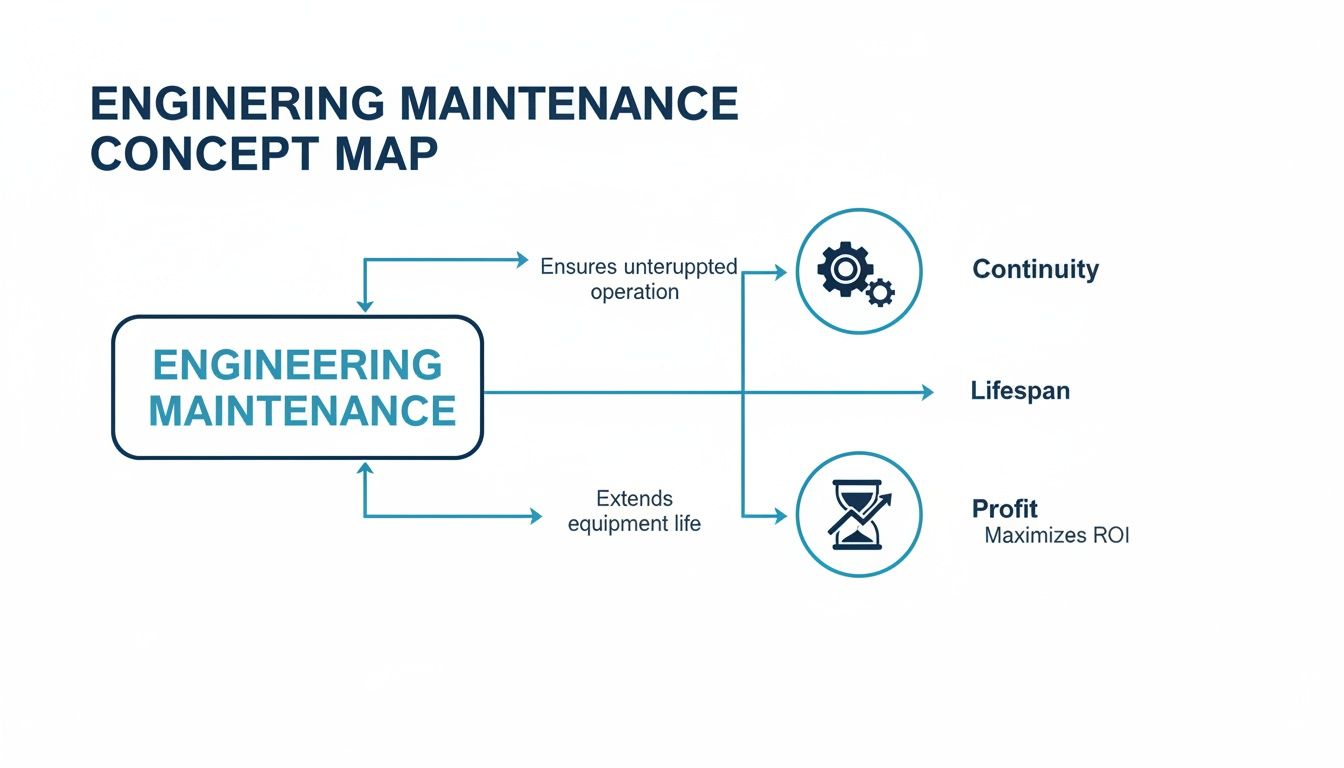
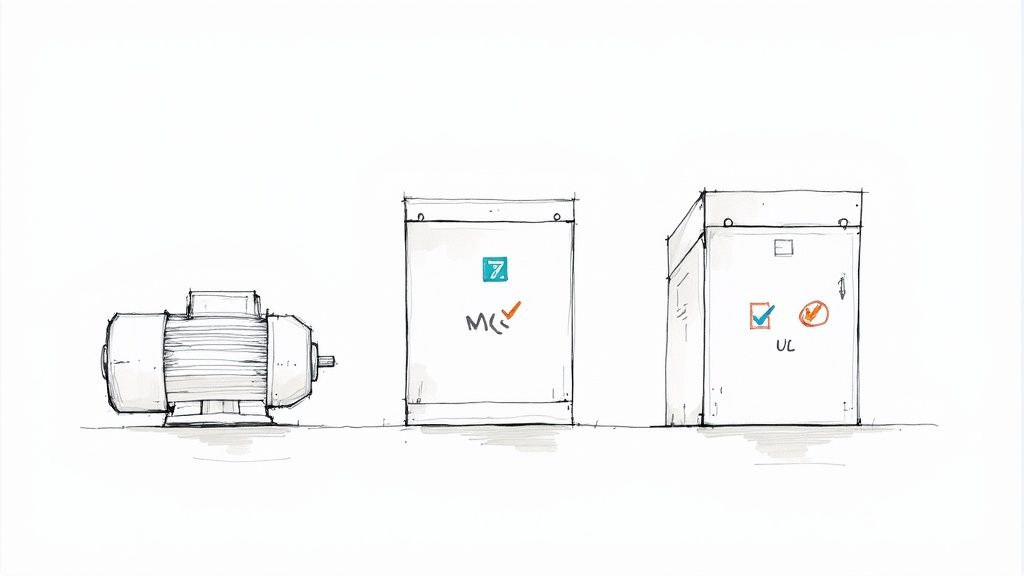
Engineered maintenance services are all about getting ahead of the curve. It’s a smart, proactive strategy that blends deep engineering know-how with advanced data analysis to predict and stop equipment failures before they ever happen. This approach completely changes the game, moving maintenance from a reactive "break-fix" model to a strategic one that optimizes the entire lifecycle of your critical industrial assets, from electric motors to complex UL-listed control systems.
Beyond the Break-Fix Mentality
Think of a Formula 1 pit crew. They don't just wait for a tire to blow out. They use live telemetry to see engine stress in real-time and prevent a breakdown mid-race. That’s the exact mindset behind engineered maintenance services. It’s a conscious shift away from the old—and incredibly expensive—cycle of waiting for something to break and then scrambling to fix it.
Instead of seeing maintenance as just another line item on the budget, this approach turns it into a genuine strategic advantage. It weaves fundamental engineering principles into the day-to-day upkeep of your machinery, directly boosting the reliability, safety, and efficiency of your most important assets. For plant managers and original equipment manufacturers (OEMs), this is a powerful way to drive operational excellence.
From Reactive to Proactive
The traditional way of doing things is purely reactive. A motor burns out, a control panel shorts, and suddenly, your entire production line grinds to a halt. What follows is a frantic scramble to diagnose the issue, find the right parts, and get a technician on-site—all while the costs of downtime pile up. In fact, unplanned downtime costs industrial manufacturers an estimated $50 billion every single year.
Engineered maintenance flips that script. It starts by asking a much better question: "How can we engineer failure right out of the system?" This forward-thinking strategy is built on a few key pillars:
Data-Driven Decisions: Forget rigid schedules or waiting for an alarm to go off. This is about using real-time data from sensors and diagnostic tools to get a true picture of equipment health.
Root Cause Analysis: When a problem does pop up, the goal isn't just a quick patch. It’s about digging deep to understand the underlying engineering cause so it never happens again.
Lifecycle Optimization: We're looking at the entire lifespan of an asset—from its first day of commissioning to its final replacement—to make sure you get the absolute maximum value out of it.
System-Level Thinking: This isn't just about one component. It’s about understanding how your motors, drives, and control systems all interact, letting you spot potential points of failure within the bigger picture.
By focusing on proactive, data-informed strategies, engineered maintenance services don't just fix problems—they systematically prevent them, turning upkeep into a predictable and value-driven activity.
This strategic pivot creates a clear path toward rock-solid reliability. By using real engineering expertise to make sense of complex data, your facility can move past simple preventive checklists and start tackling the fundamental reasons equipment fails in the first place. It’s all about creating an operation that is more resilient, predictable, and ultimately, more profitable.
So, what does an engineered maintenance services program actually look like on the ground, beyond the high-level strategy? Think of it less as a single service and more as a sophisticated diagnostic toolkit for your entire operation.
It’s a suite of specific, data-driven techniques and technologies all working in concert to give you an unprecedented look into the health of your most critical assets. Each component is designed to detect the subtle, almost invisible signs of wear and tear long before they spiral into catastrophic failures. The goal is to catch problems at their absolute earliest stage when they are cheapest and easiest to fix.
Predictive Diagnostics: Your Early Warning System
At the heart of any modern maintenance program, you'll find predictive diagnostics. This isn't just about following a schedule; it's about using advanced tools to listen for the earliest whispers of trouble, turning abstract data into real, actionable intelligence. It's like a doctor using an EKG to spot a heart issue before any outward symptoms ever appear.
This proactive stance is only possible thanks to a few key technologies:
Vibration Analysis: Every rotating machine, whether it's a motor, pump, or fan, has a unique vibration signature when it's running smoothly. We use specialized equipment to measure this signature and detect tiny changes that signal developing problems like bearing wear, shaft misalignment, or imbalance.
Thermal Imaging: Overheating is one of the most common and destructive signs of electrical and mechanical stress. Using infrared thermography, our technicians create a visual map of heat, allowing them to spot a faulty connection in a UL-listed control panel or an overworked motor long before it burns out.
This is what it means to be proactive—connecting real-world data with a clear strategy to stop failures before they ever start.
Specialized Motor and Control Panel Maintenance
While predictive tools are vital, they're only half the battle. They need to be paired with deep, hands-on expertise, especially when it comes to high-value assets like industrial motors and custom control panels. Maintenance for these complex systems goes way beyond a simple checklist.
For electric motors, this means targeted services like motor circuit analysis and advanced lubrication management. Just doing lubrication right can prevent over 50% of premature bearing failures. But an engineered approach takes it further by analyzing the lubricant itself for microscopic metal fragments that indicate internal wear.
Maintaining UL-listed control panels is even more critical because it directly impacts safety and compliance. A specialized program ensures every single component, from circuit breakers to variable frequency drives, is functioning exactly to specification. This isn't just about preventing downtime; it's about protecting your people and ensuring the entire system keeps its UL certification.
Let's take a look at the core services that make up a robust engineered maintenance program. The table below breaks down what each service does and where it's typically applied, giving you a clear picture of how these components fit together to protect your assets.
Key Services in an Engineered Maintenance Program
Service Component
Primary Objective
Typical Application
Vibration Analysis
Detect early-stage mechanical faults in rotating equipment.
Motors, pumps, fans, gearboxes, compressors
Thermal Imaging
Identify overheating in electrical and mechanical systems.
Control panels, circuit breakers, motor casings, bearings
Motor Circuit Analysis
Assess the electrical health of a motor from the controller.
AC/DC motors, generators
Lubricant Analysis
Analyze oil and grease for contaminants and wear particles.
Bearings, gearboxes, hydraulic systems
Commissioning
Verify new or repaired equipment meets performance standards.
New production lines, upgraded motor controls, custom panels
Each of these services provides a different piece of the puzzle. When combined, they give you a complete, 360-degree view of your equipment's health, allowing for truly intelligent and proactive maintenance decisions.
Why This Level of Expertise Is More Important Than Ever
Demand for these advanced services is surging as more industries finally recognize the crushing cost of unplanned downtime. It’s part of a massive market shift where businesses are investing heavily in technical expertise to stay competitive. In fact, the U.S. engineering services market hit USD 407.3 billion in 2024 and is projected to reach USD 581.0 billion by 2030.
That kind of growth points to a fundamental truth in modern industry: combining advanced diagnostic technology with deep engineering knowledge isn't a luxury anymore—it's a competitive necessity.
To get started organizing these efforts, you can see how it all fits into a broader plan with our guide on creating a preventive maintenance schedule template. By building a program around these core components, you can transform your maintenance department from a reactive cost center into a powerful driver of productivity and profit.
Calculating the ROI of Proactive Maintenance
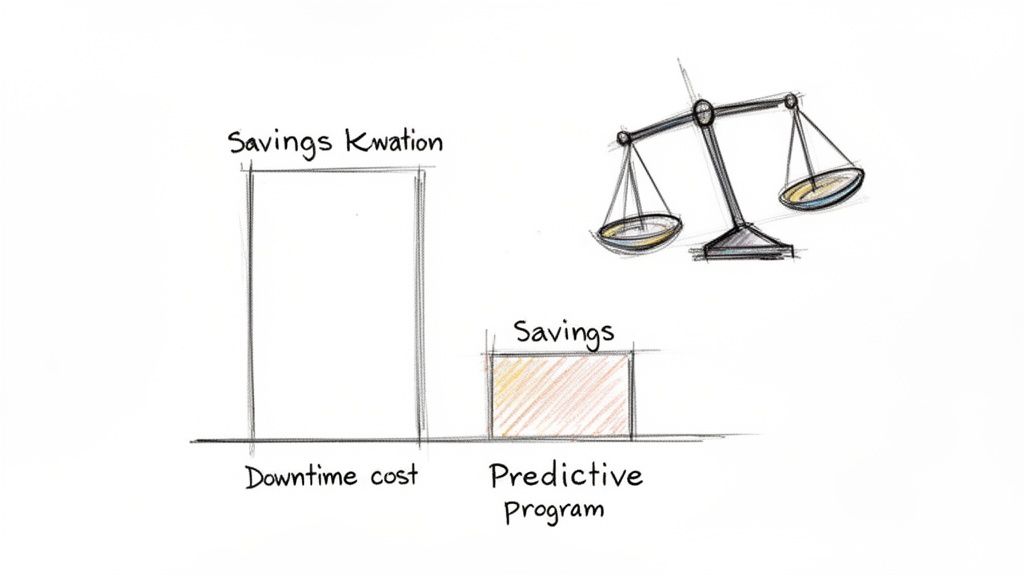
Getting buy-in for engineered maintenance services means translating the technical wins into the language everyone understands: dollars and cents. Sure, things like vibration analysis and thermal imaging are impressive, but their real magic is measured in saved costs and boosted productivity. This is where calculating the return on investment (ROI) becomes your most convincing tool.
Think of engineered maintenance not as an expense, but as a strategic investment in your plant's profitability. The ROI calculation proves this by putting the cost of doing nothing—unplanned downtime—head-to-head against the cost of a smart, proactive program. For anyone in procurement or project engineering, this gives you a clear, data-driven case to make.
The True Cost of Unplanned Downtime
First things first: you need to figure out what an unexpected failure actually costs your business. It’s almost always way more than just the price of a replacement part. An equipment failure creates a domino effect of expenses that can ripple through your entire operation.
To get a real number, you have to add up a few key factors:
Lost Production: This one’s the biggie. How much revenue do you lose for every hour a line is down?
Labor Costs: Think about the wages for idle operators just standing around, plus the overtime you’ll pay your maintenance crew for the emergency fix.
Repair and Replacement: This covers the new parts—often at a premium for rush delivery—and any outside contractors you have to call in.
Secondary Damage: A catastrophic motor failure can easily take out other components with it, turning a small problem into a massive, expensive repair.
Add all that up, and you get a clear cost-per-hour of downtime for your most critical assets. That number is the bedrock of your entire ROI calculation.
Building a Hypothetical ROI Scenario
Let's walk through an example. Imagine a critical conveyor system in a manufacturing plant, all run by a large electric motor. The plant has done its homework and knows that every hour this conveyor is down costs them $20,000 in lost production and other expenses.
Over the last year, this conveyor failed out of the blue three times, leading to a total of 15 hours of downtime.
The Cost of Inaction: 15 hours of downtime × $20,000 per hour = $300,000 in lost revenue
Now, let's say the plant decides to invest $50,000 a year in an engineered maintenance services program for its critical motors. This program includes quarterly vibration and thermal scans, which catch two of the three potential failures before they can happen. The team addresses these issues during scheduled maintenance, so there’s zero unplanned downtime from them.
One minor, unpredictable failure still slips through, but because the system is being monitored, they catch it much faster. It only leads to 3 hours of downtime instead of the usual 5.
Calculating the Financial Return
With a proactive program in place, the plant’s financial picture looks a whole lot better. The annual cost of downtime plummets to just $60,000 (3 hours × $20,000). To find the net savings, we just subtract the new downtime cost and the program's cost from the original loss.
Net Savings: $300,000 (original loss) – $60,000 (new downtime cost) – $50,000 (program cost) = $190,000
Now for the ROI. The formula is simple:
(Net Savings / Program Cost) × 100 = ROI
In our scenario, that looks like this: ($190,000 / $50,000) × 100 = 380% ROI
That’s a powerful number. It means that for every dollar the company put into the maintenance program, it got $3.80 back in saved revenue. This completely changes the conversation from "How much does it cost?" to "How much will it save us?" To dig deeper, check out our guide on the benefits of predictive maintenance for manufacturing.
This shift toward financial returns and reliability is why the maintenance services market is booming. The global market, which covers everything from electric motor controls to automation, was valued at USD 81.86 billion in 2025 and is projected to hit USD 122.09 billion by 2029. That's a compound annual growth rate of 10.5%, all driven by the need for smarter upkeep and sustainable tech.
Defining Success with KPIs and Service Agreements
Any good partnership for engineered maintenance services has to be built on a foundation of clarity and trust. You can't just cross your fingers and hope for the best. To make the relationship work, you need to agree on what "success" actually looks like from the very beginning. This is where Key Performance Indicators (KPIs) and a well-defined Service Level Agreement (SLA) come into play.
Think of KPIs as the scoreboard for your entire maintenance program. They’re the hard numbers that tell you if your strategy is paying off. Vague goals like “improving reliability” won't cut it; you need real data to measure progress and prove the value of your investment.
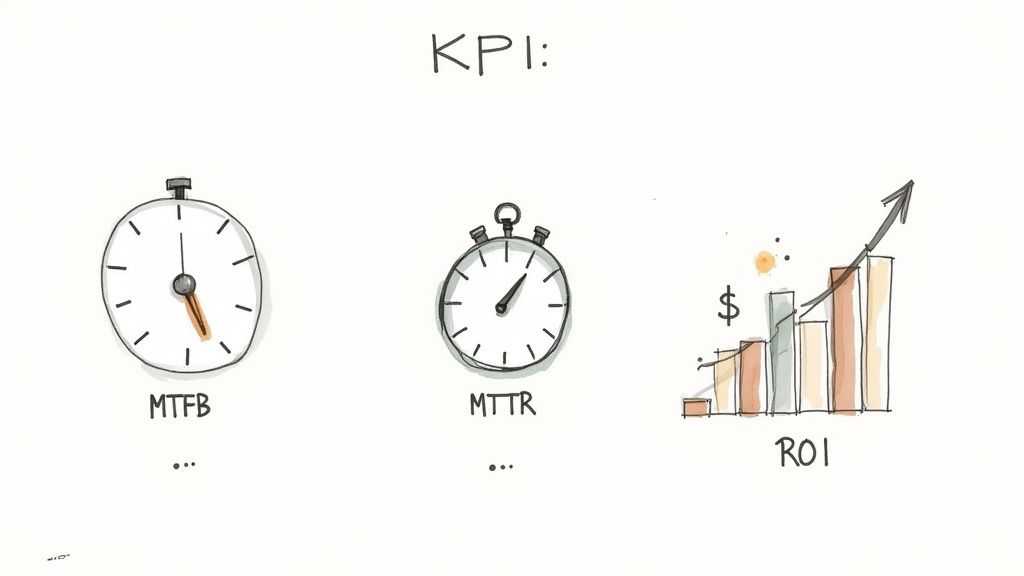
Key Performance Indicators That Matter
When you're trying to gauge the impact of an engineered maintenance program, you want to focus on metrics that truly reflect the health of your equipment and the efficiency of your operations. Instead of drowning in a sea of data points, it's better to zero in on a handful of KPIs that tell a compelling story.
Here are a few of the most critical ones we see making a real difference:
Mean Time Between Failures (MTBF): This is the average time your equipment runs without a hitch between breakdowns. If your MTBF is trending upward, it’s a fantastic sign that your proactive maintenance is working, preventing failures before they happen.
Overall Equipment Effectiveness (OEE): OEE is the gold standard for measuring just how productive your manufacturing time really is. It combines availability (uptime), performance (speed), and quality (defects) into one powerful metric. A rising OEE score means your maintenance efforts are directly contributing to your bottom line.
Maintenance Cost per Unit: This KPI connects your maintenance spend directly to your output. If this number starts to drop, it’s proof that you're getting more efficient and your maintenance program is delivering a stronger return on investment.
These aren't just numbers on a spreadsheet. They turn maintenance from a reactive, "gut-feel" chore into a data-driven strategy, giving you the proof you need to show real improvements in uptime and profitability.
Table: Reactive Maintenance vs Engineered Maintenance
It’s one thing to talk about proactive maintenance, but seeing the difference side-by-side really drives the point home. The old "if it ain't broke, don't fix it" model is a recipe for surprise downtime and spiraling costs. An engineered approach, on the other hand, is about getting ahead of the curve.
Here's a quick comparison:
Aspect
Reactive Maintenance (Break-Fix)
Engineered Maintenance (Predictive)
Philosophy
"Wait for it to fail, then fix it."
"Predict and prevent failure before it happens."
Downtime
Unplanned and often extensive.
Minimal and scheduled.
Costs
High, unpredictable emergency repair costs.
Lower, predictable, and budgeted.
Asset Lifespan
Shortened due to repeated failures.
Extended through proactive care.
Safety
Higher risk from unexpected equipment failure.
Improved safety through well-maintained equipment.
The takeaway is clear: Engineered maintenance is a strategic investment in reliability, while reactive maintenance is a constant, costly firefighting exercise.
Crafting a Strong Service Level Agreement
Once you’ve nailed down your KPIs, the next step is to cement them into a formal Service Level Agreement (SLA). An SLA is so much more than a contract; it’s a shared playbook that outlines expectations, responsibilities, and performance goals. It ensures you and your service provider are always on the same page.
A well-structured SLA is the bedrock of a transparent and accountable partnership. It puts expectations in writing, defines performance targets, and clarifies what happens if those commitments aren't met, protecting everyone involved.
A solid SLA has to be specific and realistic. It should clearly define the scope of services and the exact performance targets your provider is committing to. For any engineered maintenance program, your SLA should always include:
Guaranteed Response Times: How fast will a technician be on-site? This should be clearly defined for different levels of urgency, from a routine check to a critical failure.
Uptime Commitments: Set a clear target for equipment availability, like 99.5% uptime for your most critical assets. This ties your provider’s performance directly to your operational stability.
KPI Reporting Standards: Agree on how often you'll get performance reports and what they'll look like. This should include monthly dashboards tracking trends in MTBF, OEE, and your other key metrics.
Scheduled Maintenance Windows: A clear, agreed-upon schedule for all preventive and predictive work ensures tasks get done on time without causing unnecessary production delays.
By setting these benchmarks before you even start, you're building a framework for success. It transforms your maintenance program from a simple list of tasks into a strategic initiative with measurable outcomes that deliver genuine business value.
How to Choose the Right Maintenance Partner
Picking a partner for engineered maintenance services is a huge decision, one that goes way beyond signing a simple vendor contract. You're not just hiring a crew to fix broken equipment; you're handing them the keys to the operational heart of your entire facility. The right partner acts like an extension of your own team, bringing in deep engineering know-how to proactively keep your most critical assets humming.
Get this choice wrong, and you're staring down the barrel of recurring failures, surprise downtime, and serious safety risks. But a truly great partner can flip that script, turning maintenance from a reactive, money-pit of a department into a predictable, value-adding part of your operation. That requires a vetting process that cuts through the sales fluff and zeroes in on what they can actually do and what they've already done.
Vetting Technical Expertise and Field Experience
First things first, you have to dig into their technical chops. Any potential partner needs to prove they have a profound understanding of your specific equipment and the environment it runs in. This is absolutely critical when you’re dealing with specialized gear like UL-listed control panels or intricate motor control centers, where safety and compliance aren't just suggestions—they're the law.
Start asking sharp questions about their real-world, hands-on experience. A qualified team should be able to walk you through their process without stumbling.
Diagnostic Tooling: Do they own and use modern diagnostic tools like thermal imagers and vibration analyzers, or are they just going to farm that work out to someone else? Having this tech in-house usually means a stronger commitment and quicker response when things go sideways.
Engineering Resources: Are there actual professional engineers on staff who can dig into a root cause failure analysis? You want a team that recommends system improvements, not just one that knows how to swap out a part.
System Integration Knowledge: How well do they play with your existing automation and control architecture? Their ability to plug in without causing chaos is a massive factor. We talk more about what separates the good from the great in our guide on choosing an industrial automation system integrator.
A partner’s value isn't just in the fancy tools they bring to the job. It's in the engineering brainpower that can actually interpret the data. The best in the business can look at a subtle vibration reading, connect it to a specific mechanical fault, and then engineer a solution that makes sure it never happens again.
Assessing Safety Protocols and Proven Track Record
Beyond the technical skills, you need to see a rock-solid commitment to safety and a documented history of getting the job done right. A strong safety culture is about protecting your people and your plant. A solid track record gives you the peace of mind that they can actually deliver on what they promise.
When you’re checking out potential providers, really dig into their operational history and safety standards. This is how you separate the seasoned pros from the rest of the pack.
Critical Evaluation Checklist
Use this checklist to keep your conversations focused and make it easier to compare your options:
Safety Record: Ask to see their formal safety program and hard numbers, like their Experience Modification Rate (EMR). A low EMR is a clear sign they take safety seriously and perform consistently.
Case Studies and References: Don't just take their word for it. Ask for real-world case studies that are relevant to your industry and equipment. More importantly, insist on talking to a few of their current clients who are facing the same challenges you are.
Reporting and Communication: How are you going to know what’s going on? A professional partner will provide detailed reports that are easy to understand and clearly connect their maintenance work to your business goals.
Training and Certifications: What kind of training are their techs getting? Look for certifications that matter, like NFPA 70E for electrical safety, credentials in predictive tech, and any OEM-specific training.
At the end of the day, choosing the right partner for engineered maintenance is about finding a team that's on the same page as you. You need a group with the technical depth, the proven experience, and an unwavering focus on safety to not just fix your assets, but to actively make them more reliable and high-performing for the long haul.
Engineered Maintenance in Action
All the theory and technical talk is great, but let's be honest—what really matters is how this stuff works in the real world. Seeing engineered maintenance services solve messy, high-stakes problems is where the true value clicks. It’s how the concept goes from a line item on a budget to a genuine game-changer for your entire operation.
This isn't just a niche service, either. The industrial maintenance market, which covers specialized work on things like motor control centers, was a USD 57.6 billion industry in 2024. It's on track to hit a staggering USD 108.24 billion by 2035.
What’s fueling that growth? A massive shift toward predictive maintenance. In fact, a whopping 91% of companies using it report they’re seeing fewer breakdowns and faster repair times. You can dig into more of these industrial maintenance market trends if you're curious.
Eliminating Delays for a Packaging OEM
Picture a food packaging OEM. Their entire business model hinges on hitting tight shipping deadlines, day in and day out. The problem was, their main conveyor system kept shutting down at random, creating massive production bottlenecks. Every failure put shipments on hold and soured relationships with their biggest clients.
They finally put a predictive maintenance plan in place, zeroing in on the conveyor's motor controls. Technicians started running regular vibration analysis, and it wasn't long before they spotted the early signs of wear on a critical bearing in one of the primary drive motors.
Instead of waiting for a catastrophic failure, they swapped out the bearing during a planned maintenance window. The result? Zero unplanned downtime for the next fiscal year. No more late shipments, and client confidence was fully restored.
This is a perfect example of how engineered maintenance directly protects your revenue. It shifted their entire mindset from reactive firefighting to a smart, proactive defense against costly downtime.
Boosting Compliance at a Water Treatment Facility
Here's another great example from a municipal water treatment facility. They were stuck with old, clunky control panels that were not only sucking down way too much power but also making it nearly impossible to keep up with changing regulatory standards.
The fix was a complete upgrade to custom-engineered, UL-listed control panels. This move didn't just solve one problem—it delivered two huge wins. The new system came with energy-efficient variable frequency drives (VFDs) built-in.
The outcome was a night-and-day difference:
Compliance Assured: That UL listing gave them documented proof that their systems met the latest industry requirements, making audits a breeze.
Energy Costs Slashed: The new VFDs adjusted motor speeds based on real-time demand, cutting the plant's energy bill by over 20%.
These stories drive home a key point. Engineered maintenance is so much more than just preventing breakdowns. It’s a powerful strategy that tackles complex business challenges, from logistics and customer satisfaction to regulatory compliance and cost control.
Your Questions, Answered
Making the switch to a smarter maintenance strategy always brings up a few questions. Let's tackle some of the most common ones we hear from plant managers and facility operators who are considering engineered maintenance services.
Is This Just for Massive Industrial Plants?
Not at all. While the big players definitely see huge returns, the core ideas of engineered maintenance scale beautifully to fit operations of any size. It’s all about applying the effort where it has the most impact.
For a small or mid-sized facility, the first step is usually a criticality analysis. A good partner will sit down with you to pinpoint that handful of machines where an unexpected shutdown would really hurt. By aiming predictive tools and engineering know-how at just those critical systems, you can get a serious ROI without a massive initial spend.
How Long Until We See Results?
This isn't a year-long waiting game. The rollout is almost always done in phases, specifically so you can start seeing value right away.
The initial discovery phase—auditing assets, setting up sensors, and getting baseline data—usually takes just a few weeks. After that, we can launch a pilot program on your most critical equipment within the first couple of months. This gives you early wins and proves the concept. A full, facility-wide implementation might stretch over six to twelve months, but the program is designed to pay for itself long before it’s fully complete.
The whole point is to generate tangible value, and fast. A phased approach lets you knock out the highest-risk problems first, delivering a clear ROI that builds a rock-solid case for expanding the program.
Isn't This Just a Fancy Name for Predictive Maintenance?
That's a common misconception, but the difference is pretty significant. The easiest way to think about it is that Predictive Maintenance (PdM) is one of the tools in the toolbox, while Engineered Maintenance is the entire strategic game plan.
Predictive Maintenance (PdM): This is all about using technology like vibration analysis and thermal imaging to forecast a failure. It answers the question, "When is this motor bearing likely to give out?"
Engineered Maintenance Services: This is the bigger picture. It uses PdM but adds a crucial layer of deep-dive problem-solving. We’re talking root cause failure analysis, system design improvements, and managing the asset's entire lifecycle. It doesn't just predict the failure; it works to engineer it out of the system for good by asking, "Why did the bearing fail in the first place, and what can we redesign to make sure it never happens again?"
In short, predictive maintenance is a tactic. Engineered maintenance is the complete strategy for winning the war against downtime.
Ready to turn your maintenance department from a cost center into a competitive advantage? The team at E & I Sales brings the deep engineering expertise and advanced diagnostic tools you need to keep your most critical systems running flawlessly. Start building a more reliable operation today.
When most people think of "maintenance," they picture a technician with a wrench, fixing something that's already broken. But in the world of industrial operations, that's just a tiny piece of the puzzle. Real engineering maintenance is less about fixing and more about preventing.
More Than Just a Fix-It Crew
Think of it like the pit crew for a Formula 1 car. They aren't just waiting for a tire to blow out. They're constantly monitoring, tweaking, and swapping components to keep that machine screaming around the track at peak performance. That’s the essence of engineering maintenance services. It’s the strategic discipline of keeping your most critical assets—the heart of your operation—running like a Swiss watch.
This is the fundamental shift from a reactive, fire-fighting culture to a proactive, controlled one. Instead of scrambling when a critical motor grinds to a halt and brings your entire production line down, a smart maintenance strategy anticipates the failure before it ever happens. It’s about having experts who understand the intricate language of your machinery, from the subtle vibrations of a generator to the precise calibration of a control panel.
The Real-World Value of Maintenance
Let's be clear: investing in professional engineering maintenance isn't a cost center. It's a direct investment in your company's profitability and resilience. When you have a solid maintenance program in place, you're not just oiling gears; you're protecting your bottom line.
A well-executed strategy directly supports your core business goals:
Getting More from Your Assets: Expert care stops premature wear and tear in its tracks, squeezing every last drop of productive life out of your expensive equipment.
Keeping the Lights On: Proactive maintenance is the enemy of unplanned downtime. It keeps your lines running, your orders shipping, and your customers happy.
Protecting Your Profits: A single catastrophic failure can easily cost millions in lost production, emergency repair bills, and potential safety incidents. Good maintenance is your best insurance policy.
Keeping Your People Safe: There's no way around it—well-maintained equipment is safer equipment. This protects your team and keeps you on the right side of safety regulations.
This isn't just a niche idea; it's a massive, growing industry. The global maintenance services market is a powerhouse, valued at USD 81.86 billion and on track to hit USD 122.09 billion. That’s a 10.5% compound annual growth rate, driven by a global push for sustainability and the urgent need to keep aging infrastructure online. You can dive deeper into the maintenance services market report on researchandmarkets.com.
From massive manufacturing plants to sprawling energy facilities, every industry relies on these specialists to build a foundation of reliability and safety. This proactive mindset is what makes everything else possible, paving the way for the specific strategies we'll get into next.
The Four Core Maintenance Strategies You Need to Know
When it comes to keeping a facility running, there's no single magic bullet. Effective engineering maintenance isn't about a one-size-fits-all approach; it's about having the right tool for the right job. Think of it like taking care of your car—you don't treat a burnt-out headlight the same way you treat a weird noise coming from the engine.
A smart maintenance program blends different strategies to create a balanced, cost-effective plan that keeps the gears turning. Let's break down the four core approaches every plant manager should understand.
As you can see, the end goal is always the same: keep the operation running, get the most out of your equipment, and protect the bottom line. How we get there is where these strategies come into play.
1. Preventive Maintenance: The Scheduled Checkup
This is the one most people are familiar with. Preventive maintenance (PM) is all about routine, scheduled work designed to catch problems before they become catastrophes. It’s the industrial version of changing your car’s oil every 5,000 miles. You do it based on a calendar or a usage meter, not because something is actually wrong.
The triggers are simple: inspect a motor every quarter, or lubricate a bearing after every 1,000 hours of runtime. While it's a massive leap forward from just waiting for things to break, you do run the risk of performing unnecessary work on perfectly healthy components. A well-organized preventive maintenance schedule template is your best friend here, helping you map out and track every task.
2. Predictive Maintenance: The Smart Warning System
Now we're getting smarter. Predictive maintenance (PdM) is a condition-based strategy that relies on real-time data to tell you when a machine needs attention. Think of it as the check engine light on your dashboard—it warns you about low tire pressure before you end up with a flat on the side of the highway.
Using tools like vibration analysis, thermal imaging, and oil analysis, PdM lets technicians see a failure coming. This allows you to step in at the perfect moment—not too early, not too late. You get to maximize the life of your parts, slash maintenance costs, and dramatically reduce unplanned downtime. This data-driven approach is at the heart of modern engineering maintenance services.
3. Corrective Maintenance: The Necessary Fix
Let's be honest: sometimes, things just break. Corrective maintenance—also known as reactive maintenance—is the straightforward strategy of fixing something once it has failed. While it might sound like a plan for disaster, it actually has a strategic place in any good maintenance program.
You wouldn't schedule preventive maintenance for a lightbulb in the breakroom, would you? You just wait for it to burn out and then replace it. The same logic applies to non-critical, redundant, or low-cost assets where the consequence of failure is minimal. The trick is to apply this "run-to-failure" approach intentionally and not let it become the default for your critical machinery.
4. Shutdown Maintenance: The Planned Overhaul
This is the big one. Shutdown maintenance (or a turnaround) is when you take an entire plant or production line offline for a planned period of intensive, large-scale work. It’s like a full frame-off restoration of a classic car—an all-hands-on-deck effort to inspect, repair, and upgrade everything at once.
This strategy is reserved for complex jobs that are simply impossible to do while the plant is running. It demands military-grade planning and coordination to get everything done efficiently before bringing the whole system back online.
Each of these four strategies plays a crucial role. The best maintenance programs don't just pick one; they artfully combine all four based on equipment criticality, failure patterns, and cost.
Comparing Core Maintenance Strategies
To make it even clearer, here's a side-by-side look at how these four strategies stack up against each other.
Strategy Type
Trigger
Primary Goal
Example Application
Preventive
Time or Usage Schedule
Prevent failures before they occur
Quarterly inspection of an HVAC unit
Predictive
Real-time Condition Data
Intervene just before failure
Analyzing motor vibrations to detect bearing wear
Corrective
Equipment Failure
Restore functionality after a breakdown
Replacing a blown fuse on a control panel
Shutdown
Pre-planned Outage
Perform major overhauls and upgrades
Relining a blast furnace during a plant turnaround
As you can see, the trigger for action and the ultimate goal are what really set them apart. By understanding these differences, you can start building a maintenance program that ensures rock-solid reliability without wasting a dime—striking the perfect balance between proactive care and practical reality.
What a Maintenance Partner Actually Covers
So, we've talked strategy. Now, let's get down to the nuts and bolts. When you bring on an engineering maintenance partner, what are they actually doing on your facility floor? This isn't about vague promises; it's about a hands-on partnership designed to protect your most critical assets.
A good service agreement cuts through the fluff and focuses on the specialized electrical and mechanical systems that are the lifeblood of your operation. It’s about having an expert eye on the equipment that, if it goes down, grinds everything to a halt.
Let's pull back the curtain on what's typically covered.
Critical Care for Electric Motors
Think of electric motors as the workhorses of your plant. They run tirelessly, and you absolutely can't afford for them to quit. Maintaining them is a specialized craft.
Motor service goes way beyond a quick shot of grease. We're talking detailed inspections and diagnostics to catch things like bearing wear, insulation breakdown, or slight misalignments before they turn into a catastrophic failure that forces a costly rewind or a full replacement.
Servicing Motor Control Centers (MCCs)
If motors are the muscle, the Motor Control Center (MCC) is the brain. This is where you'll find the starters, variable frequency drives (VFDs), and programmable logic controllers (PLCs) that orchestrate your entire process.
An MCC is a dense, complex hub of electrical gear that needs serious attention. Ignoring it is like never checking the main breaker panel in your house—when something goes wrong here, it can take out an entire wing of your facility. That's why proper motor control center maintenance is non-negotiable for operational stability.
A poorly kept MCC isn't just an operational risk; it's a major safety hazard, with the potential for arc flash incidents. Regular service involves torquing connections, detailed cleaning, and using thermal imaging to find hot spots before they erupt.
Maintaining Custom UL Panels
Your custom UL-certified control panels are the bespoke brains behind specific machines or integrated systems. They’re engineered to run everything from complex automation sequences to critical safety interlocks.
Keeping these panels in top shape means ensuring every relay, breaker, terminal block, and power supply is working exactly as it was designed. This isn't just for reliability—it's essential for keeping the panel's UL listing valid, staying compliant, and guaranteeing the safety of the equipment it commands.
Low to Medium Voltage Switchgear Upkeep
Your switchgear is the gatekeeper of your entire electrical system. It's the first line of defense, protecting all your expensive downstream equipment from overloads and short circuits. It is, without a doubt, one of the most critical pieces of infrastructure you own.
A failure here isn't a minor hiccup. It can trigger a plant-wide blackout and create incredibly dangerous arc flash conditions. Professional engineering maintenance services for switchgear are your direct defense against these high-stakes disasters.
A solid switchgear service plan always includes:
Circuit Breaker Testing: Making sure the breakers will actually trip when they're supposed to.
Protective Relay Calibration: Verifying the "brains" of the gear are correctly set to spot problems.
Busbar Inspection and Cleaning: Preventing dangerous flashovers caused by dust, moisture, or loose connections.
These principles of electrical safety and uptime aren't confined to the factory floor. For a different perspective, this complete guide to EV charger servicing applies a similar logic to public infrastructure. In both worlds, the mission is the same: keep it safe, keep it running, and protect the investment. Once you understand what a true maintenance partner covers—from the motor to the main switchgear—you're in a much better position to know what your facility really needs.
How to Measure Maintenance Success and ROI
Spending on engineering maintenance shouldn't feel like a black box. How do you actually prove that the money you're putting in is a strategic investment and not just another line item on an expense report? The answer is simple: you track the right data and connect it directly to your bottom line.
Vague feelings about "things running better" won't convince a CFO. To justify and optimize your maintenance budget, you have to speak the language of numbers. This means adopting Key Performance Indicators (KPIs) that turn maintenance activities into clear, measurable outcomes that directly impact profitability.
It’s this shift in perspective that's crucial for showing real value and securing ongoing support for your maintenance programs.
Key Metrics That Tell the Real Story
You don't need dozens of complex formulas to get started. A handful of core KPIs can give you a powerful snapshot of how effective your maintenance program really is. Think of them as the vital signs for your plant's health.
Two of the most fundamental metrics are:
Mean Time Between Failures (MTBF): This is the average time a piece of equipment runs smoothly before it breaks down. A higher MTBF is a crystal-clear sign of improved reliability.
Mean Time To Repair (MTTR): This tracks the average time it takes to get failed equipment back online, from the moment it stops to the moment it's running again. A lower MTTR reflects a more efficient maintenance operation.
Let's put that into perspective. Imagine a critical bottling line conveyor. If its MTBF jumps from 500 hours to 1,500 hours, you’ve just tripled its reliability and slashed production interruptions. If your team also cuts its MTTR from four hours down to one, you're back in business that much faster when a failure does happen.
By focusing on improving just these two numbers, you create a powerful ripple effect. Higher reliability (MTBF) and faster recovery (MTTR) directly translate into more uptime, higher output, and increased revenue.
Calculating the True Return on Investment
Beyond the day-to-day operational metrics, the ultimate measure of success is Return on Investment (ROI). This calculation ties your maintenance spending to tangible financial gains, making the value proposition impossible to ignore.
The ROI formula for maintenance is pretty straightforward:
(Financial Gain from Maintenance – Cost of Maintenance) / Cost of Maintenance
The real trick is accurately calculating the "Financial Gain." This isn’t just about the money you saved on a specific repair; it’s about the massive cost of the downtime you prevented.
Think about this scenario:
A predictive maintenance program costs you $50,000 for the year.
This program helps your team spot a failing gearbox on the main production line before it completely seizes up.
An unexpected failure of that gearbox would have caused 48 hours of downtime, costing $10,000 per hour in lost revenue—that’s a $480,000 loss.
In this case, your $50,000 investment prevented a disaster worth nearly half a million dollars. The ROI is massive, proving that proactive maintenance isn't a cost center; it's a high-yield investment. This financial reality is driving huge growth, with the maintenance and support segment projected to hit USD 753.5 million. In North America, companies are already cutting unplanned downtime by 30-40% by outsourcing maintenance and using predictive analytics. You can dig into more of these engineering services market trends on grandviewresearch.com.
Building a Culture of Measurement
Putting KPIs in place is more than just a technical exercise—it’s a cultural shift. It means getting serious about collecting data consistently, reporting it clearly, and committing to using those insights to get better every day.
Start by getting a baseline for your most critical assets. Once you know where you stand, you can set realistic targets for improvement and track your progress. This data-driven approach is what transforms maintenance from a necessary evil into a strategic driver of operational excellence and, ultimately, profitability.
Choosing the Right Engineering Maintenance Partner
Picking an engineering maintenance services partner is one of the biggest calls an operations manager has to make. This isn't just about getting someone to fix what’s broken. You're building a strategic relationship that has a direct line to your plant's safety, uptime, and bottom line.
The right partner feels like a natural extension of your own team. The wrong one? They can become a constant source of risk, inefficiency, and headaches. You need to look past the price tag and take a methodical approach to find a provider who truly gets your operation and shares your commitment to safety.
Do They Have the Right Kind of Experience?
First things first, your partner needs to have serious technical chops in your specific world. A team that excels in food and beverage processing understands sanitary standards and the relentless pace of production in a way that an oil and gas specialist simply won't.
Don't be shy about asking for proof. Request case studies or, even better, references from companies that look a lot like yours. You're looking for verifiable expertise—certified technicians and engineers who know their way around everything from your medium voltage switchgear to the PLCs running your lines. As facility owners know, a partner who can work with your existing digital tools is a huge plus, which is why integrating BIM for owners in maintenance planning has become such a critical conversation.
Often, the best partners go beyond just repairs. They can act as an effective industrial automation system integrator, helping you find new ways to improve your entire process.
A Rock-Solid Safety Record Isn't Negotiable
In our world, safety is everything. A provider's safety record is a crystal-clear indicator of their discipline and professionalism. It tells you exactly how they’ll operate when they’re on your floor.
Here’s what to look for:
Experience Modification Rate (EMR): An EMR under 1.0 is the gold standard. It shows they are statistically safer than the industry average.
OSHA Compliance: Ask them directly about their history of OSHA recordable incidents and the safety programs they have in place.
Technician Training: How do they train their people? Dig into their safety protocols, certifications, and what they do for ongoing education.
A partner with a stellar safety record isn't just protecting their own crew. They're protecting your people, your equipment, and your business from liability and disaster.
Understanding the Money: Comparing Pricing Models
You need to know how a potential partner bills so you can budget properly and make sure you're getting real value. It usually comes down to two main approaches.
1. Fixed-Fee Contracts You pay one set price for a clearly defined list of services over an agreed-upon time. This model gives you predictable costs, which is perfect for routine preventive maintenance schedules where there are few surprises.
2. Time-and-Materials (T&M) Contracts With T&M, you're billed for the actual hours worked plus the cost of any parts or materials used. It’s a flexible model that works well for unpredictable corrective maintenance jobs or special projects where it's tough to nail down the full scope from the start.
The global engineering services market is huge, valued at around $2.0 trillion. This is driven by all sorts of regional needs, like the push in North America for energy-efficient retrofits to cut operational risks. Getting the pricing model right is your first step in tapping into these services effectively.
Your Engineering Maintenance Questions Answered
Diving into industrial upkeep always stirs up a few questions. Picking the right strategy—or the right partner—for your engineering maintenance services is a big deal, and you need straight answers. Let's tackle some of the most common questions we hear from plant managers and engineers to give you that clarity.
What Is the Difference Between Facility Maintenance and Engineering Maintenance?
It’s easy to lump all maintenance into one bucket, but they’re two completely different animals.
Think of it this way: facility maintenance takes care of the building itself. Engineering maintenance takes care of the highly specialized production equipment inside that building.
Facility Maintenance is all about the building’s core infrastructure. We're talking HVAC repairs, plumbing, lighting, and general structural work needed to keep the place safe and comfortable.
Engineering Maintenance, on the other hand, is laser-focused on the complex machinery that actually makes your product. This means servicing things like electric motors, custom UL control panels, and medium-voltage switchgear—assets that demand certified engineering know-how to handle safely.
One keeps the roof over your head, and the other keeps your production lines moving.
The distinction is critical. Your facility tech can fix a leaky pipe, but only a qualified maintenance engineer can properly diagnose and service the variable frequency drive running your main conveyor system.
How Can a Small Business Afford Comprehensive Maintenance Services?
If you're running a smaller operation, a full-blown maintenance contract can sound like a budget-buster. But you don't need an all-or-nothing plan to get real results. Smart, targeted strategies make professional maintenance totally accessible.
The best place to start? Identify your most critical assets. Pinpoint the handful of machines that would cause the most financial pain if they went down. From there, you can build a focused preventive maintenance plan just for that high-priority equipment. It's a surgical approach that delivers the most bang for your buck.
Another great option is a retainer-based contract for corrective maintenance. This gives you an expert on-call when you need one most, without the overhead of a full-time, in-house team. It's a model that gives you peace of mind and scales right alongside your business, offering a practical path to better reliability.
What Role Do AI and IoT Play in Modern Maintenance?
This isn't just hype. Artificial Intelligence (AI) and the Internet of Things (IoT) are completely changing the maintenance playbook. They’re helping us shift from being reactive to being predictive, giving teams the power to stop failures before they ever happen. It’s a massive leap forward.
IoT sensors are like a 24/7 health monitor for your equipment. You place them on motors, pumps, and other critical assets, and they constantly collect real-time data on vibration, temperature, and energy use. This firehose of information is where AI steps in.
AI algorithms chew through all that data, spotting subtle patterns a human could never see. The system can then predict when a part is likely to fail, giving you a heads-up weeks or even months in advance. This move to condition-based maintenance is just incredibly efficient—it gets rid of unnecessary scheduled work and helps you squeeze every bit of productive life out of your most important assets.
At E & I Sales, we know that reliable equipment is the backbone of your operation. We bring the expert support, custom control solutions, and deep product knowledge you need to keep your facility running at its absolute best. Let's build a more reliable future for your plant together.
A truly proactive motor control center maintenance program is built on a foundation of rigorous safety prep, not last-minute fixes. It’s about creating a bulletproof plan before you ever open a cabinet—establishing clear Lockout/Tagout procedures, gearing up with the right arc flash PPE, and digging into the technical docs. This upfront work ensures every action you take is safe, informed, and actually effective.
Establishing Your MCC Maintenance Foundation
Before a single tool touches a motor control center, the real work has already begun. Laying the groundwork for safety and efficiency is everything. I’ve seen too many teams jump right in, and it's a dangerous mistake that leads to accidents, fried equipment, and painful stretches of downtime.
Effective maintenance isn't just about turning wrenches; it's about building a systematic, safety-first culture around these critical assets.
This foundation really comes down to three things: completely isolating energy sources, protecting your people, and knowing the equipment's history inside and out. If you drop the ball on any one of these, you're introducing massive risk and turning a controlled procedure into a high-stakes gamble.
Fortifying Safety with Lockout/Tagout Protocols
A rock-solid Lockout/Tagout (LOTO) procedure isn't just a suggestion—it's the absolute cornerstone of safe MCC maintenance. This is way more than just flipping a switch. It's a documented, verifiable process that guarantees all energy sources are dead and locked out before anyone gets started. For complex MCCs, that often means tracking down multiple power feeds, sneaky control circuits, and even the stored energy lurking in capacitors.
Your LOTO program has to be specific to each piece of gear. A generic, one-size-fits-all checklist just doesn't cut it. Here’s what a proper procedure looks like in the real world:
Detailed Shutdown Steps: It clearly maps out the sequence for de-energizing, isolating, and securing every single energy source. No ambiguity.
Verification of Isolation: This is the big one. A qualified person must test for the absence of voltage with a properly rated multimeter before work begins. It’s a non-negotiable step.
Clear Lock and Tag Application: It defines exactly who is authorized to apply locks and tags, making sure every worker involved has their own personal lock on the isolation point.
Shift Change Procedures: It lays out how LOTO is handed off between shifts to maintain a continuous bubble of safety.
The single most critical moment in any electrical maintenance task is proving the absence of voltage. Never, ever assume a circuit is dead. Always test, verify, and then test again before you proceed.
Selecting the Right Personal Protective Equipment
Personal Protective Equipment (PPE) is your last line of defense against the brutal physics of an arc flash. Let's be clear: standard work gloves and a hard hat are not going to cut it when you're working on or near an energized MCC. The level of PPE you need is determined by an arc flash risk assessment, which calculates the potential incident energy at that specific spot.
This risk is broken down into PPE Categories by NFPA 70E, ranging from 1 to 4. For instance, getting into a 480V MCC might call for Category 2 PPE. That typically means an arc-rated shirt and pants, an arc flash suit hood, and voltage-rated gloves with leather protectors. Always look for the arc flash label on the MCC panel—it will tell you the incident energy level and the required PPE category for working safely.
Gathering and Reviewing Essential Documentation
Walking into a maintenance job blind is a recipe for disaster. Before you even think about starting, your team needs to gather and review all the relevant documentation. This paperwork is your roadmap. It helps technicians understand the system's design, its operational history, and all its little quirks. If you're new to the equipment, just understanding what a motor control center is through some foundational reading can provide crucial context.
Here are the key documents you need in hand:
One-Line Diagrams: These show the power flow through the MCC, identifying sources, feeders, and major components.
Schematics and Wiring Diagrams: These give you the nitty-gritty details on control circuits, interlocks, and how everything is connected.
Previous Maintenance Logs: This is gold. It offers insights into past problems, repairs, and recurring issues that can help guide your inspection.
Reviewing this documentation lets you plan the scope of work, spot potential challenges ahead of time, and make sure you have the right spare parts and tools ready to go.
Your Proactive MCC Inspection Schedule
A reliable motor control center doesn't just happen. It's the direct result of a smart, consistent inspection schedule. If you're still stuck in the old "fix-it-when-it-breaks" loop, you're falling behind. In today's highly automated plants, unexpected downtime can easily eat up 20-30% of your production losses. That’s a massive, and frankly, unnecessary hit to the bottom line.
Building a rhythm of daily, monthly, and annual checks is the key. It transforms motor control center maintenance from a chaotic, reactive fire drill into a predictable, value-adding part of your operation. This is about catching the small stuff long before it has a chance to become a plant-stopping catastrophe. When everyone from floor operators to senior techs is involved, you create a culture of reliability.
This is the fundamental workflow for any maintenance task. It's a simple but powerful reminder: always review the documentation, put on the right gear, and properly isolate the equipment. Following this sequence every single time is non-negotiable for keeping your team safe and ensuring the job gets done right.
MCC Maintenance Schedule At a Glance
To make this easier to manage, here's a quick breakdown of what to focus on and when. This table summarizes the core tasks, helping you build a comprehensive plan that covers all your bases.
Frequency
Key Mechanical Checks
Key Electrical Checks
Key Safety Checks
Daily
Visual check for obstructions, loose parts, or physical damage.
Listen for unusual buzzing or humming. Check indicator lights.
Confirm area is clean, dry, and free of clutter.
Monthly
Verify cooling fan operation and check air filters for buildup.
Visually inspect terminal blocks for discoloration or heat.
Test pilot lights and annunciators. Ensure all labels are legible.
Annually
Torque all connections. Lubricate moving parts (stabs, breakers).
Perform thermal imaging, insulation, and contact resistance tests.
Verify grounding. Test breaker trip mechanisms and interlocks.
This schedule isn't just a checklist; it's a framework for consistency that drives long-term equipment health and operational stability.
The Power of Daily Walk-Throughs
The most frequent checks are often the simplest, but don't underestimate their power. These are quick sensory inspections that your plant operators can—and should—be doing on their regular rounds. We're not talking about a deep diagnostic analysis here; the goal is to spot anything that’s different from yesterday.
Train your operators to use their eyes, ears, and even nose to pick up on early warning signs. A faint, new buzzing sound or a slight discoloration on a panel might be the very first clue that something is starting to go wrong.
Here's what they should be looking for daily:
What You Hear: Listen for any unusual humming, buzzing, or crackling coming from transformers and contactors. A healthy MCC has a steady, low hum. Anything else needs a closer look.
What You See: Scan for any visual signs of overheating. This often looks like discoloration or darkened spots on enclosures, bus bars, or wire insulation.
What’s Around It: Make sure the area around the MCC is clean, dry, and completely clear of obstructions. Clutter can block critical airflow, leading to overheating, and it's a major safety hazard.
Monthly Hands-On Verifications
Monthly checks take things a step further than the daily walk-through. This is where a qualified technician gets a bit more hands-on. While these inspections are still mostly visual and non-intrusive, they focus on actively verifying the operational status of key components.
I remember one facility where a routine monthly check found a single, loose control wire on a critical starter. The constant vibration from nearby machinery was slowly working it free. It took less than five minutes to tighten that one connection. That simple fix prevented a plant-wide shutdown that would have cost the company tens of thousands of dollars for every hour they were down.
That’s the real value of proactive maintenance. You turn a potential catastrophe into a minor, two-minute adjustment. A few minutes of prevention truly saves days of cure.
On your monthly tour, zero in on these areas:
Pilot Lights and Indicators: Don't just look at them—manually test all pilot lights and indicator lamps to make sure they actually work. A burnt-out bulb could be hiding a serious fault.
Ventilation and Filters: Check that every cooling fan is spinning freely and that the filters are clean. Clogged filters are one of the top causes of overheating inside MCC cabinets.
Control Circuit Connections: Get a good look at the terminal blocks. You're looking for clean, tight wiring with zero evidence of heat damage or discoloration.
The Annual Deep-Dive Inspection
The annual inspection is the big one. This is the most intensive part of your motor control center maintenance program, where the equipment is fully de-energized, locked out, and given a complete, thorough service. Think of it as a comprehensive health check-up for your entire MCC.
This deep dive is your chance to uncover hidden problems that are impossible to spot during normal operation. It requires specialized test equipment and is absolutely critical for verifying the integrity of your whole electrical system.
Your annual checklist must include:
Thermal Imaging (Thermography): Before you shut anything down, perform a thermal scan of the MCC while it's under a normal load. This will instantly show you high-resistance connections and overloaded components by revealing hotspots invisible to the naked eye.
Insulation Resistance Testing: Grab a megohmmeter (or "Megger") and test the insulation resistance of the bus bars and all major cabling. This helps you find any degradation in the insulation before it can lead to a dangerous short circuit.
Contact Resistance Checks: For your circuit breakers and contactors, measure the resistance across the closed contacts. High resistance is a dead giveaway for pitting or wear and a clear sign that a failure is on the horizon.
Torque Verification: Break out a calibrated torque wrench and check every single electrical connection against the manufacturer's specifications. Loose connections are still the number one cause of electrical failures. Period.
With your inspection schedule locked in, it's time to get your hands dirty. This is where the real work of any solid motor control center maintenance program happens—moving from just looking at things to physically ensuring they're safe, reliable, and built to last.
This isn't just about going through the motions. How you handle these tasks separates a well-oiled MCC from a ticking time bomb. We'll break it down into four critical areas: mechanical cleaning, electrical connection integrity, protective device testing, and proper lubrication. Each one is a crucial piece of the puzzle.
Mechanical Cleaning for Optimal Performance
Don't underestimate dust and grime. In an MCC, they're not just ugly—they're a legitimate threat. A thick layer of industrial dust acts like a blanket, trapping heat and forcing components to run hot. This heat slowly cooks wire insulation and electronics, paving the way for an early failure.
Worse yet, if that dust has conductive particles (think metal shavings from a machine shop), it can create tiny bridges for electricity to cross, leading to a short circuit. Cleaning has to be done right.
Vacuum First: Start with a good vacuum that has a HEPA filter and non-conductive attachments. This gets rid of loose debris without just blowing it deeper into the equipment.
Use Approved Solvents: For the tough stuff, use a lint-free cloth and an approved, fast-drying electrical cleaning solvent. Never spray any liquid directly into the MCC.
Compressed Air with Caution: If you have to use compressed air, make sure it’s clean, dry, and free of oil. Use low pressure and aim the airflow to push contaminants out of the enclosure, not into sensitive spots like relays.
The Critical Art of Torquing Connections
Simply "tightening all connections" is a recipe for disaster. The goal is to torque all connections to manufacturer specifications. Overtightening is just as bad as a loose connection—it can stretch bolts, strip threads, and even warp bus bars, creating new hot spots.
You absolutely need a calibrated torque wrench for this. An uncalibrated one is just a fancy breaker bar, giving you a false sense of security. The whole point is to get the perfect clamping force for a solid, low-resistance connection that won't back off from heat cycles and vibration.
A shocking number of electrical failures boil down to one thing: a loose connection. Using a calibrated torque wrench isn’t just a nice-to-have; it's one of the most powerful preventative tasks you can perform.
Here’s a pro tip: After torquing, use a torque seal or paint marker to draw a line from the bolt head to the terminal. Next time you're in there, a quick glance will tell you if anything has vibrated loose. It's also a great idea to keep a log of the specified torque values for each section of your MCC.
Testing and Verifying Protective Devices
The circuit breakers, fuses, and overload relays are the silent bodyguards for your expensive motors. You can't just assume they're ready to do their job. These devices need to be tested to prove they will actually trip when a fault occurs. An overload relay that doesn't trip can turn a simple problem into a catastrophic motor burnout.
This requires specialized test equipment that can inject a controlled current to simulate an overcurrent or fault.
Primary Current Injection: This is the gold standard. The test set pushes a high current through the entire breaker or overload, testing every part of the system from the sensor to the trip mechanism.
Secondary Current Injection: This is a quicker, more common test. It checks the trip unit's "brain" and mechanics without sending high current through the main conductors. It's a fantastic way to verify the electronics are working correctly.
The results are compared against the manufacturer's time-current curve (TCC). If a device trips too slowly—or not at all—it’s no longer protecting your equipment and needs to be adjusted or replaced. Knowing the essentials of motor protection is key here, and you can dive deeper into the core principles of the protection of motors to build your team's skills.
Lubrication of Mechanical Systems
Finally, let's talk about the moving parts. Disconnect handles, racking mechanisms, and breaker stabs all need the right lubrication to work smoothly and safely. A handle that's seized up is a major safety hazard, especially in an emergency.
Stick to the manufacturer-recommended lubricant. The wrong grease can attract more dirt, attack plastic parts, or dry out and make the problem even worse. All you need is a thin, clean film of lubricant to cut down on friction without becoming a dust magnet. This simple step makes all the difference when you need to rack out a breaker or throw a disconnect in a hurry.
Using Predictive Technology to Prevent Failures
The best motor control center maintenance strategy is one that catches failures before they even think about happening. When you move past simple scheduled inspections, you start transforming MCC upkeep from a chore into an intelligent, data-driven process. This approach lets you put your time and resources exactly where they’re needed most, which is a massive win for cutting down unplanned downtime.
Predictive tools essentially give you x-ray vision into your equipment while it's running, uncovering threats you'd never see otherwise. Think of it as giving your MCC a high-tech check-up, spotting the small stuff when it's still small and easy to fix. This switch from reactive repairs to proactive intervention is a total game-changer for plant reliability.
Uncovering Hidden Hotspots with Thermal Imaging
One of the most powerful tools in your predictive toolkit has to be thermal imaging, or thermography. A thermal camera sees infrared energy, painting a picture of temperature differences. For an MCC, that's pure gold. It helps you instantly spot overloaded circuits, high-resistance connections, and failing components that are starting to run hot.
You just can't see these problems with the naked eye. I've seen it countless times: a routine thermal scan shows one breaker in a bucket running 15-20°C hotter than the identical units right next to it. That's an immediate red flag for a loose connection or a dying component, letting you schedule a quick fix during planned downtime instead of dealing with a catastrophic failure in the middle of a production run.
Listening for Trouble with Vibration Analysis
While thermal imaging is king for electrical issues, vibration analysis is your go-to for sniffing out mechanical problems in the motors themselves. Every motor has a specific vibration "signature" when it's running perfectly. Specialized sensors can pick up on tiny changes to that signature, giving you a heads-up on problems like:
Bearing Wear: This is the most common cause of motor failure, and it creates a very distinct high-frequency vibration.
Misalignment: When the motor shaft isn't perfectly lined up with its load, it causes serious vibration and stress.
Imbalance: Problems with rotors or connected fans can throw things off balance, leading to a ton of premature wear and tear.
Catching these things early means you're replacing a bearing for a few hundred bucks instead of a whole motor for tens of thousands. This is especially important for motors on complex drives; a good handle on variable frequency drive basics is crucial for figuring out if the problem is the motor or its controller.
Predictive maintenance isn't about replacing parts on a schedule; it's about replacing the right part at the right time. It's the difference between scheduled surgery and a trip to the emergency room.
Leveraging IoT for Continuous Monitoring
The next real frontier in MCC maintenance is integrating Internet of Things (IoT) sensors. Forget about doing periodic checks—IoT allows for continuous, real-time data collection on everything from temperature and current draw to voltage. This constant stream of information builds an incredibly accurate performance baseline for every single motor and starter.
This is where you see advanced strategies like predictive maintenance for MEP using IoT sensors really shine. The moment any reading strays from its normal baseline, the system can fire off an automatic alert to the maintenance team, pointing them to the exact component that needs attention.
This isn't just a trend; it's rapidly becoming the standard. In 2023, around 61% of newly installed MCCs came with IoT-enabled monitoring baked in. We saw the adoption of this tech jump by 48% between 2020 and 2023 alone. The data points to a clear industry shift toward smarter, more connected equipment that puts uptime first. By bringing these technologies into your facility, you're not just preventing failures—you're building a more resilient and efficient operation from the ground up.
Smart Documentation and Lifecycle Management
The best maintenance plan in the world doesn't mean much if the knowledge evaporates the second the job is done. Your real power comes from turning those maintenance actions into future intelligence. That's where meticulous records and a forward-thinking lifecycle plan come in. This documentation is your single most valuable tool for spotting wear trends, troubleshooting problems down the road, and proving you're meeting compliance standards.
Think about it: without a detailed history, you're flying blind with every new issue. Every inspection, every repair, every test, and every part swap needs to be logged with dates, technician notes, and specific measurements. This data trail becomes the living biography of your equipment.
Building Your Maintenance Logbook
Your maintenance log is so much more than a simple notebook; it’s a critical operational asset. It doesn't matter if it's a high-tech CMMS (Computerized Maintenance Management System) or a well-organized physical binder—consistency is what counts.
Vague entries like "checked starter" are completely useless. You need actionable detail. A solid log entry should always include:
Asset ID: The specific MCC and bucket number.
Date and Time: Exactly when the work was performed.
Technician(s) Involved: Who was on the job.
Description of Work: Be specific (e.g., "Performed annual torque check on main lugs and starter terminals").
Specific Findings: What did you find? Include real numbers (e.g., "L1 lug torqued to 275 in-lbs, L2 to 270 in-lbs, L3 to 275 in-lbs") or observations ("Found discoloration on overload relay contacts for motor P-101").
Parts Used: List any replacement components and their part numbers.
This level of detail is a goldmine. It allows you to analyze failure rates, track component aging, and predict when certain parts might need attention before they fail. It’s also a great way to spot knowledge gaps in your team, which is why it's so important to understand how to measure training effectiveness.
Strategic Spare Parts Management
Downtime is brutally expensive, but so is a warehouse crammed with spare parts you'll never use. The real goal is to build a smart, lean inventory based on your MCC's actual components and their known failure rates—all information you can pull directly from those detailed maintenance logs.
Don't fall into the trap of stocking one of everything. Focus your capital on the critical, long-lead-time components. Think specific overload relays, unique control transformers, or proprietary electronic modules. Standard fuses and contact kits can almost always be sourced more quickly when needed.
For instance, if your logs show that a particular model of contactor fails every three to four years across multiple buckets, it's a no-brainer to keep a few on the shelf. On the other hand, a main circuit breaker with a perfect track record probably doesn't warrant an expensive on-site spare.
Navigating Upgrades and Retrofits
Every MCC eventually hits a point where maintenance feels like a losing battle against obsolescence. When replacement parts get scarce or the equipment no longer meets modern safety standards like NFPA 70E, you have a choice: retrofit or replace.
A retrofit can be a great, cost-effective move. Upgrading old-school electromechanical overloads to modern electronic units can breathe new life, functionality, and reliability into an otherwise solid MCC structure. But if you’re dealing with a compromised bus bar system or a failing enclosure, a full replacement is often the safer and more economical long-term solution.
The decision really boils down to a clear cost-benefit analysis. You have to weigh the rising cost of maintenance and downtime for the old unit against the capital investment of a new one. This is especially relevant in a growing market. The global motor control center market was valued at USD 6.5 billion in 2024 and is projected to hit USD 10.2 billion by 2033, a surge driven by automation and the need for ever-more-reliable equipment. You can learn more about this trend and its impact on industrial operations at IMARC Group. Smart lifecycle management ensures you're investing wisely in this expanding field.
Your Top MCC Maintenance Questions, Answered
Even with the best-laid plans, questions always pop up when you're in the thick of maintaining a motor control center. It's just the nature of the beast. Facility managers and the techs on the floor often run into the same hurdles and have to make the same tough calls.
Let's clear the air on some of the most common questions we get from the field. These aren't textbook answers; they come from years of hands-on experience troubleshooting, maintaining, and upgrading these critical pieces of equipment.
How Often Should We Be Running Thermal Imaging on an MCC?
For most critical systems, annual thermal imaging is the gold standard. The key here is that the scan must be done while the MCC is energized and under a normal load. An unloaded MCC won't show you the thermal hotspots that indicate high-resistance connections, which defeats the whole purpose.
But don't treat that as a hard-and-fast rule. If your MCC lives in a rough neighborhood—think high ambient heat, tons of dust, or constant vibration—you'd be smart to bump that up to semi-annually. This gives you a much better chance of catching things like loose connections or overloaded circuits long before they turn into a catastrophic failure.
What Are the Most Common Points of Failure?
You might be surprised to learn that the biggest headaches in an MCC often start with the smallest parts. In our experience, a handful of specific components are behind the vast majority of failures.
Keep a close eye on these usual suspects:
Loose Terminal Connections: This is, hands down, the number one cause of overheating and electrical faults. It's almost always driven by vibration and the constant expansion and contraction from thermal cycling.
Control Component Failure: Relays and contactors are mechanical devices, and they wear out. All that constant cycling takes a toll on the coils and contacts.
Starter Coil Burnout: Whether it's from overvoltage, undervoltage, or just old age, starter coils eventually give up the ghost, taking the whole motor circuit down with them.
Insulation Degradation: Over the years, heat and environmental junk break down wire insulation, which is a ticking time bomb for short circuits.
The overwhelming majority of MCC faults trace back to a mechanical issue, not a purely electrical one. A loose wire, a worn contact, or a stuck relay is often the root cause—which is exactly why hands-on inspections and torque checks are so vital.
When Should We Retrofit vs. Replace an Entire MCC?
The "repair or replace" debate for an aging MCC usually boils down to a few key factors. If your unit is pushing 20-25 years old, just tracking down compatible spare parts can turn into a full-time, expensive scavenger hunt.
But age isn't the only factor. Watch out for these other red flags:
Rising Failure Rate: If your maintenance logs show a clear trend of more frequent failures and downtime, that unit is on its last legs.
Outdated Safety Standards: Older MCCs were built in a different era. Many simply can't meet modern arc flash safety requirements, and that puts your people at risk.
Exceeded Capacity: Your facility has grown, but has your MCC? If you're pushing its original design capacity, you're borrowing trouble. It's time for an upgrade.
Most of the time, a simple cost-benefit analysis makes the decision for you. When you compare the rising cost of emergency repairs and lost production against the investment in a new, safer, and more reliable system, the right path forward becomes pretty clear.
When it's time to upgrade, retrofit, or design a new system, having an expert partner makes all the difference. E & I Sales provides engineered UL-listed control panels and turnkey integration services to ensure your motor control solutions are reliable, safe, and built for the long haul. Let's discuss your next project.