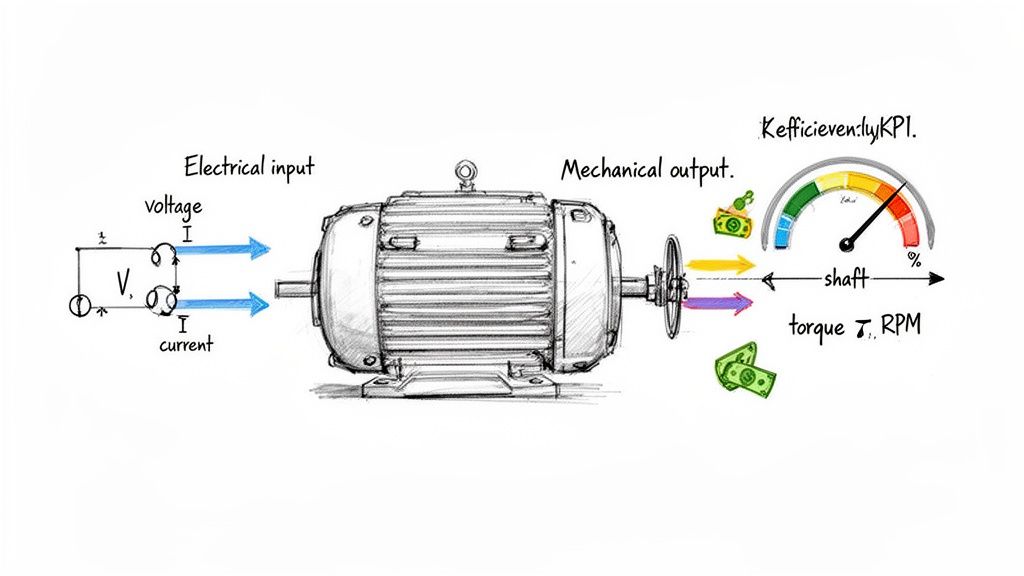
At its core, calculating electric motor efficiency is pretty straightforward: you divide the mechanical output power by the electrical input power. The result, expressed as a percentage, tells you exactly how well that motor is converting electricity into real, useful work.
Anything that isn't converted is lost, usually as heat.
Why Electric Motor Efficiency Is a Critical KPI
While the formula itself is simple, the number it gives you is one of the most important Key Performance Indicators (KPIs) you can track in any industrial setting. For plant engineers and maintenance managers, this isn't just some abstract figure—it’s a direct window into your operational health and financial performance.
A motor running at high efficiency means lower energy bills, reduced operating costs, and better equipment reliability. Simple as that.
To really get a handle on this, you need to know the two sides of the equation:
Electrical Input Power: This is what the motor pulls from the grid. Measured in watts (W) or kilowatts (kW), it's the product of voltage, current, and something called the power factor.
Mechanical Output Power: This is the actual work the motor is doing at the shaft. You figure this out from its rotational speed (RPM) and the torque (rotational force) it's delivering.
The gap between these two numbers is where the waste happens. These losses are the enemy of an efficient operation.
Understanding Where the Energy Goes
Every single watt that doesn't help turn the shaft is wasted energy, and it almost always escapes as heat. This excess heat is what cooks a motor from the inside out, shortening its lifespan and setting you up for a premature failure.
The main culprits behind these energy losses are things like:
Copper Losses (I²R Losses): These come from the natural electrical resistance in the motor's copper windings.
Core Losses: Hysteresis and eddy currents create losses in the motor's magnetic steel core.
Mechanical Losses: Good old-fashioned friction in the bearings and wind resistance (drag) from the cooling fan.
Stray Load Losses: This is a catch-all for a bunch of other minor losses that are tricky to measure but add up as the motor's load increases.
The whole point of modern motor design and a solid maintenance program is to chip away at these losses. An inefficient motor isn't just an energy hog; it runs hotter, putting constant stress on its parts and making unplanned downtime a matter of when, not if. This is precisely why energy efficiency initiatives through strategic maintenance are so vital.
To give you a better grasp of what to look out for, here’s a quick breakdown of the factors at play.
Key Factors Influencing Motor Efficiency
The table below summarizes the primary elements that determine a motor's overall efficiency. It's a handy quick-reference for engineers trying to diagnose performance issues or specify new equipment.
Factor
Description
Impact on Efficiency
Motor Load
The percentage of the motor's full-rated load at which it is operating.
Motors are most efficient near 75-95% of their rated load. Efficiency drops significantly at loads below 50%.
Motor Design & Quality
The materials used (e.g., copper vs. aluminum windings, quality of steel) and the precision of manufacturing.
Higher-quality materials and better designs directly reduce copper, core, and stray load losses.
Operating Voltage
The stability and level of the supply voltage.
Consistent, balanced voltage minimizes electrical losses. Under- or over-voltage can increase heat and reduce efficiency.
Maintenance
Regular lubrication, cleaning of cooling fins, and bearing checks.
Proper maintenance reduces mechanical friction and ensures the motor runs cooler, preventing heat-related losses.
Power Factor
The ratio of real power (kW) to apparent power (kVA) in an AC circuit.
A low power factor means more current is needed to do the same work, increasing I²R losses in the windings.
Understanding these interconnected factors is the first step toward building a more robust and cost-effective operation.
The Financial Impact of Motor Inefficiency
The real-world dollar cost of poor motor efficiency is staggering. In developed regions like the United States and Europe, electric motors are responsible for a massive 40-50% of all industrial electricity consumption.
Even a small efficiency gain, when multiplied across a facility, can lead to huge savings. For example, just identifying and upgrading motors stuck in the 75-80% efficiency range can make a noticeable dent in your utility bills.
Think about a manufacturing plant with 500 motors. If you can boost the average efficiency from 85% to a premium level of 93%, you could slash annual energy costs by 15-20%. At an average electricity rate of $0.10/kWh, that one project could save the company over $100,000 a year.
This is exactly why knowing how to calculate motor efficiency is such a fundamental skill. It helps you pinpoint underperforming assets, build a business case for upgrades, and make maintenance decisions based on hard data.
Of course, other elements like the power factor play a big role in your overall electrical health. If you want to dive deeper, you can learn more about the power factor definition and its impact on your systems.
Gearing Up: The Right Tools for an Accurate Measurement
Before you even think about calculating motor efficiency, you have to be able to trust your numbers. And that trust comes down to one thing: the quality of your measurement tools. Using a basic multimeter when you need a power analyzer is like trying to do heart surgery with a butter knife—you might get a result, but you wouldn't bet a critical decision on it.
The whole game is about getting a crystal-clear picture of two things: the electrical power going in and the mechanical power coming out. Each side of that equation demands its own set of specialized gear.
Nailing the Electrical Input
First up, you've got to accurately measure the voltage, current, and power factor feeding the motor. This isn't a job for just any old clamp meter you have rattling around in your toolbox; the instrument has to fit the complexity of the job.
For a quick spot-check on a single-phase AC motor running under a steady load, a high-quality Digital Multimeter (DMM) with a clamp-on ammeter can give you a decent ballpark figure for voltage and current. It gets you in the neighborhood.
But for any serious efficiency audit—especially if you're dealing with three-phase systems or motors hooked up to a Variable Frequency Drive (VFD)—you absolutely must use a Power Quality Analyzer. There's no substitute.
A power quality analyzer is the non-negotiable tool for any professional-grade test. It measures voltage and current across all three phases at the same time, calculating the true power (kW), apparent power (kVA), and, most importantly, the true power factor. A standard DMM simply can’t do this, and relying on one will inject massive errors into your input power calculation right from the start.
When you're picking an analyzer, make sure it has these features:
True-RMS Measurement: This is critical for getting an accurate read on the distorted, non-sinusoidal waveforms that VFDs kick out.
Three-Phase Capability: It has to be able to watch all phases simultaneously to catch any imbalances.
Data Logging: The ability to record data over a period of time is huge. It lets you see how efficiency shifts as the motor's load changes.
Without this level of instrumentation, your entire effort to measure efficiency accurately crumbles before you've even started.
Quantifying the Mechanical Output
Once you have a solid handle on the electrical input, it's time to measure what the motor is actually doing at the shaft. This means measuring its rotational speed and the amount of torque it's delivering to the load.
Measuring Rotational Speed (RPM) The go-to tool here is a Tachometer. You’ll generally run into two types:
Contact Tachometer: This has a small wheel or tip you press right against the end of the motor shaft. It's direct, simple, and gets the job done.
Non-Contact (Photoelectric) Tachometer: This type uses a laser or an infrared beam aimed at a small piece of reflective tape stuck to the shaft. It's much safer for high-speed machinery or when the shaft is tough to get to.
For most fieldwork, a good handheld digital tachometer with an accuracy of ±1 RPM is more than enough to get the speed data you need for the output power formula.
Measuring Torque Here’s where things can get tricky in the field. Measuring torque accurately often requires some pretty specialized equipment.
In-Line Torque Sensor: These are installed right between the motor and the load, where they directly measure the rotational force. They're incredibly accurate but mean you have to uncouple the machinery, which makes them a better fit for a workshop or lab environment than a quick field test.
Dynamometer: A dynamometer, or "dyno," is the gold standard for motor testing. It doesn't just measure torque and speed; it can also act as a programmable load. This lets you test the motor across its entire operating range and map out a beautiful, detailed efficiency curve.
Calculating Efficiency with the Direct Measurement Method
When you need hard, undeniable data on how a motor is really performing, nothing beats the direct measurement method. This is the gold standard for a reason. It involves simultaneously measuring the electrical power going into the motor and the mechanical power coming out of it while it's hooked up to a real-world load.
This approach takes all the guesswork out of the equation. It provides a clear, direct, and highly accurate snapshot of the motor's efficiency right then and there. What goes in must either come out as useful work or be lost as heat and noise. Direct measurement quantifies this relationship perfectly.
This diagram breaks down the basic setup for gathering the data you need.
As you can see, you’ve got a power analyzer on the input side and a combination of a tachometer and a dynamometer on the output. This setup gives you all the variables needed for a rock-solid efficiency calculation.
Mastering the Input Power Formulas
First up, you need to nail down the electrical input power (P_in), which we measure in watts (W). The formula you'll use depends on whether you're dealing with a single-phase or a three-phase system—and in most industrial settings, you'll be working with three-phase.
For Single-Phase Motors:
P_in = Voltage (V) × Current (I) × Power Factor (PF)
For Three-Phase Motors:
P_in = Voltage (V) × Current (I) × Power Factor (PF) × √3
That extra factor, the square root of 3 (~1.732), is the magic number for three-phase calculations. It accounts for the phase difference in the power delivery. For the most accurate reading, make sure you're using the average line-to-line voltage and the average line current.
Measuring the Mechanical Output Power
Next, we need to figure out the mechanical output power (P_out). This is the actual rotational work the motor is delivering at the shaft, and it's a product of both its speed and its torque.
When you're working with standard imperial units, the formula looks like this:
The number 5252 is a conversion constant that gets everything into horsepower. But to compare apples to apples, we need both input and output in the same units. That means converting horsepower to watts. Luckily, that’s easy:
1 Horsepower = 746 Watts
So, your final output power is simply P_out (HP) × 746. Now you have both P_in and P_out in watts, and you’re ready for the final step.
Bringing It All Together: A Worked Example
Let’s walk through a real-world scenario. You're testing a 50 HP, 460V three-phase motor that runs a big pump at a manufacturing plant. You’ve got your power analyzer hooked to the motor's input and a dynamometer on the output shaft.
You let the motor run for a bit to get up to a stable operating temperature, then you load it up and record the numbers:
Average Line-to-Line Voltage (V): 462 Volts
Average Line Current (I): 58 Amps
Power Factor (PF): 0.88
Shaft Speed (RPM): 1775 RPM
Shaft Torque (lb-ft): 145 lb-ft
Alright, let's crunch the numbers.
1. Calculate Input Power (P_in): Using our three-phase formula: P_in = 462 V × 58 A × 0.88 PF × 1.732 = 40,841 Watts
2. Calculate Output Power (P_out): First, let's get the horsepower: P_out (HP) = (145 lb-ft × 1775 RPM) / 5252 = 48.98 HP
Now, convert that to watts: P_out (W) = 48.98 HP × 746 W/HP = 36,543 Watts
Our direct measurement shows this motor is operating at 89.5% efficiency under this specific load. This is why direct testing is so valuable—it’s not an estimate. It’s a definitive performance benchmark.
The Importance of Testing at Multiple Load Points
Here’s something a lot of people miss: a single efficiency number at full load doesn't tell the whole story. Very few motors run at 100% load all day long. Their efficiency changes dramatically depending on how hard they're working.
For a complete picture, you need to test at various load points—I always recommend 25%, 50%, 75%, and 100% of the motor's rated capacity.
When you plot these results, you get an efficiency curve. This curve is infinitely more useful for understanding real-world energy use. It will almost always show you that peak efficiency happens somewhere between 75% and 100% load, and it drops off a cliff below 50%. Knowing this helps you right-size motors for their jobs and avoid the classic, costly mistake of running a huge motor for a tiny task.
Using the Indirect Method for In-Service Motors
So, what do you do when you need a motor's efficiency numbers, but taking the equipment offline for a full dynamometer test just isn't an option? In the real world of a busy plant, you can't always shut down a critical production line. This is exactly where the indirect method, also known as the segregated loss method, proves its worth.
Instead of trying to measure mechanical output directly, this approach works backward. You start by accurately measuring the electrical power going into the motor. Then, you systematically track down and quantify all the internal energy losses. Whatever is left over after you subtract those losses is your useful mechanical output power.
The formula itself is straightforward:
Efficiency (%) = (Input Power – Total Losses) / Input Power × 100
This technique is a lifesaver for any maintenance manager or plant engineer who needs to assess the health of installed equipment without causing a major headache. It gives you a reliable efficiency figure for a motor that’s already hard at work, driving a pump, fan, or conveyor.
Breaking Down the Four Key Motor Losses
To get this right, you have to play detective and hunt down four distinct types of energy loss. Each one represents a different way the motor bleeds off electrical energy as something other than useful rotational force—mostly heat.
Copper Losses (I²R Losses): These are the most common culprits. They're caused by the simple electrical resistance in the copper windings of the stator and rotor. As current flows, the windings heat up, and that heat is pure energy loss.
Core Losses: These happen inside the motor's laminated steel core. They're a combination of hysteresis (energy lost from constantly reversing the magnetic field) and eddy currents (tiny, wasteful currents induced in the core material itself).
Mechanical Losses: This bucket covers pure friction. We're talking about friction in the motor's bearings plus the "windage" created by the internal cooling fan and other spinning parts pushing against the air.
Stray Load Losses: This is the catch-all category for a bunch of other complex losses that change depending on how hard the motor is working. They come from things like leakage flux and other secondary effects that are tricky to pin down but still contribute to the overall inefficiency.
By carefully segregating and adding up these individual losses, you can build a surprisingly accurate picture of the total energy going to waste.
The Testing Procedure for Segregated Losses
Pinpointing each type of loss requires a couple of specific tests. The two most important ones are the no-load test and the stator resistance measurement.
Stator Resistance Test: This is a simple but absolutely critical first step. You'll use a high-precision ohmmeter to measure the DC resistance across the motor leads. This value is essential for calculating your copper losses (I²R) later on. A pro tip: make sure you do this when the motor is at a known, stable temperature, because resistance changes with heat.
No-Load Test: For this one, you uncouple the motor from its load and let it run freely at its rated voltage and frequency. You measure the input power it's drawing. Since the motor isn't doing any real work, the power it's consuming is purely to overcome its own internal losses—the core losses and mechanical losses combined.
Think of it like a financial audit, but for watts instead of dollars. By combining the results from these tests with the input power you measure under normal operating load, you can piece together the motor's complete energy balance sheet.
Direct vs. Indirect Efficiency Measurement Methods
For engineers and managers deciding how to approach motor testing, understanding the pros and cons of each method is key. The direct method is the gold standard for accuracy but requires taking the motor out of service. The indirect method offers a practical alternative for live, in-service equipment.
Here's a quick breakdown to help you choose the right tool for the job.
Attribute
Direct Method (Input-Output)
Indirect Method (Segregated Loss)
Accuracy
Highest (typically ±1%)
Very good (typically ±3%)
Equipment
Dynamometer, torque sensor, power analyzer
Power analyzer, ohmmeter, tachometer
Disruption
High (motor must be removed from service)
Low (can be done on an installed motor)
Best For
Lab testing, new motor acceptance, R&D
In-field diagnostics, energy audits, troubleshooting
Complexity
Mechanically complex setup
Electrically focused tests
Standard
IEEE 112 (Method B)
IEEE 112 (Method E) / IEC 60034-2-1
Ultimately, while the direct method provides the most precise answer, the indirect method delivers actionable data without shutting down your operations, making it an invaluable tool for real-world facility management.
The segregated loss method, which is rooted in standards like IEEE 112 and was refined by organizations like Ontario Hydro back in the 1980s, gives us a non-intrusive way to see what's happening inside. In fact, research shows its accuracy is typically around ±3%. That's a huge improvement over less reliable estimates. A 1995 ACEEE paper on motor efficiency testing methods is a great resource if you want to dig into the historical data.
A Practical Example with a 100 HP Motor
Let's walk through a scenario. You're tasked with assessing a 100 HP, 460V three-phase motor out on the plant floor. The nameplate tells you it should pull about 75 kW at full load. You run the segregated loss tests and get these numbers:
Copper Losses (I²R): 5 kW
Core Losses: 4 kW
Mechanical Losses: 3 kW
Stray Load Losses (estimated): 3 kW
Add them up, and your total calculated losses are 5 + 4 + 3 + 3 = 15 kW.
Since you measured an input of 75 kW, the actual mechanical output is 75 kW – 15 kW = 60 kW.
Now, you can calculate the real-world efficiency: Efficiency = (60 kW / 75 kW) × 100 = 80%
That's a problem. A modern NEMA Premium motor of this size should be hitting 93.6% efficiency. This hard data gives you everything you need to build the business case for a replacement. The savings get even bigger when that motor is driving equipment where you can fine-tune the output. For more on that, see our guide on AC motor variable speed options.
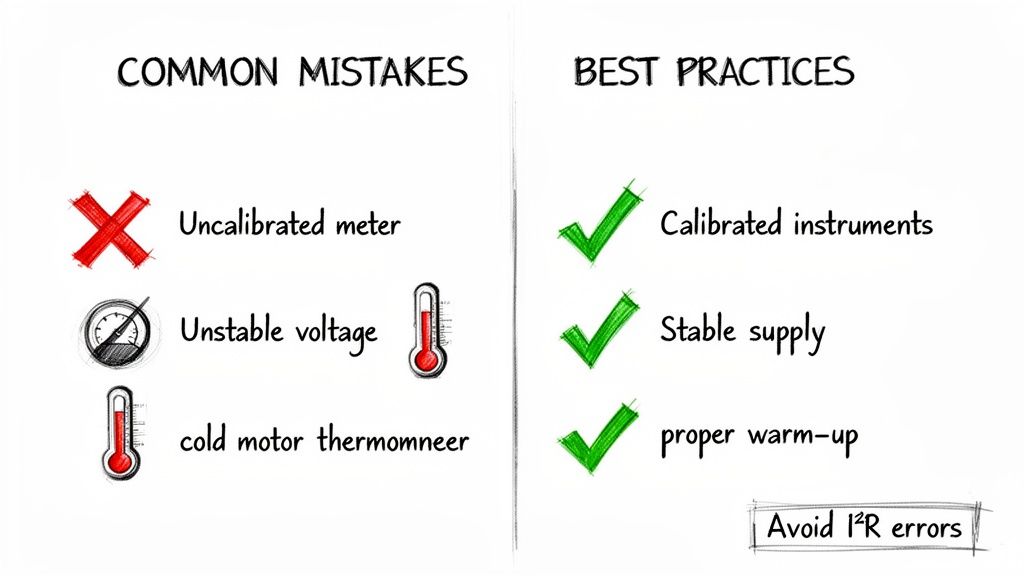
Common Mistakes and Best Practices for Reliable Results
Knowing the formulas and having the right tools is a great start, but it's only half the battle. Out in the real world, the industrial environment is messy. It's full of variables that can—and will—throw off your measurements, leaving you with data that looks fine on paper but doesn't reflect what's actually happening.
Experience teaches you where the traps are. I've seen it time and again: avoiding a few common mistakes is what separates a truly meaningful energy audit from an academic exercise. This is the stuff that makes your results not just correct, but reliable.
The Pitfall of Cold Testing
One of the most common blunders I see is testing a motor right after it's been turned on. A cold motor will give you misleading results every single time. Why? Because the electrical resistance of its copper windings changes dramatically with temperature.
As a motor runs, it heats up. That heat raises the resistance of the windings. Thanks to Ohm's Law, higher resistance means higher copper losses (I²R losses), which drags down the motor's real-world efficiency.
Best Practice: Let the motor run under its typical load for at least an hour, or until its frame temperature stops climbing. This "thermal soak" is crucial. It ensures your power readings reflect its true, steady-state performance.
Ignoring Your Instrument Calibration
This one should be obvious, but it’s surprisingly common. Using uncalibrated instruments is a recipe for disaster. A power analyzer that's off by just a couple of percentage points can create a cascade of errors, making your final efficiency calculation totally useless.
Think of it this way: your calculations are built on a foundation of numbers your tools provide. If that foundation is shaky, the whole structure you build on top of it will be worthless.
Calibrate Regularly: Every piece of test equipment, especially your power analyzer and torque sensors, needs a valid calibration certificate. Stick to the manufacturer's recommended interval, which is usually once a year.
Do a Sanity Check: Before a big test, I always try to do a quick check on a known, stable source if possible. It’s a simple way to confirm your gear is behaving as expected before you sink hours into collecting bad data.
Document Everything: Keep a log of your instrument serial numbers and their last calibration dates. This is basic good practice for any serious quality or predictive maintenance program.
Understanding the Impact of Power Quality
Dirty power can wreak havoc on motor performance and completely skew your efficiency numbers. Things like voltage imbalance between phases, low voltage, or harmonic distortion from VFDs all force a motor to run hotter and less efficiently.
For example, a voltage imbalance of just 2% can crank up motor losses by nearly 20% and cause a serious temperature rise. If you miss this, you'll end up blaming the motor for poor performance when the real culprit is the power supply.
Check Voltage Stability: Before you start, make sure the supply voltage is stable and within ±10% of the motor's nameplate rating.
Measure Phase Balance: For three-phase systems, the voltage between each phase needs to be balanced. Anything over a 1% imbalance is a red flag that needs to be investigated.
Use True-RMS Meters: This is non-negotiable. If there's a Variable Frequency Drive (VFD) in the mix, you absolutely must use a true-RMS power analyzer. A standard meter can't accurately read the messy, non-sinusoidal waveforms from a VFD, which will lead to wildly inaccurate input power data.
Following these field-tested practices ensures your efforts produce data you can actually trust and act on. If you ever run into performance problems you just can't pin down, getting a professional opinion is a smart move. You can learn more about specialized troubleshooting in our guide to electric motor service options.
Common Questions on Motor Efficiency
Even after you get the hang of the direct and indirect methods, a few practical questions always pop up. That's perfectly normal. Diving into the nitty-gritty of motor efficiency calculations always brings up some real-world headaches worth tackling head-on.
Let's walk through some of the most common questions we hear from folks in the field.
What's the Real Difference Between NEMA and IEC Standards?
This is a huge point of confusion, especially for teams sourcing equipment for international projects. At a high level, the National Electrical Manufacturers Association (NEMA) sets the bar in North America, while the International Electrotechnical Commission (IEC) standards are the global benchmark.
They’re chasing the same goal but use different language.
NEMA keeps it simple with "Energy Efficient" and the higher-tier "Premium Efficient."
IEC uses a numbered system, climbing from IE1 (Standard Efficiency) all the way up to IE5 (Ultra-Premium Efficiency).
While their testing methodologies are pretty similar, the actual efficiency targets for each class can differ. The most important thing is to know which standard governs your project. That way, you can specify—and later verify—the right motor for the job without any expensive surprises.
How Does a VFD Mess with My Efficiency Calculations?
Ah, the Variable Frequency Drive (VFD). It's a game-changer for control, but it definitely complicates your efficiency math. First off, the VFD itself isn’t 100% efficient. It has its own internal losses, usually burning off 2-5% of the power it draws. This means your total system efficiency (VFD + motor) will always be a few points lower than the motor's efficiency alone.
But the bigger issue is the VFD's output. It's not a clean, smooth sine wave like you get from the grid. This choppy, distorted waveform will completely fool a standard multimeter, leading to wildly inaccurate input power readings. You absolutely need a true-RMS power analyzer to get a correct measurement.
If you want to isolate the motor's true performance, you have to measure power at the VFD's output terminals—the lines running straight to the motor. Don't measure at the VFD's input. This is probably the single most common mistake people make when testing VFD-driven motors.
Can I Just Trust the Nameplate Efficiency Rating?
Think of that nameplate number as the motor's best-case scenario—achieved in a lab, under perfect conditions, at its full rated load. It’s a decent starting point, but you have to take it with a grain of salt in the real world.
Several things can drag a motor's operating efficiency well below what’s stamped on the side:
Partial Loading: Efficiency plummets once a motor operates below 50% of its rated load. This is incredibly common.
Voltage Imbalance: Even a small discrepancy between phases creates a huge drag on performance and generates excess heat.
High Temps: A hot environment increases winding resistance, which directly translates to lower efficiency.
For any serious energy audit or a critical piece of machinery, there's just no substitute for getting your own field measurements.
How Often Should I Be Testing My Critical Motors?
There's no one-size-fits-all answer here, but the best practice is to build a testing schedule based on how critical the motor is. A great place to start is by getting a detailed baseline efficiency test done right after a new motor is commissioned.
From there, aim to re-test every three to five years. You should also make it standard procedure to test a motor after any major repair, especially a rewind. A sloppy rewind can easily slash efficiency by 1-2%, and you need to know if you're now running a less-efficient machine. Tying current monitoring into your condition monitoring program is another smart move—it can give you an early heads-up that performance is degrading and it's time for a closer look.
At E & I Sales, we provide the premium electric motors and integrated control systems that form the backbone of efficient industrial operations. From specification to commissioning, we help you build reliable, high-performance systems. Find out how we can support your next project.
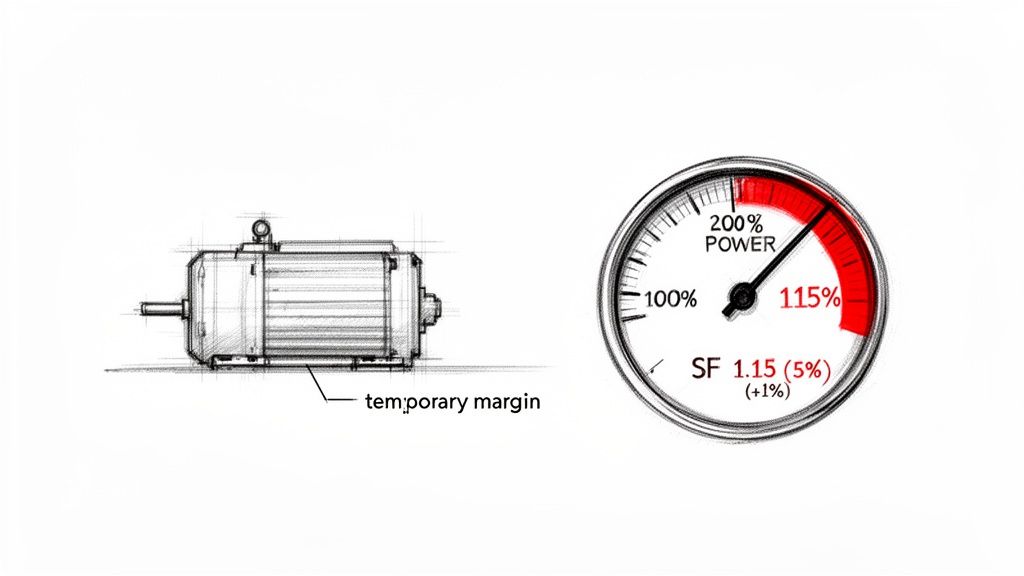
Put simply, a motor's service factor is a multiplier that tells you how much extra load it can handle for short bursts. It's essentially a built-in safety margin. For example, a motor with a 1.15 service factor can operate at 15% above its rated horsepower without immediately frying itself.
Decoding Motor Service Factor: The Built-In Power Margin
Think of it like driving a car. You wouldn't drive with the pedal floored and the engine screaming in the redline all day. But to get up a steep hill or pass another vehicle, you might push it for a few moments. The car is built to handle that brief, intense demand.
A motor's service factor is that engineered redline. It's not "free" horsepower—it's a carefully calculated reserve capacity designed to handle the unpredictable, real-world challenges that inevitably pop up.
The Official Definition And Its Practical Meaning
The National Electrical Manufacturers Association (NEMA) gives us the formal definition. According to the NEMA MG 1 standard, the service factor (SF) is "a multiplier which, when applied to rated power, indicates a permissible power loading that may be carried under the conditions specified for the service factor.”
In plain English, this means a 10 horsepower (HP) motor with a 1.15 SF is thermally designed to safely deliver 11.5 HP when needed. That 1.15 value has become an unofficial standard for general-purpose industrial motors for a reason.
This built-in cushion is absolutely critical for a few key reasons:
Handling Unexpected Loads: It gives the motor the muscle to manage intermittent spikes in demand, like when a conveyor belt has to start moving under a particularly heavy load.
Voltage Fluctuations: It provides a buffer against the minor voltage sags common in industrial plants, which could otherwise cause the motor to struggle or overheat.
System Resiliency: It makes the whole operation more robust, preventing nuisance trips and production stoppages from brief, unusual operating conditions.
In essence, service factor provides a margin for error. It’s the difference between a system that runs smoothly despite minor hiccups and one that constantly trips offline, causing expensive downtime.
Getting a handle on this concept is about more than just numbers on a nameplate. It's about understanding how electrical power gets converted into the real-world mechanical work that gets the job done. For a closer look at that relationship, our guide on torque calculation for a motor is a great next step.
Properly applying service factor ensures you're designing and maintaining reliable, resilient industrial systems that perform exactly as you expect them to.
Finding and Reading the Service Factor on a Motor Nameplate
Think of a motor's nameplate as its birth certificate and resume rolled into one. It’s packed with every critical detail you need to know about what that motor can do, and learning to decipher it is a core skill for anyone in the field.
When you're looking for the service factor, you won't have to search too hard.
Most manufacturers make it pretty obvious. Just scan the nameplate for the abbreviations SF or S.F., or sometimes the full "Service Factor." It’s almost always a decimal, like 1.15 or 1.25, and you'll usually find it huddled up next to the other headliners like horsepower (HP), RPM, and voltage.
But just spotting the number is only half the battle. That little decimal doesn't mean much in isolation. To really understand what it's telling you, you have to see it as part of the bigger picture, especially in its relationship with the motor's horsepower and full-load amperage (FLA).
Putting The Numbers In Context
Here's the best way to think about it: the horsepower rating is the motor's day-in, day-out marathon pace. It's the load it was designed to handle continuously without breaking a sweat.
The service factor? That’s the motor’s sprint capability. It tells you exactly how much extra power you can pull from it for short bursts without causing immediate damage. These two numbers work as a team, defining the absolute peak power the motor can safely deliver under ideal conditions.
Take a look at this real-world example. On the nameplate below, the SF is clearly marked as 1.15. Notice where it’s located—right next to the 3 HP rating. That’s not a coincidence. Manufacturers put them side-by-side to emphasize their direct link.
Getting this connection right is absolutely crucial. It’s the key to sizing your equipment correctly and, just as importantly, setting up your protective devices to prevent a burnout.
How Using Service Factor Impacts Motor Lifespan
Pushing a motor into its service factor range might feel like getting a free power boost, but there's a steep price to pay: a shorter lifespan. There’s no such thing as free horsepower. The cost of tapping into that reserve margin is accelerated wear and tear, pure and simple.
The number one enemy of any electric motor is heat. Running continuously into the service factor generates a ton of it, and that heat directly attacks the motor's most vulnerable parts—the winding insulation and the bearings. When you push a motor past its rated horsepower, the current draw goes up, which in turn cooks the windings. This thermal stress is the single biggest reason motors fail before their time.
The 10-Degree Rule and Its Financial Impact
There's a well-known rule of thumb in motor maintenance called the "10-degree rule." It’s a harsh but accurate guideline: for every 10°C (18°F) you run a motor's windings above their rated temperature, you cut the insulation's life in half. It's an unforgiving penalty for running too hot.
Let's take a motor with a 1.15 service factor. When you operate it at that peak load, you're not just asking for 15% more power; you're generating a disproportionate amount of heat. According to guidance from both EASA and NEMA, this overload rapidly ages the insulation and bearings. While a 1.15 SF load increases the current by about 15%, the heat generated is a different story. Heat from resistance (known as I²R loss) scales with the square of the current, meaning the extra heat is actually closer to 32%. You can discover more insights about motor thermal limits on PlantEngineering.com.
This isn't just an abstract electrical principle; it has real, tangible financial consequences. An overheated motor leads directly to:
Brittle Insulation: Over time, the heat makes the insulation on the copper windings fragile and prone to cracking. This leads to electrical shorts and catastrophic failure.
Bearing Failure: That same excess heat breaks down the grease in the motor's bearings, causing more friction, seizing, and eventually, a total breakdown.
Unexpected Downtime: A motor that dies prematurely grinds production to a halt, leading to expensive delays and emergency repair bills.
Think of a motor's service factor as a temporary reserve for unexpected peaks, not a continuous operating point. Leaning on it all the time is a surefire way to drive up maintenance costs, shorten your equipment's life, and deal with unplanned shutdowns.
Getting this relationship right is critical for building a reliable system. It’s not just about picking the right motor, but also setting up the proper safeguards. That’s why we also recommend you read our detailed guide on the protection of motors.
Smart Applications for Sizing Motors and Setting Overloads
Knowing what a motor service factor is on paper is one thing, but the real magic happens when you apply it intelligently out in the field. Seasoned pros don't look at a service factor as free horsepower; they see it for what it is—a strategic buffer. It’s a crucial safety margin for dealing with the messy, unpredictable reality of industrial work.
This built-in capacity is the perfect tool for handling those temporary, intermittent peak demands that can bring a lesser system to its knees. Think of a positive-displacement pump that has to work a little harder to push through a slug of thick fluid, or a conveyor belt groaning to a start under a heavy, lopsided load. These are precisely the moments a 1.15 SF is designed to absorb, preventing a costly system shutdown.
This isn't a new concept. Service factor has always been a design and reliability margin meant to cover real-world uncertainties, like minor voltage sags or the simple fact that it's tough to predict the exact horsepower an application will need. For system integrators building complex motor control centers, specifying motors with a 1.15 SF on critical drives is a time-tested strategy to slash nuisance trips and keep the line running. For a great technical breakdown on how this NEMA-defined margin adds reliability, check out this piece on Electrical Engineering Portal.
Setting Overload Protection Correctly
One of the most critical jobs for service factor is in setting a motor's overload protection. This is where theory directly impacts equipment safety and operational uptime. If you set the overload relay too low, you're signing up for frustrating nuisance trips. But set it too high, and you're leaving your expensive motor completely exposed to burnout.
Thankfully, the National Electrical Code (NEC) gives us clear, direct guidance. According to NEC 430.32, for any motor with a service factor of 1.15 or greater, you can set the overload device at up to 125% of the motor's Full Load Amps (FLA) listed on the nameplate. This setting gives the motor breathing room to safely use its service factor margin for short periods without tripping out.
On the other hand, if you're working with a motor with a service factor of 1.0, the rule changes. The maximum overload setting is capped at 115% of the FLA. That tighter tolerance is there for a reason—the motor has no built-in thermal capacity to handle overloads.
The bottom line is simple: your motor's service factor directly dictates how you configure its primary defense mechanism. Getting this setting right is fundamental to protecting your investment.
This relationship between running in the service factor, heat, and motor life is a straight line. The more you lean on that SF, the more heat you generate, and heat is the number one enemy of a motor's insulation and bearings.
As you can see, consistently relying on the service factor generates excess heat, which is the fast track to premature motor failure.
A Practical Step-by-Step Example
Let's walk through a quick, real-world scenario to lock this in.
Check the Nameplate: You've got a 10 HP motor. The nameplate shows an FLA of 28 amps and an SF of 1.15.
Apply the NEC Rule: Since the SF is 1.15, we know we can go up to 125% of the FLA for our overload setting.
Do the Math:28 Amps (FLA) x 1.25 = 35 Amps.
Set the Overload Relay: You'll dial in your overload relay to trip if the current draws more than 35 amps for a sustained period.
This simple calculation gives you a system that's both tough and safe. Getting these protective devices configured correctly is a core skill in motor control. For those who want to go deeper, we have a complete guide on how to size a motor starter that unpacks all these components in much more detail.
When You Should Avoid Using the Service Factor
While a motor’s service factor gives you a nice little power margin, it’s a tool with strict limitations, not a get-out-of-jail-free card. Knowing when not to use it is just as important as knowing when you can. In certain environments, leaning on that built-in buffer isn't just a bad idea—it can be downright dangerous.
Think of the service factor as a thermal savings account. In some situations, external conditions have already spent that entire savings for you, leaving zero margin for error.
High Ambient Temperatures and High Altitudes
A motor's standard ratings, including its service factor, are based on a very specific set of ideal conditions: operating at or below 40°C (104°F) and at an altitude of no more than 1,000 meters (3,300 feet). The moment you step outside those boundaries, the motor's ability to keep itself cool starts to plummet.
High Temperatures: In a hot factory or outdoors in the summer sun, the motor is already struggling to shed its own heat. Pushing it into the service factor range generates even more heat, which can cook the winding insulation and lead to a catastrophic failure.
High Altitudes: The air gets thinner the higher you go. Thinner air means the cooling fan can't move as much heat away from the motor's body, making it run hotter even under a normal load.
In both of these scenarios, the environment itself effectively "uses up" the thermal cushion that the service factor is meant to provide. To operate safely, you have to derate the motor and treat its service factor as 1.0.
Hazardous and Explosive Environments
When you're dealing with a location classified as hazardous—think refineries, grain elevators, or chemical plants—any extra heat can become an ignition source for flammable dust or vapors. It’s no surprise, then, that motors built for these environments are held to a much higher safety standard.
In hazardous locations, the motor's surface temperature is a critical safety parameter. Operating in the service factor range raises this temperature, creating an unacceptable risk. For this reason, all hazardous-duty motors are rated with a 1.0 service factor and must never be operated above their nameplate horsepower.
When Using a Variable Frequency Drive (VFD)
Heads up: pairing a standard, general-purpose motor with a Variable Frequency Drive (VFD) almost always means you forfeit the service factor. A VFD controls the motor's speed by manipulating the power waveform, a process that inherently introduces extra heat into the motor windings. This heating effect is especially bad at low speeds when the motor's own cooling fan is barely spinning.
That added heat from the VFD eats up the motor's thermal reserve, making it totally unsafe to push the load beyond its nameplate rating. Unless you're using a specialized inverter-duty motor that is explicitly designed with a service factor for VFD operation, you must assume the SF is 1.0.
The table below summarizes the key conditions where you need to back off and treat the service factor as 1.0.
Service Factor Derating Guide
This table outlines common operating conditions that require derating a motor's service factor to 1.0 to ensure safe, reliable operation and prevent premature failure.
Operating Condition
Recommended Service Factor
Reason for Derating
Ambient Temp > 40°C (104°F)
1.0
Reduced cooling capacity prevents the motor from dissipating the extra heat of an overload.
Altitude > 1,000 m (3,300 ft)
1.0
Thinner air makes the cooling fan less effective, increasing operating temperature.
Hazardous/Explosive Locations
1.0
Prevents surface temperatures from exceeding safety limits and becoming an ignition source.
Used with a Standard VFD
1.0
The VFD introduces additional heat, consuming the motor's thermal margin.
Frequent Starting/Stopping
1.0
High inrush currents during startup generate significant heat, leaving no room for overload.
Remember, these are not just suggestions; they are critical guidelines for protecting your equipment, your facility, and your personnel. When in doubt, always derate to a service factor of 1.0.
Expert Guidance for Motor and Control Panel Design
Really getting a handle on motor service factor is a game-changer when you're designing systems that need to be both tough and cost-effective. It’s what lets you turn those abstract numbers on a nameplate into smart engineering calls, making sure your equipment can actually handle what the real world throws at it. This is how you nail the balance between performance and a long, reliable service life.
But you can't just stop at the motor. To apply these principles right, you have to look at the whole electrical system. The motor is just one piece of the puzzle—the control panel protecting it is just as crucial. This is where teaming up with an expert who gets the entire picture, from the motor spec all the way to the UL-listed control panel integration, really pays off.
Aligning Components for Optimal Performance
A single-source partner is your best bet for making sure your motor, overload protection, and system controls are all singing from the same song sheet. This kind of integrated approach helps you sidestep the usual traps, like mismatched parts or badly configured safety devices, which are a fast track to premature failures and expensive downtime.
By treating the motor and its controls as one unified system, you're optimizing the entire operation for safety, reliability, and peak performance right out of the gate. It's about preventing problems before they even have a chance to start.
This holistic way of thinking takes the guesswork out of the equation and guarantees every component is working together smoothly. For instance, an expert can pinpoint a motor with the perfect service factor for your specific load, then build a control panel with overload relays calibrated precisely to that motor’s unique FLA and SF ratings.
When you get down to it, this level of detailed engineering gives you a system that isn't just up to code—it's built to last. It’s about creating a dependable operational backbone that supports your production goals without cutting corners, making sure your investment is protected by smart, forward-thinking design.
Got Questions About Motor Service Factor?
Once you get the hang of motor service factor, you start running into those tricky real-world situations. It’s one thing to understand the theory, but it’s another to apply it when you’re standing in front of a control panel. Let’s clear up a few of the most common questions that pop up.
Can I Use a VFD to Squeeze More Horsepower Out of the Service Factor?
This is a big one, and the answer is a hard no. It's a common and frankly dangerous assumption. The moment you connect a standard motor to a Variable Frequency Drive (VFD), its service factor is automatically reduced to 1.0. You should never try to push the motor beyond its nameplate horsepower rating when using a VFD.
Why? It all comes down to heat. A VFD introduces extra heat into the motor windings, a problem that gets worse at lower speeds when the motor's own cooling fan isn't spinning fast enough to be effective. That extra heat eats up the very thermal safety margin the service factor was meant to provide. Unless you have a specific inverter-duty motor that is explicitly rated for VFD use with a service factor above 1.0, the rule is absolute: SF is 1.0.
Is a Motor with a 1.25 SF Just Flat-Out Better Than One with a 1.15 SF?
Not at all. "Better" is completely relative to the job at hand. A higher service factor like 1.25 definitely gives you a bigger cushion for short-term overloads, but it doesn't make the motor superior across the board.
For instance, you’ll often see a 1.25 SF on Open Drip-Proof (ODP) motors, where there's plenty of airflow to help with cooling. On the flip side, a heavy-duty, Totally Enclosed Fan-Cooled (TEFC) motor built for a gritty, tough environment might be designed with a more conservative 1.15 SF. The best motor is the one that's a perfect match for its load, environment, and duty cycle. A high SF is great for unpredictable loads, but a 1.0 SF motor sized perfectly for a steady, continuous load might even be the more efficient choice.
How Does Running in the Service Factor Range Affect My Warranty?
Running a motor in its service factor range (above its rated horsepower) won't automatically void your warranty. After all, the motor was designed with that capability for intermittent use.
But here’s the catch: consistently running in that SF range dramatically shortens the life of the motor's insulation and bearings, making a premature failure much more likely. If the motor burns out from overheating because it was running in its SF range plus dealing with other stressors like high ambient heat, a manufacturer could easily challenge or deny a warranty claim. They expect you to use the service factor as a safety net for occasional spikes, not as a permanent horsepower boost.
At E & I Sales, we know that peak performance comes from the whole system, not just one part. Our experts are here to help you select the right motor and design a custom, UL-listed control panel that delivers the protection, reliability, and longevity your operation demands. Learn more about our comprehensive motor and control solutions.
Ever walked onto a sprawling factory floor and felt the hum of dozens, maybe even hundreds, of motors powering everything from conveyors to massive industrial pumps? It’s a symphony of controlled chaos. Now, imagine trying to manage each one of those motors individually. That’s a recipe for disaster.
This is exactly where a Motor Control Center, or MCC, comes into play. Think of it as the central nervous system for your entire operation. It’s not just a big metal box; it's the command hub that brings order, safety, and efficiency to all that electromechanical muscle.
The Heart of Industrial Automation
At its core, an MCC is an assembly of one or more enclosed cabinets that houses all the individual motor control units. We often call these individual units "buckets" or "cubs" in the field. Each bucket is dedicated to a specific motor, giving you a single, centralized spot to manage your entire fleet of electric motors.
This modular design is what makes it so powerful. Instead of running around the plant floor to start, stop, or troubleshoot a machine, you can do it all from one location. If you're looking to understand the components they control, you can explore a wide variety of these in our guide to industrial electric motors.
To truly get a handle on what an MCC does, let's break down its core functions and the components that make it all happen.
Core Functions and Components of a Motor Control Center at a Glance
An MCC isn't just a simple on/off switch. It’s a sophisticated system designed for control, protection, and streamlined management. The table below gives you a quick snapshot of what it does and the key hardware involved.
Core Function
Description
Key Components Involved
Control
Provides the ability to start, stop, reverse, or adjust the speed of individual motors, giving operators precise command over machinery.
Motor Starters, Push Buttons, Variable Frequency Drives (VFDs)
Protection
Acts as a vigilant bodyguard, safeguarding expensive motors from electrical faults like overloads, short circuits, and phase loss.
Circuit Breakers, Fuses, Overload Relays
Centralization
Consolidates all motor controls into a single, organized location, which drastically simplifies maintenance, troubleshooting, and monitoring.
Enclosures, Bus Bars, Terminal Blocks, Control Wiring
By bringing these elements together, the MCC transforms a collection of independent machines into a cohesive, manageable production system.
This approach is so fundamental to modern industry that its value is growing rapidly. The global MCC market was valued at around USD 6.96 billion and is projected to skyrocket to nearly USD 12.14 billion by 2032. This isn't just a trend; it's a testament to how essential centralized control has become. You can dive deeper into the growing MCC market trends on maximizemarketresearch.com.
An MCC isn't just a cabinet of switches; it is the foundational platform for safe, efficient, and scalable industrial automation. It transforms a collection of individual machines into a cohesive, manageable production system.
Ultimately, an MCC is the backbone of any serious industrial operation. It’s the unsung hero ensuring every motor does its job correctly and safely, keeping the wheels of modern manufacturing and processing turning without interruption.
Anatomy of a Motor Control Center
To really understand what a motor control center is, you have to look past the steel doors. The best way to think about it is like a heavy-duty, industrial filing cabinet. But instead of holding paperwork, each drawer is a self-contained unit built to power, protect, and control a single motor out on the plant floor. That modular design is the secret sauce behind its efficiency and safety.
Let's pull open those drawers and deconstruct this "filing cabinet" piece by piece. We'll see how it takes immense electrical power and channels it into precise, useful work. At its core, the system is built on a clear hierarchy for power distribution.
This diagram gives you a great visual of how an MCC acts as a central hub, handling the core jobs of control, protection, and centralization all in one spot.
As you can see, the MCC is positioned as the "brain" of the operation, delegating specific tasks to its internal systems—which is a perfect reflection of how the physical components are actually laid out.
The Power Superhighway: Main and Vertical Bus Bars
The backbone of any MCC is its bus bar system. Think of the main horizontal bus as a multi-lane electrical superhighway. It typically runs across the top of the entire MCC structure, carrying the massive bulk power feed—often thousands of amps—from the main transformer or switchgear.
Branching off this highway are the vertical bus bars, which run up and down each vertical section of the cabinet. These act like exit ramps, safely tapping into the main power and delivering it to each level where a motor control unit can be plugged in. This incredibly robust framework ensures every single unit gets a reliable, high-current connection.
Individual Motor Units: The Buckets
Now for the most recognizable part of an MCC: the individual motor control unit, which everyone in the industry calls a bucket or cubicle. These are the removable "drawers" from our filing cabinet analogy. Each bucket is a complete, self-contained module with all the gear needed to control and protect one specific motor.
This modular, slide-out design is an absolute game-changer for maintenance. A technician can safely kill the power to a single bucket, pull it out for repair or replacement, and leave the rest of the MCC running. No more shutting down an entire process to fix one motor.
Inside each bucket, you'll find a small team of components working in concert.
Motor Starter: This is the workhorse, usually a contactor, that physically starts and stops the motor by connecting or disconnecting it from the power bus.
Overload Relay: Think of this as the motor’s personal bodyguard. It constantly watches the current being pulled by the motor. If it senses the motor is working too hard and drawing too much current for too long, it trips and cuts power, saving the motor from burning itself out.
Circuit Breaker or Fuses: This is your catastrophic failure protection. It acts instantly to kill the power during a major fault, like a dead short. It’s designed to prevent a single motor failure from turning into a much bigger, more destructive problem for the whole MCC.
Supporting Components and Control Logic
Beyond the main power-handling parts, a few other components play crucial roles inside the bucket and the wider MCC structure.
You'll almost always find a control power transformer (CPT) tucked inside a bucket. Its job is simple but vital: it steps down the high motor voltage (like 480V) to a much safer, lower control voltage (usually 120V AC or 24V DC). This low voltage powers the starter coils, indicator lights, and push buttons, making the system far safer for operators and electricians to interact with.
Every element within a motor control center, from the main bus to the smallest terminal block, is engineered for a specific purpose. It's a system where high power and precise control meet in a safe, centralized, and serviceable package.
Finally, you have the control wiring and terminal blocks. These are the nerves of the system. They connect the bucket to the outside world—to start/stop buttons on a control panel, to sensors out on the line, and increasingly, to Programmable Logic Controllers (PLCs) for full automation. This is where the "control" in Motor Control Center truly happens, turning a simple signal into a powerful action at the motor.
Exploring the Different Flavors of MCCs
Just like you wouldn't grab a sledgehammer to do a watchmaker's job, not all Motor Control Centers are built the same. They come in different varieties, each engineered for specific voltage demands, operational smarts, and maintenance philosophies. Picking the right one is crucial—it's like choosing the central nervous system for your entire operation.
The first and most obvious way to slice it is by voltage. MCCs are fundamentally categorized by the power levels they're designed to handle, which dictates where and how they fit into the industrial landscape.
This evolution from simple electrical closets to data-rich nerve centers is a story about modern industrial automation. The global MCC market, valued at USD 5.95 billion, is on a trajectory to hit USD 11.89 billion by 2035. This growth isn't just about needing more power; it's about the industry-wide shift toward smarter manufacturing. You can dig deeper into the factors driving the MCC market on marketresearchfuture.com.
Low Voltage vs. Medium Voltage MCCs
The first fork in the road when you're looking at MCCs is the voltage rating. This single detail determines the scale and type of machinery it can safely wrangle.
Low Voltage (LV) MCCs: These are the ones you'll see most often. Operating at 600V or less (with 480V being a very common sight in the US), they are the absolute workhorses of manufacturing plants, commercial buildings, and processing facilities. They're busy running the standard-sized motors for your conveyors, pumps, fans, and mixers.
Medium Voltage (MV) MCCs: When you're dealing with the really big stuff, you need more muscle. MV MCCs handle voltages from 2.3kV all the way up to 15kV. You'll find these beasts in heavy-duty sectors like mining, oil and gas, and power generation, where they're tasked with controlling massive compressors, grinders, and pumps that need a huge jolt of power to get going and keep running.
Conventional vs. Intelligent MCCs
Beyond raw power, the next big divide is intelligence. The technology tucked inside each MCC bucket has come a long way, creating a clear line between the old-school traditional units and the new, data-driven ones.
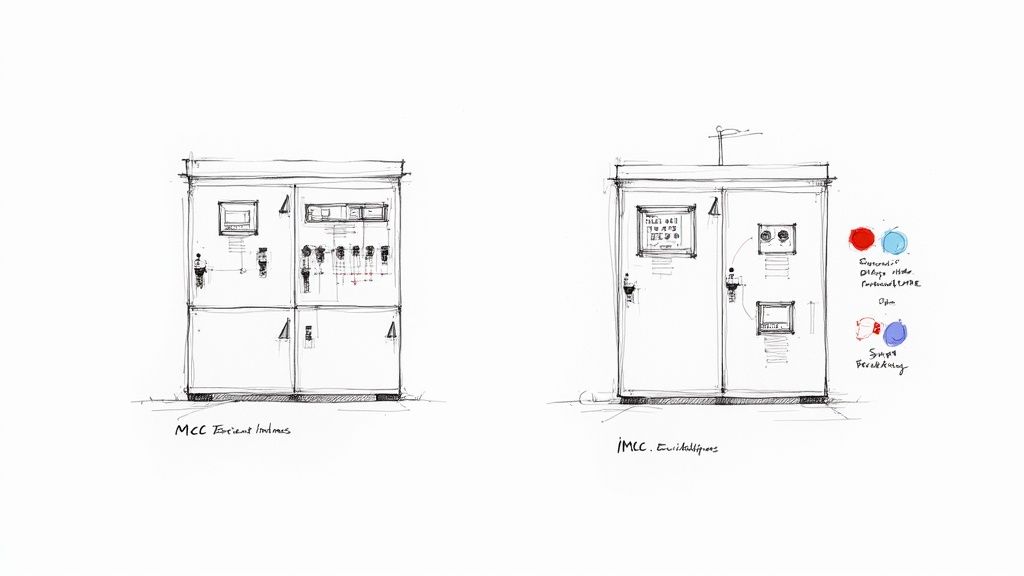
A conventional MCC is pure, reliable electromechanical brawn. It relies on hardwired connections to do its job: start, stop, and protect a motor. They're incredibly dependable and have a long-proven track record, but troubleshooting usually means getting hands-on with a multimeter. You're not getting much operational data out of them.
Then you have the Intelligent MCC (iMCC), which brings communication smarts right into each motor control unit. Think of it as the brainy evolution of its predecessor.
An iMCC isn't just an electrical distribution hub anymore; it's a rich source of operational data. It gives you a real-time window into the health and performance of every single motor in your plant.
These smart units are networked, talking directly to the plant's main control system—a PLC or DCS. This constant conversation allows for remote monitoring and control, but more importantly, it streams a ton of valuable diagnostic data: motor current, temperature, run-time hours, you name it. This information is pure gold for predictive maintenance, helping teams catch potential failures long before they shut down a production line.
Here’s a look at how these two types stack up side-by-side.
Comparing Conventional MCCs vs. Intelligent MCCs (iMCCs)
Feature
Conventional MCC
Intelligent MCC (iMCC)
Control Logic
Hardwired, relay-based logic.
PLC/DCS integrated, software-based logic.
Diagnostics
Manual troubleshooting with meters.
Real-time, remote diagnostics and fault data.
Data Availability
Limited to none.
Rich data stream (current, temp, runtime, etc.).
Maintenance
Reactive; fix things when they break.
Predictive; fix things before they break.
Footprint
Requires more field wiring and I/O cabinets.
Reduced footprint, less field wiring.
Commissioning
Time-consuming point-to-point wiring checks.
Faster commissioning through network checks.
Typical Use
Simpler applications, tight budgets.
Critical processes, data-driven operations.
While conventional MCCs are still a solid choice for straightforward jobs, the move toward iMCCs reflects a bigger trend: using data to make smarter, safer, and more profitable decisions on the plant floor.
Fixed vs. Withdrawable Unit Designs
Finally, we have the physical design of the units themselves, which has a huge impact on maintenance and uptime.
Fixed MCCs: In this setup, all the motor control components are bolted directly into the structure. It’s a more budget-friendly option upfront, but if you need to perform maintenance or replace a unit, you have to shut down that entire section of the MCC.
Withdrawable MCCs: This is the modular "bucket" design we talked about earlier. Each unit can be physically disconnected and pulled out while the main bus bars stay energized. For any facility where every minute of uptime counts, this feature is a lifesaver. A faulty unit can be swapped with a spare in minutes, minimizing production loss and keeping technicians much safer.
Understanding Essential MCC Standards and Safety
When you pack that much electrical muscle into one place, like a motor control center does, you have to play by a strict set of rules. We're talking about standards and safety protocols that aren't just suggestions—they’re the bedrock of reliable engineering and, more critically, keeping people safe. Getting these guidelines right is non-negotiable for anyone specifying, installing, or working near an MCC.
In North America, the National Electrical Manufacturers Association (NEMA) is the authority for this kind of gear. NEMA sets the standards for enclosures, which basically tells you how well an MCC is shielded from its surroundings. Getting this rating right is the first step to making sure your equipment is a good match for its environment.
Decoding NEMA Enclosure Types
Think of a NEMA rating as the right kind of armor for your MCC. You wouldn't wear shorts in a blizzard, and you definitely wouldn't stick a standard indoor MCC in a washdown area of a food plant. Each NEMA type spells out exactly what it can handle in terms of dust, water, and other hazards.
You'll run into these all the time:
NEMA 1: This is your basic indoor model. It keeps fingers and falling dirt out of the live parts but won't do a thing against liquids. It’s perfect for a clean, dry electrical room and not much else.
NEMA 12: A solid step up, this one is built for the factory floor. It’s designed to handle the dust, dirt, and dripping, non-corrosive liquids common in industrial settings.
NEMA 4X: This is the heavyweight champ. It’s watertight like a standard NEMA 4 enclosure, but with a crucial upgrade: corrosion resistance. Usually built from stainless steel or fiberglass, these are the go-to for tough spots like wastewater treatment plants, food processing facilities, and coastal locations where salty air is a problem.
Choosing the right NEMA enclosure isn’t just a detail; it's a foundational decision that impacts the safety and lifespan of your entire motor control system.
Confronting the Danger of Arc Flash
Beyond just keeping the elements out, the most terrifying risk with an MCC is an arc flash. This isn't just a spark; it's a full-blown electrical explosion that happens when a short circuit jumps through the air. It unleashes a blinding flash, a blast of heat that can hit 35,000°F, and a powerful pressure wave. It's an absolutely lethal event for anyone caught nearby.
To tackle this incredible danger, the industry developed arc-resistant MCCs. These aren't just regular cabinets with thicker steel. They are meticulously engineered systems designed to contain an arc flash and channel its explosive force safely away from people.
An arc-resistant MCC uses a combination of reinforced doors, heavy-duty latches, and specially designed vents or plenums. If an arc flash happens, this system works in concert to direct the superheated gases and blast pressure up and away from anyone standing in front of the unit. It’s a design that dramatically increases the odds of survival.
This isn't just an optional add-on; it's a life-saving feature for any high-energy application. While following general safety guidelines is always a must, specifying arc-resistant gear is a proactive step that prevents catastrophic injuries. And, of course, a solid understanding of the protection of motors is the first line of defense, helping to prevent the very faults that can lead to these disasters.
Real-World Applications of Motor Control Centers
Theory and components are one thing, but where does the rubber really meet the road? To get a feel for what a motor control center actually does, you have to see it in action. These centralized power hubs are the unsung heroes in nearly every major industry, pulling the strings in some of the world's most demanding environments.
From the precise choreography of an automotive assembly line to the life-sustaining processes of a water treatment plant, MCCs provide the steady, coordinated control that modern industry is built on. Let's dive into a few key sectors where these systems are absolutely essential.
Oil and Gas Operations
The oil and gas industry is a world of extremes. Safety and reliability aren't just goals—they're non-negotiable. In these hazardous, often explosion-prone environments, MCCs are built tough, specified with robust, explosion-proof enclosures (like NEMA 7) to ensure a single spark can't ignite flammable gases.
They are the command center for the powerful motors that drive:
Pumps that push crude oil through miles of pipeline.
Compressors that manage natural gas pressure with incredible force.
Drilling equipment spinning away on offshore rigs and remote fields.
In this field, the MCC's ability to centralize control in a safe area while managing equipment in a hazardous zone is mission-critical. Downtime is incredibly expensive, and a failure can have devastating safety consequences, making the MCC the operational heart of the entire facility.
In high-stakes industries like oil and gas, an MCC is more than a convenience; it's a foundational safety system that enables complex operations to run without incident in the harshest conditions imaginable.
Automotive Manufacturing and Automation
Ever walk onto the floor of a modern car factory? It's a symphony of automation. Robotic arms weld frames with perfect precision as conveyor belts shuffle chassis seamlessly down the assembly line. The conductor of this complex dance is a series of motor control centers.
In this world, uptime and precision are everything. An MCC delivers the coordinated control needed for thousands of motors to work in perfect harmony. Its modular, withdrawable bucket design is a massive advantage here—a faulty motor unit can be swapped out in minutes, preventing a costly shutdown of the entire production line.
The automotive industry relies heavily on MCC technology. In fact, this segment is projected to capture about 35% of the market share by 2035, a trend supercharged by the global shift to electric vehicles and the intense automation their production demands. This growth is especially strong in the Asia-Pacific region, which holds a dominant 44.01% of the market thanks to rapid industrialization.
Water and Wastewater Treatment
Clean water is a vital public service that runs 24/7, and MCCs are at the very core of these essential facilities. They control the motors for the pumps, blowers, clarifiers, and mixers responsible for moving and treating millions of gallons of water every single day.
A treatment plant can be an incredibly corrosive environment, with high humidity and constant exposure to chemicals like chlorine. That's why MCCs in these plants are often housed in rugged NEMA 4X stainless steel or fiberglass enclosures designed to resist rust and degradation.
Intelligent MCCs are also becoming the standard, allowing operators to remotely monitor pump performance and energy usage. This helps municipalities run more efficiently and, more importantly, predict maintenance needs before a critical failure occurs.
How to Specify, Install, and Maintain Your MCC
A motor control center is a serious, long-term investment—it's the operational backbone of your facility. Getting the most out of that investment comes down to three critical phases: getting the specs right, installing it correctly, and being proactive with maintenance. Treating these steps as an afterthought is just asking for inefficiency, unexpected downtime, and serious safety risks.
Think of it like building a high-performance engine for a race car. You wouldn't just grab random parts off a shelf and hope for the best. You'd carefully select every component for your specific performance goals, assemble it with absolute precision, and stick to a strict service schedule to keep it at peak performance. Your MCC deserves that exact same methodical approach to guarantee a long and reliable life.
Specifying Your MCC for Success
The specification phase is where you lay the entire foundation for a successful project. This isn't just a shopping list; it's where you translate your real-world operational needs into a detailed technical blueprint. Rushing this stage is a common mistake that leads to an undersized, oversized, or poorly configured system that will cause headaches for years to come.
A thorough spec process means taking a deep dive into your plant's electrical and mechanical landscape. Getting these details right from the start ensures the final product is a perfect fit for what you need it to do.
Before you sign off on any design, make sure you've worked through this checklist:
Load Requirements: What are the horsepower, full-load amp (FLA) ratings, and service factors for every single motor this MCC will control? Be exhaustive.
Voltage and Fault Current: Confirm the system voltage (e.g., 480V) and—this is critical—the available fault current at the MCC’s location. This ensures your short-circuit protection is up to the task.
Enclosure Rating: Match the NEMA enclosure type (like NEMA 1, 12, or 4X) to the actual environment. Is it a clean room or a washdown area?
Component Types: What kind of starters do you need? Specify whether they should be simple across-the-line, soft starters, or even fully integrated Variable Frequency Drives.
Communication Needs: If you're going for an Intelligent MCC, you need to define the communication protocol (EtherNet/IP, for example) so it can talk to your plant’s PLC or DCS.
Installation Best Practices
Once your shiny new MCC arrives on site, a meticulous installation is absolutely essential for both safety and performance. This is not the place to cut corners. A proper install means every connection is secure and every control circuit functions exactly as designed before the system goes live.
Key steps for a solid installation include:
Proper Grounding and Bonding: This is the single most critical safety step. A solid grounding system is non-negotiable for protecting people and equipment from electrical faults.
Torque Verification: Don't just "hand-tighten" it. Use a calibrated torque wrench to tighten every power connection—from the main bus bars to individual bucket stabs—to the manufacturer’s exact specifications. Loose connections are a leading cause of overheating and catastrophic failure.
Control Logic Verification: Before you even think about energizing the motors, do a point-to-point checkout of all control wiring. Make sure start/stop commands, safety interlocks, and sensor inputs work flawlessly.
Proactive Maintenance for Longevity
Finally, a consistent preventive maintenance program is what will maximize your MCC’s lifespan and stop those dreaded unplanned outages. An MCC that's just installed and forgotten is a ticking time bomb.
Proactive maintenance transforms your MCC from a potential liability into a reliable asset. It’s the difference between scheduling a quick inspection and dealing with a catastrophic, middle-of-the-night shutdown.
Implement a maintenance schedule that includes these core activities:
Annual Thermal Imaging: Use an infrared camera to scan the MCC while it's under load. This non-invasive check is brilliant for spotting hot spots from loose connections or failing components long before they become a major problem.
Routine Cleaning: Keep the inside of the MCC free of dust and contaminants. Grime can compromise insulation and lead to short circuits.
Component Testing: Periodically test the mechanical operation of your circuit breakers and the trip function on overload relays. You need to know they’ll work when you need them most.
Got Questions About MCCs? We've Got Answers.
Even after you've got the basics down, a few specific questions always seem to pop up about Motor Control Centers. Think of this as your quick-reference guide to tackle those common "what if's" and "how does that work?" moments.
What's the Real Difference Between an MCC and a Switchboard?
It's easy to get these two mixed up since they both sit in a control room and distribute power, but their jobs are fundamentally different. A switchboard is like the main water line coming into a building—its job is to take one massive electrical feed and split it into smaller circuits to power everything from lights to outlets across the facility.
An MCC, on the other hand, is a specialist. It’s purpose-built to centralize the control and protection of all your electric motors. It’s packed with dedicated motor starters and overload relays, all neatly organized into those iconic pull-out "buckets." You just won't find that kind of motor-specific setup in a standard switchboard.
Why Do MCC Buckets Need to Be Withdrawable?
The slide-in, slide-out design of MCC buckets is a massive win for both safety and uptime. It’s a genius feature that lets you physically pull a single motor control unit out, completely disconnecting it from the live electrical bus, without having to kill power to the entire MCC.
In any plant where downtime costs a fortune, this modularity is everything. You can perform maintenance, troubleshoot a problem, or swap out a faulty unit for one motor while every other process keeps humming along. It drastically cuts downtime and, more importantly, makes the work a whole lot safer for your technicians.
What is an arc-resistant MCC? Think of it as a fortified safety system. It's engineered to contain and redirect the raw, violent energy of an arc flash explosion, channeling the blast away from people to prevent life-threatening injuries.
Can You Add a VFD to an Existing MCC?
Absolutely. Dropping a Variable Frequency Drive (VFD) into an existing MCC is a really common and effective upgrade. You can do this by either installing the VFD into a brand-new bucket built to fit the MCC or by retrofitting a bucket that used to hold an old starter.
But hold on—it's not quite a simple plug-and-play job. You've got to think through a few key things first:
Physical Space: Is the bucket actually big enough to hold the VFD and all its necessary bits and pieces?
Heat & Ventilation: VFDs can throw off a lot of heat. You have to make sure the enclosure has enough airflow to keep the drive from cooking itself.
Bus Capacity: Can the MCC's main electrical bus handle the power draw? And what about the potential for harmonic distortion that VFDs can introduce?
It's always a good idea to bring in a qualified engineer to make sure the integration is done safely and correctly.
What Does "Arc-Resistant" Actually Mean?
An arc-resistant MCC is all about surviving the worst-case scenario: a catastrophic electrical explosion called an arc flash. These units are built like tanks with heavily reinforced doors, specialized latches, and carefully designed vents.
The whole point is to contain and redirect the immense pressure and superheated plasma from an arc flash. The design funnels that explosive force up and away from anyone standing in front of the gear, dramatically reducing the risk of severe injury or death when you're working with high-fault currents.
At E & I Sales, we live and breathe this stuff. We specialize in building robust, reliable motor control solutions that are a perfect fit for your facility's unique needs. From initial spec to final commissioning, our team has the expertise to make sure your operations run safely and efficiently. See what we can do for you at https://eandisales.com.