Think of industrial controls automation as the central nervous system of a modern factory. It’s the combination of hardware and software that orchestrates everything from a single robotic arm to an entire production line. This isn't about replacing people; it's about replacing manual, repetitive oversight with intelligent, consistent processes that just work.
What Is Industrial Controls Automation?
At its heart, industrial controls automation is about giving machinery a brain. Walk into any advanced manufacturing plant today, and you won't see hundreds of operators flipping switches or turning dials. What you will see is a symphony of motion, precision, and speed, all thanks to a carefully designed network of automated systems.
This is the invisible force that guarantees the thousandth product off the line is identical to the first.
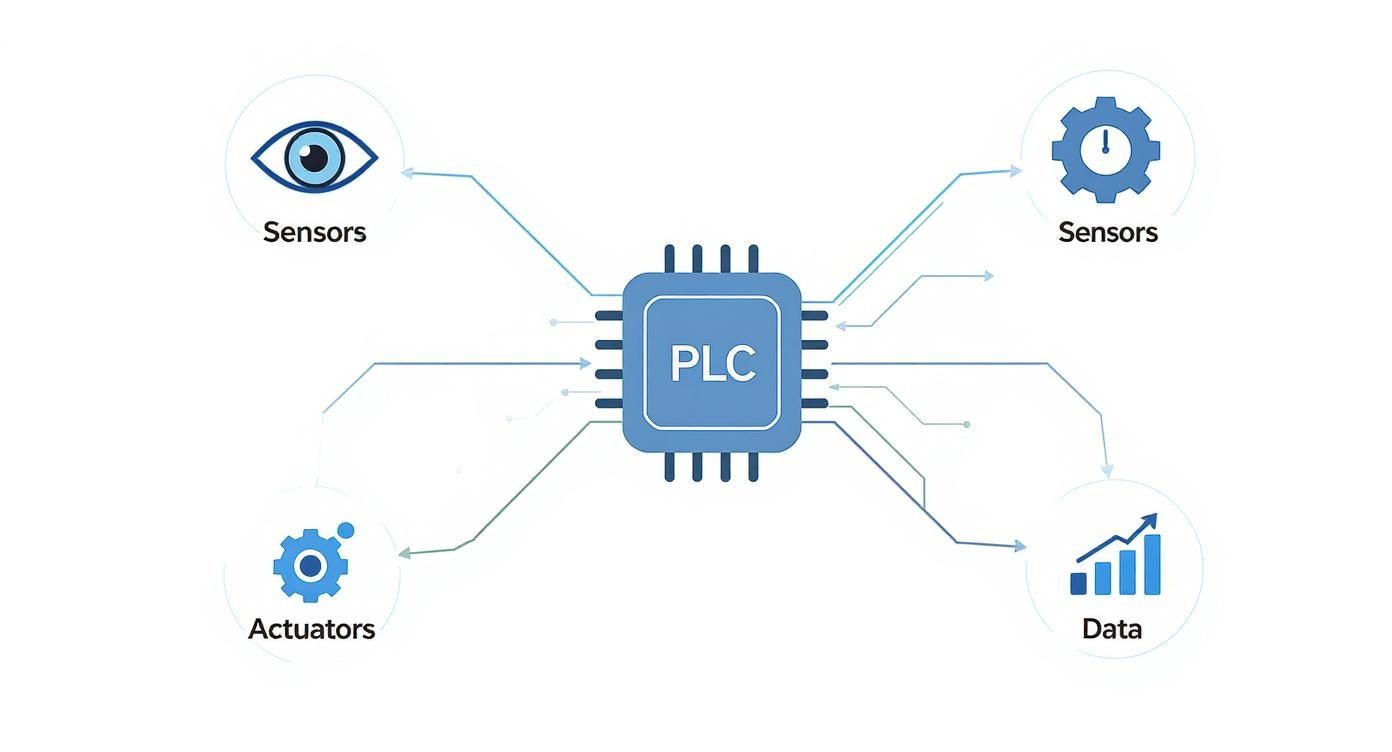
This whole system runs on a simple, continuous loop. Sensors act as the eyes and ears, gathering real-time data on things like temperature, pressure, or position. That information gets sent to the "brain"—usually a Programmable Logic Controller (PLC)—which makes split-second decisions based on its programming. From there, actuators like motors, valves, and grippers act as the "muscles," carrying out those commands with perfect accuracy.
The Driving Force Behind Modern Production
Let's be clear: adopting industrial controls automation isn't just a trend. It's a fundamental shift in how things get made. The main goal is to take human inconsistency out of the equation for repetitive tasks, paving the way for operational excellence.
This explosive growth is happening for one reason: automation delivers tangible, bottom-line results across every sector you can imagine, from car manufacturing to food and beverage packaging.
The real objective of industrial controls automation is simple: to create systems that are more efficient, safer, and more reliable than any manual process could ever be. It’s about achieving predictability in a complex environment.
Core Goals and Business Impact
At the end of the day, any decision to automate is tied directly to clear business goals. While the technology itself can get complex, the reasons for using it are refreshingly straightforward—it’s all about improving the bottom line and making operations more stable.
The table below breaks down the primary objectives that drive automation projects.
Objective
Description
Example Impact
Boost Efficiency & Throughput
Automating processes allows machinery to run faster and longer than humanly possible, often 24/7.
A packaging line that once produced 100 units per hour can now produce 300 with the same footprint.
Improve Product Quality
Automation eliminates human error from assembly and processing, ensuring every product meets exact specifications.
Defect rates in a CNC machining process drop from 3% to less than 0.1%, drastically reducing material waste.
Enhance Workplace Safety
Dangerous, repetitive, or strenuous tasks are handed over to machines, moving people out of harm's way.
Robotic welding cells eliminate worker exposure to harmful fumes, intense light, and high temperatures.
Reduce Operational Costs
Automation cuts long-term costs related to manual labor, rework, material waste, and downtime from errors.
A facility saves thousands per year by automating palletizing, reducing labor costs and injury-related expenses.
Ultimately, a well-implemented automation system is what allows a manufacturer to truly compete. It provides the tools needed to produce high-quality goods quickly, safely, and cost-effectively, which is the name of the game in today's global market.
The Building Blocks of a Control System
At its heart, an industrial control system is a lot like the human body. It has distinct parts that all work in harmony to pull off some pretty complex tasks. To really get a handle on industrial controls automation, you first need to know the core components—the actual hardware that senses what's happening, makes decisions, and then acts with incredible precision.
Picture a modern bottling plant. You’ve got thousands of bottles zipping down a conveyor, getting filled, capped, and labeled, all without a single person laying hands on them. This high-speed choreography is only possible because every piece of the automation puzzle knows exactly what it's supposed to do and when.
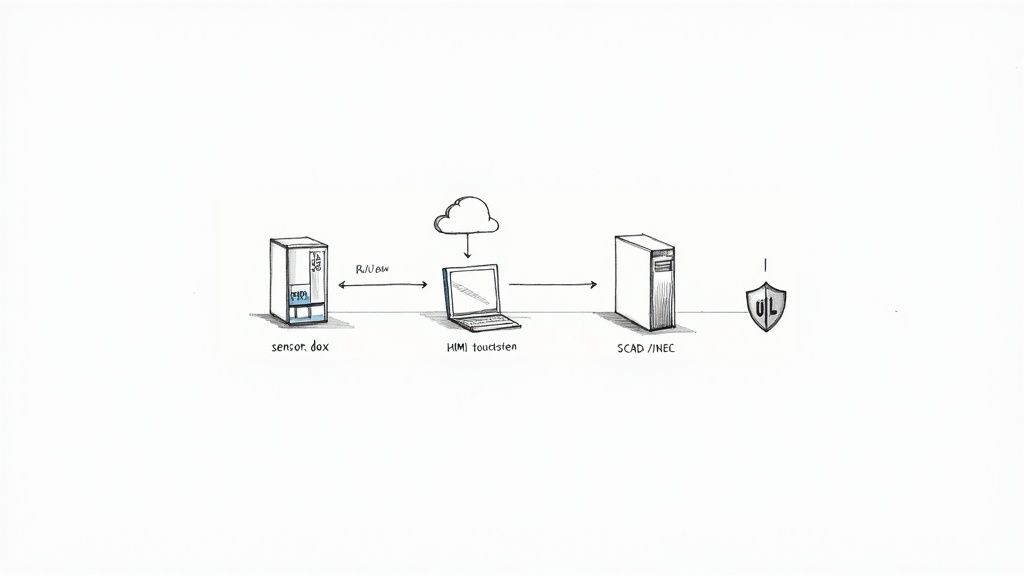
This diagram shows how the system's "brain" connects to its "senses" and "muscles."
As you can see, the PLC is the central hub. It's constantly crunching data from sensors to tell actuators what to do, creating a non-stop feedback loop that keeps everything running smoothly.
The Senses of the System: Input Devices
Every automated action has to start with information. Input devices, which are mostly sensors, act as the "senses" of the machine. Their job is to detect what’s going on in the real world and translate those physical conditions into electrical signals the control system can understand.
You'll find all kinds of input devices on a factory floor:
Proximity Sensors: These guys detect if an object is present without actually touching it. Back in our bottling plant, a proximity sensor confirms a bottle is perfectly positioned before the filling nozzle even thinks about activating.
Photoelectric Sensors: Using a beam of light, these can spot objects, check for colors, or even read marks. One might be used to verify a cap is properly twisted onto a bottle before it gets sent down the line.
Temperature and Pressure Sensors: Absolutely vital for process control. In a pasteurization line, these sensors make sure the product hits and holds a specific temperature for just the right amount of time.
Level Sensors: These measure how much liquid or material is in a tank or silo, telling a pump when it's time to kick on or shut off.
Without accurate and reliable data from these devices, the whole system would be flying blind.
The Brain of the Operation: Controllers
If sensors are the senses, then the controller is definitely the brain. This is where all the logic lives. The controller grabs all the incoming signals from the input devices, runs them through its programmed instructions, and then fires off commands to the output devices.
The workhorse controller in most manufacturing is the Programmable Logic Controller (PLC). Think of a PLC as a super-tough industrial computer built to survive the heat, dust, and vibration of a factory. It runs its program in a continuous, lightning-fast loop, making it incredibly reliable for machine control. Everything from the conveyor speed to the exact fill volume is dictated by the PLC's logic. Our internal guide takes a closer look at proper industrial control panel design, where these critical brains are housed.
The Voice and Eyes: The Human-Machine Interface
Even though a system is automated, you still need a human in the loop. The Human-Machine Interface (HMI) is the operator's window into the whole process. It’s usually a touchscreen panel that shows real-time data, alarms, and production status in an easy-to-read graphical format.
An HMI translates complex machine data into actionable information. It allows an operator to monitor the process, adjust settings like production speed, and troubleshoot issues without needing to understand the underlying PLC code.
From the HMI in our bottling plant, an operator could see how many bottles have been filled, get an alert if a capper jams, or switch the entire line over to run a different bottle size with just a few taps.
The Muscles of the Machine: Output Devices
Okay, so a decision has been made. Now what? Something has to physically happen. That's where output devices, or actuators, come in. They are the "muscles" of the system, taking commands from the PLC and turning electrical energy into real-world motion.
A few key output devices include:
Electric Motors: The movers and shakers that power conveyors, pumps, and fans.
Valves: Solenoid valves open and close to control the flow of liquids or gases—like the one dispensing soda into each bottle.
Actuators: These are typically pneumatic or hydraulic cylinders that push, pull, lift, or clamp things. An actuator might be what presses the label onto a finished bottle.
Relays and Contactors: These are essentially heavy-duty switches. They take a small signal from the PLC and use it to turn on and off much bigger equipment, like high-power motors.
Tying all of this together is the system's communication layer. Having a robust network infrastructure is non-negotiable; it's what ensures all these components can talk to each other without a hitch. Together, these building blocks create a cohesive system where every part knows its job, turning simple inputs into complex, high-speed production.
Understanding Control System Architectures
Knowing the individual parts of a control system is one thing. Understanding how they work together as a team is where the real magic happens. The way you organize those parts is the system's architecture, and picking the right one is like setting a formation for a football team—it all comes down to the scale and complexity of the game you’re playing.
You wouldn't use a single, localized controller to manage a sprawling chemical plant, just like you wouldn’t have one quarterback try to run an entire league. The architecture determines how data flows, where decisions get made, and how resilient the whole operation is when things go wrong.
Getting this right is more critical than ever. The industrial automation control market is on track to hit around USD 160 billion by 2029, driven by a global push for smarter, more efficient systems. You can dig into the numbers and trends in this detailed industry analysis from Technavio.
The PLC-Based Approach: Centralized Control
The most direct and common setup is centralized control, usually built around a single Programmable Logic Controller (PLC). Think of it as a "one-machine, one-brain" system. It's the go-to choice for self-contained, discrete manufacturing tasks where everything is happening in one spot.
A few classic examples include:
A single packaging machine that forms, fills, and seals boxes in sequence.
A CNC milling machine laser-focused on executing a specific cutting program.
An automated welding robot on an assembly line, repeating the same welds all day.
In this setup, one PLC is the undisputed boss. It takes in all the sensor data, runs the logic, and fires off all the commands. It’s simple, cost-effective for smaller jobs, and a lot easier to troubleshoot because you know exactly where to look.
Centralized control is the workhorse of machine-level automation. It excels at high-speed, self-contained tasks where simplicity and responsiveness are paramount.
Distributed Control Systems (DCS) for Plant-Wide Processes
But what happens when your "machine" is an entire plant? When you need to control a whole process spread across a massive facility, a single brain just won't cut it. That's where a Distributed Control System (DCS) steps in.
Instead of one central controller, a DCS uses multiple controllers, or "brains," distributed throughout the plant. Each one is responsible for a specific part of the process.
Picture a large oil refinery. You have separate processes for cracking, distillation, and treatment, all happening at once but all needing to work in perfect harmony. A DCS puts a dedicated controller at each of these stages. These local controllers handle their own business while reporting back to a central supervisory system, making sure the entire plant operates like a single, well-oiled machine. This design is also incredibly reliable—if one controller goes down, the whole plant doesn't grind to a halt.
SCADA Systems: The Control Tower View
Now, let's zoom out even further. What if you need to monitor and control operations spread across different sites, or even an entire state? This is the domain of a Supervisory Control and Data Acquisition (SCADA) system.
Think of SCADA as the "air traffic control tower" for your industrial operations. It doesn't usually get bogged down in the millisecond-by-millisecond control logic; it leaves that to the PLCs and DCS controllers out in the field.
SCADA's job is to:
Gather data from all your remote equipment and sites.
Display that data on a central HMI for a human operator.
Let the operator issue high-level commands, like turning on a pump station fifty miles away.
SCADA is the backbone of our modern infrastructure—it runs everything from municipal water systems and electrical grids to oil and gas pipelines. It gives you the 30,000-foot view you need to manage assets that are miles apart.
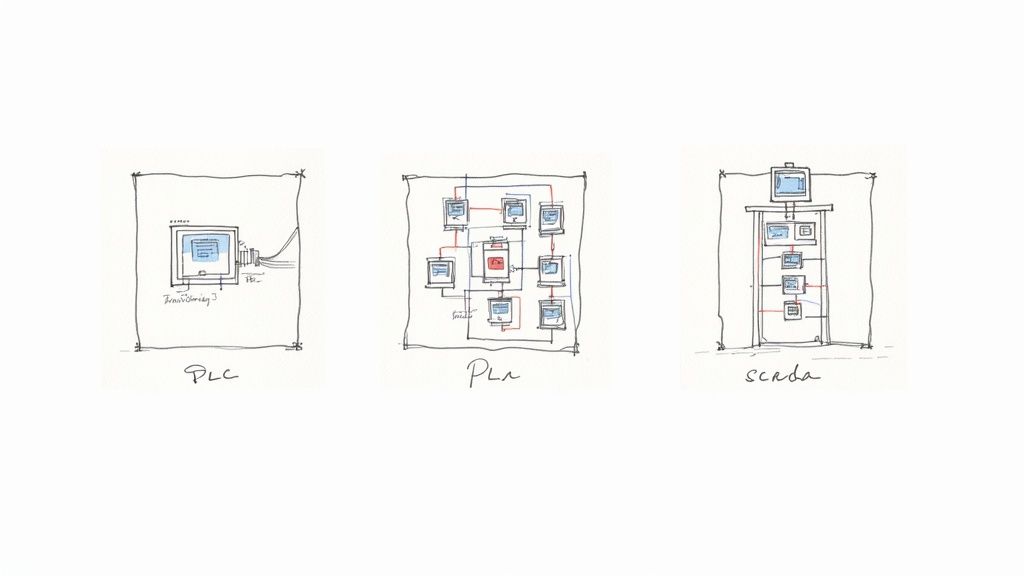
To make sense of these options, it helps to see them side-by-side. Each architecture is tailored for a specific type of job.
Control System Architectures Compared
Architecture Type
Best For
Key Feature
Typical Scale
PLC-Based (Centralized)
Discrete, high-speed, single-machine tasks.
A single, powerful controller manages a localized process.
Machine or work cell.
DCS (Distributed)
Complex, continuous processes across a single, large facility.
Multiple interconnected controllers, providing high reliability and redundancy.
Entire plant or large processing facility.
SCADA (Supervisory)
Monitoring and controlling geographically dispersed assets and facilities.
Centralized monitoring and high-level control over remote sites.
Multiple sites, region, or entire pipeline.
Ultimately, the goal is to match the architecture to the operational reality. A simple PLC is perfect for a single machine, a DCS is built for a complex plant, and SCADA is designed to give you command over a sprawling territory.
The Critical Role of Safety and Compliance
In industrial automation, it’s easy to get caught up in the drive for more speed and higher efficiency. But the real bedrock of any great control system isn’t how fast it runs—it’s how safe it is. Without a rock-solid commitment to safety standards and compliance, even the most sophisticated automation setup is just an accident waiting to happen.
This isn't just about ticking boxes for an inspector. It’s about protecting your people, your multi-million dollar equipment, and your entire operation from preventable disasters. You wouldn’t build a high-rise without following the building code to the letter, right? The exact same logic applies to industrial control panels. These standards are the collected wisdom of decades of engineering, specifically designed to prevent fires, electrical shocks, and catastrophic failures.
The Gold Standard: UL 508A
When we talk about control panel safety in North America, one name stands above the rest: UL 508A. This is the official standard for the construction of Industrial Control Panels. If you see a panel with the UL 508A Listed mark, it means it was designed and built to meet the tough safety requirements set by Underwriters Laboratories.
A UL 508A listing is far more than a simple sticker. It’s a third-party guarantee that the panel's design, components, and assembly meet strict safety and performance criteria. It gives inspectors, insurers, and the people on the floor total peace of mind.
This certification covers just about every part of the panel build, ensuring the final product is both safe and dependable. The standard gets very specific about:
Component Selection: It mandates using UL-recognized components that have already been tested for their intended use.
Wiring and Sizing: It lays out the exact rules for wire sizing, insulation types, and termination methods to stop overheating and electrical faults before they start.
Enclosure Integrity: It ensures the panel’s cabinet is correctly rated for its environment, protecting the sensitive electronics inside from dust, water, and corrosion.
Spacing and Layout: UL 508A dictates precise clearances between components to prevent dangerous short circuits and electrical arcing.
Following these rules isn’t optional. It’s how you build systems that don’t just work well, but are fundamentally safe.
A Complete Safety Framework
While UL 508A is the cornerstone for the panel itself, it doesn't exist in a vacuum. It’s part of a much larger ecosystem of codes and standards that govern the entire electrical installation.
The big one is the National Electrical Code (NEC), also known as NFPA 70. The NEC sets the ground rules for the safe installation of all electrical equipment and wiring in the U.S., from how conduit is run to how everything is properly grounded.
Another key piece of the puzzle is NFPA 79, the Electrical Standard for Industrial Machinery. This standard zeroes in on the electrical equipment of machines, making sure their control systems are safe for operators to work with day in and day out. Of course, you also have to think about power quality inside the panel. For example, knowing how a harmonic filter for VFD can stabilize the system is a crucial part of a truly comprehensive and safe design.
Together, these standards create a layered defense. Sticking to them isn't about navigating red tape; it's about building strong, reliable industrial automation systems that protect your most important assets—your people and your ability to produce.
A Practical Roadmap for Your Automation Project
Taking an industrial controls project from a bright idea on a whiteboard to a humming, productive system on your floor demands a clear, disciplined approach. You wouldn't build a house without a blueprint, a solid crew, and a final inspection, and automation is no different.
The journey is best navigated with a phased roadmap. This breaks the whole complex undertaking down into manageable chunks, each with its own goals and deliverables. It’s the secret to minimizing those costly surprises and keeping the project on track, on time, and on budget.
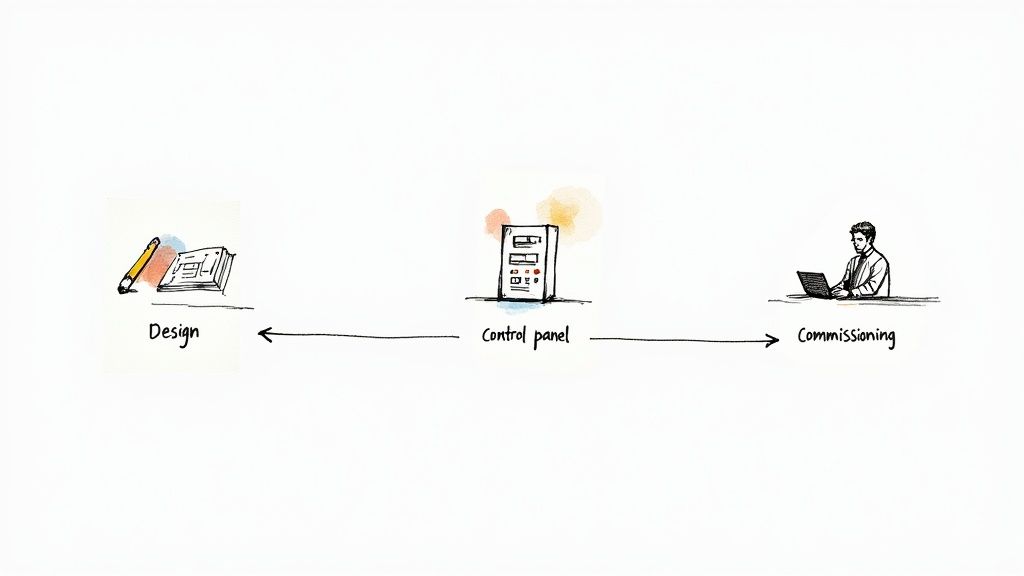
Phase 1: The Design and Engineering Stage
This is where it all begins, and honestly, it's the most critical part of the whole process. Getting the design right now saves a world of headaches and expensive changes later.
It all starts by getting crystal clear on the project's goals. What problem are we really trying to solve? Are we chasing higher throughput, tighter quality control, or a safer environment for our team?
Once the "why" is established, we get into the "how" with a detailed Functional Specification document. Think of this as the system's biography—it describes exactly how the system needs to operate, from every sequence and alarm to every button an operator will push. From there, engineers can draft the electrical schematics, the true blueprints of the control panel that map out every last component, wire, and connection.
Phase 2: The Build and Assembly Stage
With approved designs in hand, the project jumps from the screen to the shop floor. This is where skilled technicians take over, fabricating, wiring, and assembling the control panel. It's a game of precision where attention to detail is everything.
The build process typically looks like this:
Enclosure Layout: Components like PLCs, power supplies, and terminal blocks are physically placed inside the enclosure, ensuring everything fits while allowing for proper airflow and wiring paths.
Component Mounting: All the hardware gets securely bolted to the panel’s backplane, following the schematics to the letter.
Wiring and Termination: Technicians meticulously run every wire—cutting, labeling, and landing each one on the correct terminal. Following UL 508A standards here isn't optional; it's essential for a safe, compliant panel.
A well-built control panel is more than just functional; it's a work of art. Neat wire management, crystal-clear labels, and precise assembly aren't just for show—they make the panel far easier to troubleshoot and maintain for years to come.
Before the panel ever leaves the shop, it goes through a rigorous quality check to make sure the physical build perfectly matches the drawings.
Phase 3: The Commissioning and Startup Stage
This is the moment of truth when the system comes to life. Commissioning is the methodical process of testing and proving that every single part of the system works together as intended.
It often kicks off with a Factory Acceptance Test (FAT) right at the panel builder’s shop. This gives you, the client, a chance to see the panel powered up and test its core logic before it even ships—a massive risk-reduction step.
Once the FAT is signed off, the panel heads to your facility for installation. The commissioning team then gets to work:
I/O Checkout: Every sensor, switch, motor, and valve is checked, verifying the signal path from the field device all the way back to the PLC and out again.
Functional Testing: The system is put through its paces, running every operational sequence to confirm it behaves exactly as laid out in the functional spec.
Safety System Verification: All emergency stops, light curtains, and other safety circuits are tested relentlessly to ensure they perform flawlessly when it matters most.
The project wraps up with a Site Acceptance Test (SAT), where you formally sign off that the system meets every requirement. Pulling off these phases smoothly requires real-world experience, which is why partnering with the right team is so important. For more on what to look for, you can explore our guide on choosing an industrial automation system integrator.
Measuring the True Value of Your Investment
Any industrial controls automation project is a serious capital expense. Once the dust settles, you've got to prove it was worth every penny, especially if you want to secure funding for the next big thing.
This isn't just about ticking a box. It's about turning a necessary expenditure into a powerful competitive advantage by showing clear financial and operational wins. The trick is to measure what actually matters and translate those shop-floor improvements into the language everyone in the C-suite understands: money.
Beyond the Price Tag: Calculating True ROI
The most straightforward way to justify the project is to calculate the Return on Investment (ROI). But a common mistake is only comparing the upfront cost to direct labor savings. A real ROI calculation for automation goes much deeper, accounting for a whole range of benefits that hit the bottom line.
To build a compelling business case, you need to track the specific Key Performance Indicators (KPIs) that your new automation system directly impacts. This hard data moves the conversation away from "cost" and firmly into "investment" territory.
Here are the big ones to watch:
Increased Throughput: How many more widgets are you making per hour or per shift? It's the cleanest measure of a productivity boost.
Reduced Material Waste: Precision automation means fewer mistakes and less scrap. Tracking this reduction is a direct line to cost savings.
Decreased Downtime: How much less time are you spending on unplanned shutdowns? Every minute a line is down, money is walking out the door.
Improved Quality: Look at the drop in product rejection rates or customer returns. Better quality means fewer costly recalls and warranty headaches.
The Gold Standard: Overall Equipment Effectiveness (OEE)
If you want one single metric that tells the whole story, it's Overall Equipment Effectiveness (OEE). OEE is the gold standard for measuring manufacturing productivity because it rolls three critical factors into one clean score, giving you a powerful, holistic view of your operation's health.
OEE essentially measures how much of your planned production time is genuinely productive. A world-class OEE score is 85% or higher, but honestly, many facilities start much lower. That just means there's a massive opportunity for improvement with automation.
OEE is calculated by multiplying three core components:
Availability: This tracks any event that stops planned production—think equipment failures or material shortages. An Availability score of 100% means the process ran without any stop-loss during its planned time.
Performance: This accounts for anything that makes the process run slower than its theoretical top speed, like micro-stops or reduced-speed cycles. A 100% Performance score means you're running as fast as theoretically possible.
Quality: This one's simple—it tracks defective parts, including those that need to be reworked. A 100% Quality score means you're producing nothing but good parts.
By tracking your OEE score before and after the automation project goes live, you create an undeniable, data-driven narrative of success. It transforms the value of industrial controls from an abstract idea into a concrete, measurable business achievement.
Got Questions About Industrial Controls? We’ve Got Answers.
Diving into industrial controls automation can feel like learning a new language. You’ve got the big picture, but the devil is always in the details. Let's tackle some of the most common questions that come up when people are moving from theory to the factory floor.
Core Technology and Project Timelines
What’s the real difference between a PLC and a DCS?
It's a classic question. Think of it like this: a PLC (Programmable Logic Controller) is a highly specialized sprinter. It’s built for one primary job—controlling a specific machine or a small, self-contained process with lightning-fast reflexes and rock-solid reliability.
A DCS (Distributed Control System), on the other hand, is the plant’s quarterback. It’s designed to see the whole field, managing and coordinating large, sprawling, continuous processes. A DCS brings all the individual plays together into one unified, plant-wide strategy.
How long does an industrial automation project actually take?
That's the million-dollar question, and the honest answer is: it depends entirely on the scope. A straightforward control panel for a single machine? We could be looking at just a few weeks from design to commissioning.
But if you're talking about a full-scale system integration across your entire facility, you’re in for a longer haul. These projects can easily take many months, sometimes even over a year, once you factor in equipment lead times, custom software development, and the crucial design and engineering phase.
The bottom line: Project timelines are a direct reflection of complexity. Small, well-defined jobs are quick wins. Large, multi-system integrations are a marathon, not a sprint, requiring a detailed roadmap from day one.
Compliance and Modernization
Why is everyone so insistent on a UL-listed control panel?
It’s all about safety and accountability. A UL-listed control panel isn't just a fancy sticker; it's your proof that the panel has been built to meet rigorous safety standards tested by an objective third party, Underwriters Laboratories.
This certification is your ticket to passing inspections, satisfying insurance requirements, and protecting your people and equipment from fire and electrical hazards. In most places, it's not a "nice-to-have"—it's a non-negotiable requirement.
Can I actually put modern controls on my old machinery?
Absolutely, and it’s one of the smartest moves you can make. This is called a retrofit, and it's a super common and cost-effective way to modernize.
We see it all the time: a machine is mechanically sound—the "bones" are good—but the controls are from a different era. By swapping out the old relays and timers for modern PLCs, HMIs, and sensors, you get all the benefits of automation—better data, higher efficiency, improved safety—without the massive capital expense of buying a brand-new machine. The first step is always a deep-dive assessment of the existing equipment to build a solid game plan.
Turning these concepts into a reliable, high-performing system takes a partner who knows both the parts and the process inside and out. At E & I Sales, we deliver complete integration services, from custom UL control panel design to full system commissioning, making sure your project is built right, fully compliant, and ready to perform.
An industrial automation system integrator is the essential bridge between your collection of complex machinery and a smooth, cohesive operation. Think of them as the conductor of an industrial orchestra. They make sure every separate piece of equipment—from motors and sensors to software and HMIs—works together in perfect harmony to hit your production targets.
Your Partner in Manufacturing Modernization
So many modern facilities share the same headache: a plant full of high-performing machines that just don't talk to each other. You might have a cutting-edge filler from one vendor, a capper from another, and a palletizer from a third. Individually, they're great. But together? They create bottlenecks, inefficiencies, and huge operational blind spots because they operate in isolation.
This is exactly where an industrial automation system integrator comes in. Their whole job is to bridge those gaps. They design and implement a unified control system that makes the entire production line function as a single, intelligent unit. They aren't just selling you equipment; they are strategic partners who diagnose deep-seated problems, engineer real-world solutions, and see complex projects through from concept to commissioning.
To get a clearer picture, here’s a quick breakdown of what a system integrator really does.
The System Integrator Role At a Glance
Core Function
Typical Clients
Primary Benefits
Design, build, and deploy unified automation and control systems.
Integrate new equipment with existing legacy machinery.
OEMs & Equipment Packagers
Faster project timelines, guaranteed system performance.
Provide specialized skills in PLC/SCADA, robotics, and electrical engineering.
Facilities with limited in-house expertise.
Access to expert knowledge without hiring full-time staff.
This table just scratches the surface, but it highlights how integrators solve tangible business problems, not just technical ones.
From Disconnected Parts to a Unified Whole
The real value of an integrator is their ability to turn operational chaos into a streamlined, data-driven process. They blend electrical engineering, software development, and—most importantly—deep industry knowledge to make your factory smarter, faster, and more reliable.
A truly qualified partner takes full ownership of making all these disparate systems play nicely together. Their work is a direct answer to the most common pain points for plant managers, engineers, and OEMs.
What does this look like in practice? An integration project usually focuses on a few key goals:
Boosting Throughput: By syncing up machine speeds and killing bottlenecks, integrators help you get more product out the door with the exact same assets.
Slashing Unplanned Downtime: A unified system gives you far better diagnostics, letting maintenance crews find and fix issues in minutes, not hours.
Improving Product Quality: Real automation means consistent, repeatable processes. This drastically cuts down on human error and keeps your product within spec.
Enhancing Safety: Properly integrated systems are built with safety from the ground up, incorporating features like light curtains and E-stops that actually protect your people.
An integrator's job is to see the entire factory floor not as a series of individual tasks, but as one interconnected ecosystem. Their expertise lies in creating the 'nervous system' that allows every component to communicate and react in real-time.
The True Scope of an Integrator
At the end of the day, bringing in an industrial automation system integrator is an investment in operational excellence. They bring the highly specialized skills needed to handle everything from fabricating a UL-listed control panel to writing complex PLC and SCADA programs.
This guide will walk you through what these experts do, the services they offer, and how you can select the right partner to truly modernize your facility. By the time you're done, you’ll see why an integrator is an indispensable asset for any company that's serious about improving productivity and staying competitive.
So, What Does a Turnkey System Integrator Actually Do?
If a system integrator is the "conductor" of your factory's orchestra, what are they actually doing with the baton? Their role goes way beyond just drawing up plans. A true turnkey partner gets their hands dirty, providing a whole range of services to take a concept and turn it into a living, breathing, reliable system.
Think of them as the master electrician and programmer for your plant's central nervous system. They don't just sketch the blueprints; they're the ones sourcing the right components, running the "nerves" and "muscles," and making absolutely sure every signal gets where it needs to go—safely and without fail.
It's no surprise that demand for these skills is exploding. The system integration market hit $46.469 billion in 2021 and is projected to reach $57.49 billion by 2025. That growth, tracked by firms like Cognitive Market Research, is coming from every corner of industry, from energy production to CPG packaging.
Designing and Building UL-Listed Control Panels
The heart of any modern automated system is the industrial control panel. This isn't just a generic grey box full of wires. It’s the physical brain of the entire operation, housing the sensitive PLCs, drives, and relays that make everything happen. A top-tier integrator doesn't just design these panels—they build them from scratch in their own UL-listed panel shop.
Why is that UL sticker so critical?
It’s a Safety Guarantee: A UL 508A certification is proof that the panel was built to strict, third-party safety standards. It’s about protecting your people and your multi-million dollar equipment.
It's Your Ticket Past Inspection: UL-listed panels are designed to meet the National Electrical Code (NEC) and other local rules. This is non-negotiable for passing inspections and keeping your insurance provider happy.
It’s Built to Last: The UL standard is incredibly detailed, covering everything from how far apart components must be to the right gauge of wire for a specific load. The result is a rock-solid panel that can handle the heat, vibration, and dust of a real industrial floor.
Frankly, a control panel without a UL listing is a massive liability. When an integrator delivers a UL-listed panel, they’re giving you a product that’s certified safe, compliant, and built for the long haul.
A UL-listed control panel is your assurance that the system's core has been professionally engineered and fabricated to the industry's highest safety and quality benchmarks. It’s a non-negotiable mark of a credible integrator.
Mastering PLC and SCADA Integration
Once the physical hardware is in place, the integrator brings it all to life with code. This is where Programmable Logic Controllers (PLCs) and Supervisory Control and Data Acquisition (SCADA) systems enter the picture.
If the control panel is the brain, think of PLCs as the reflexes. These are small, rugged computers built to survive on the factory floor. The integrator writes the custom logic that tells a motor when to spin up, a valve when to open, or a robotic arm precisely where to move—all in milliseconds.
SCADA software is the "big picture" view—the consciousness of the whole operation. It pulls data from all the individual PLCs and puts it onto a single, intuitive dashboard, often called a Human-Machine Interface (HMI).
Together, they create a complete nervous system for your plant.
Sensors (the nerves) grab data from the equipment.
PLCs (the spinal cord) process the data instantly and fire off commands.
SCADA/HMI (the conscious mind) gives your operators a bird's-eye view, letting them monitor performance and make smart decisions.
An experienced integrator is an expert at weaving these elements together seamlessly. They give you the power to see and control your entire production line from one screen.
Engineering Motor Control and Power Systems
Motors are the muscles of your operation. They drive the pumps, fans, conveyors, and mixers that do the actual work. A system integrator is responsible for designing and building the Motor Control Centers (MCCs) that safely power and control all of it.
This is a lot more than just hooking up wires. The job includes:
Calculating Electrical Loads: Making sure the power system can handle the demand from every motor without tripping breakers or causing brownouts.
Integrating VFDs: Installing Variable Frequency Drives (VFDs) to fine-tune motor speed. This not only gives you better process control but can also slash your energy bills.
Designing Safety Interlocks: Wiring the motor controls directly into the plant’s safety systems, like e-stops, to protect your team.
Getting the motor control and power distribution right is fundamental to keeping your plant running efficiently and reliably for years to come.
Final Commissioning and System Handover
The final, and arguably most important, step is commissioning. This is where theory meets reality. The integrator's team comes on-site to fire up the entire system and put it through its paces in your actual facility. It's the full-dress rehearsal before opening night.
During commissioning, the integration team is busy:
Verifying every single wire is landed in the right place.
Testing every line of PLC code under real conditions.
Calibrating sensors and instruments for pinpoint accuracy.
Simulating every possible failure to ensure safety systems work perfectly.
Training your operators and maintenance crew until they're confident running the new system.
This exhaustive process ensures that when you finally flip the switch to "go-live," the system just works. A true turnkey integrator doesn't just drop off a bunch of hardware and a binder; they deliver a fully tested, documented, and running solution that sets your team up for success.
Mapping the Automation Project Journey
Bringing an industrial automation project to life is so much more than just buying some new equipment. It’s a carefully managed journey from a high-level goal to a fully operational system that actually drives value. An experienced system integrator is your guide through this entire process, making sure every single step is handled with precision.
You can think of the project lifecycle in four distinct phases. Each stage builds on the one before it, turning a simple idea into a real-world competitive advantage. Understanding this flow shows you why an integrator is a strategic partner, not just another vendor.
Phase 1: Discovery and Design
It all starts with a deep dive into your operation. In the Discovery and Design phase, the integrator acts more like a consultant than an engineer. The main goal here is to get a rock-solid understanding of your unique challenges, your business goals, and the specific pain points you're trying to solve.
They'll be asking the tough questions to truly define the project's scope:
What's the exact inefficiency we're tackling here?
How will we measure success? What are the key performance indicators (KPIs)?
How does this new system need to play with the legacy equipment already on the floor?
This back-and-forth results in a comprehensive Functional Specification document. This isn't a simple quote; it's the master blueprint. It lays out exactly how the system will work, what it will do, and how everyone will know it’s a success, preventing costly headaches and scope creep down the road.
Phase 2: Engineering and Development
With a clear roadmap in hand, the project moves into the Engineering and Development phase. This is where the big ideas get translated into technical reality. The integrator’s electrical engineers and software developers roll up their sleeves and turn the functional spec into detailed designs.
This is where the heavy lifting happens:
Creating Electrical Schematics: These are the detailed drawings for control panels, power distribution, and all the field wiring. They're the foundation of the physical build.
Developing PLC and HMI Logic: Programmers get to work writing the custom code that will actually run the machines and creating the intuitive screens your operators will use every day.
Procuring Hardware: Key components with long lead times—like PLCs, drives, and specialized sensors—are ordered early to keep the project timeline on track.
This phase is the technical heart of the project. Meticulous engineering here ensures the final system is not only functional but also safe, compliant, and maintainable for years to come.
Phase 3: Implementation and Installation
Now, the project jumps off the screen and into the real world. During the Implementation and Installation phase, the system gets built, assembled, and ready for deployment. For any quality integrator, a huge chunk of this work happens off-site in their own shop.
UL-listed control panels are built in a controlled environment, which means higher quality and strict adherence to safety standards. The core logic is often tested on simulators long before it hits your floor—a smart move that can slash on-site startup time by as much as 30%. Once the pre-built components arrive, the on-site work of running conduit, pulling wire, and mounting hardware can begin with minimal disruption to your daily operations.
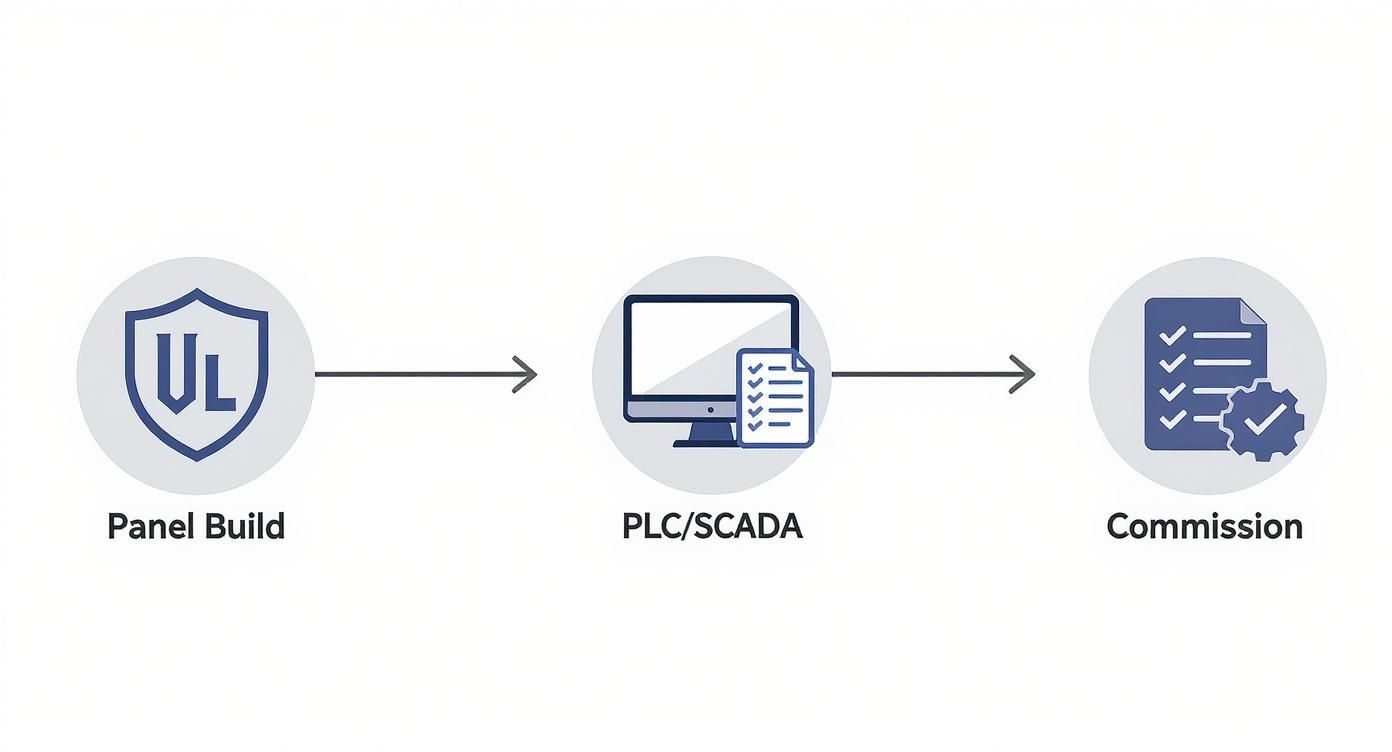
This visual shows how an integrator’s core services flow from the panel build to PLC/SCADA integration and final commissioning.
This structured workflow really shows how each step logically builds on the last, ensuring a smooth handoff from building the hardware to deploying the software and validating the whole system.
Phase 4: Commissioning and Support
This is the moment of truth. In the final Commissioning and Support phase, the system comes to life. The integrator’s field engineers are on-site to power everything up, test every function in a real-world setting, and fine-tune its performance. They methodically check every single input and output—from the tiniest sensor to the main motor starter—to make sure it works exactly as designed.
This process ends with the official "go-live," but the partnership doesn't stop there. A good integrator provides thorough documentation, hands-on training for your operators and maintenance crew, and a clear plan for ongoing support. After all, guiding a project to completion requires strong management. You can explore the core IT project manager's responsibilities to see how those same principles ensure a project’s long-term success. This final handover ensures your team is ready to take ownership and run the new system with confidence from day one.
Getting into the Weeds: Technical Designs and Compliance
To really get what an industrial automation system integrator brings to the table, it helps to peek under the hood at the technical backbone of a modern automated system. You don’t need an engineering degree, but understanding the basic architecture shows you how a bunch of disconnected machines becomes one smart, cohesive operation.
It’s all about creating a conversation between different pieces of hardware and software. Every component has a job, and the integrator is the translator making sure they all speak the same language. This builds a powerful feedback loop where machines can report their status, take new orders, and adapt on the fly.
The Basic Architecture of an Automated System
The best way to think about the system is a pyramid. At the bottom, you have the devices actually touching your product. As you move up, you get to the software that gives you the 30,000-foot view of the entire plant.
Here’s a quick tour of the key layers, from the ground up:
Field Level: This is where the action happens. It’s home to sensors (like photo-eyes or temperature probes) and actuators (motors, valves, and solenoids). The sensors are the system's eyes and ears, and the actuators are its hands and feet.
Control Level: Here you’ll find the Programmable Logic Controller (PLC). This is the local brain, taking signals from the sensors and using its programming to tell the actuators what to do. It’s making the split-second decisions that keep everything moving.
Supervisory Level: This is the command center, featuring Human-Machine Interfaces (HMIs) and SCADA systems. An HMI is the touchscreen an operator uses to interact with one machine, while SCADA gives you a central dashboard to monitor and control the whole facility.
This layered setup is the blueprint for modern manufacturing. A good integrator architects this entire data flow, making sure a single signal from a tiny sensor can eventually inform a huge business decision about plant efficiency.
It’s no surprise that the pros who can design these systems are in high demand. The market hit around USD 23.61 billion recently and is on track to reach USD 34.17 billion by 2035, according to Market Research Future. That growth is fueled by one thing: the relentless need for greater efficiency.
The Unbreakable Rules of Compliance
While a clever technical design is fantastic, it’s all built on a foundation of safety and compliance that you simply cannot ignore. These aren't just "best practices"—they're rigid codes that guarantee the system is safe, reliable, and won't cause problems down the road. For any integrator worth their salt, compliance is baked in from the very first drawing.
In North America, two of the big ones are UL 508A and the National Electrical Code (NEC).
UL 508A: This is the gold standard for Industrial Control Panels. A UL-certified shop has proven they can build panels that meet intense safety requirements for everything from component choice to wiring methods. That UL sticker is your proof of quality and a must-have to pass inspections.
National Electrical Code (NEC): The NEC is the rulebook for safe electrical installations in the U.S. An integrator has to know it inside and out to make sure every wire, conduit, and connection is done right, preventing fires and other electrical hazards.
Following these codes is about so much more than just ticking a box. It's about protecting your people, your equipment, and your investment. An experienced integrator designs every piece of the project—from the schematics to the final wire pull—with these standards front and center. For a closer look at what goes into it, check out our guide on industrial control panel design. This obsession with compliance is what separates the real pros from the rest.
How Integration Delivers Real-World ROI
Sure, technical drawings and project plans are important. But the real test of any automation project is its impact on your bottom line. A good industrial automation system integrator delivers more than just a functioning system; they deliver real business results you can see in higher throughput, fewer product defects, and a dramatic drop in unplanned downtime.
Let's move past the theory and look at what this means on the ground. The following examples show how a smart integration partner can turn a nagging operational headache into a serious competitive advantage. These aren't just stories about technical upgrades—they're stories about business transformation.
Case Study: OEM Control System Standardization
A mid-sized Original Equipment Manufacturer (OEM) that builds packaging machinery was hitting a wall. Each machine they built had a slightly different control system, often customized for a specific client. This was creating a logistical nightmare, slowing down production and making field service a slow, painful process.
They needed to standardize their control architecture across their entire product line. To get it done right, they brought in an experienced system integrator.
The solution broke down into a few key moves:
Platform Selection: First, the integrator guided the OEM in choosing a single, scalable PLC and HMI platform that could be adapted for every machine model.
Modular Code Development: Next, they built a library of modular, reusable PLC code. Instead of programming from scratch every time, engineers could now pull from proven code blocks, which cut development time by over 40%.
UL-Listed Panel Design: Finally, they engineered a standardized, UL-listed control panel. This ensured consistency, simplified manufacturing, and guaranteed safety and compliance for every single unit that shipped.
By teaming up with an integrator, the OEM completely changed how they operated. They now deploy new machines faster, give customers better support, and keep a much smaller, more manageable inventory of spare parts. It was a strategic shift that directly fueled their profitability and strengthened their position in the market.
Case Study: Manufacturing Plant Downtime Reduction
A food and beverage plant was dealing with constant, unpredictable production stoppages. Their control systems were a mess—a patchwork of old equipment from different vendors that gave them zero central visibility. When a machine failed, maintenance crews were basically flying blind, often burning hours just trying to find the root of the problem.
The mission was clear: get real-time insight into the production line to slash unplanned downtime and boost their Overall Equipment Effectiveness (OEE). The plant partnered with an integrator to design and roll out a modern SCADA system.
The new SCADA system became the single source of truth for the entire plant. It pulled data from every machine, giving operators and managers an intuitive, real-time dashboard of the facility's health.
The results were immediate. With clear diagnostics and historical data at their fingertips, the maintenance team could pinpoint issues in minutes, not hours. This proactive approach led to a 20% reduction in unplanned downtime in just the first six months.
The added visibility also opened the door to new energy efficiency gains, a topic we dive into in our article on VFD energy savings. This push for smarter integration is happening globally. In fact, the International Federation of Robotics reported that Asia installed over 404,578 industrial robots in a single year, a 5% increase. This highlights the intense demand for integrated systems that boost productivity. You can find more market insights like this on Research Nester.
How to Pick the Right Automation Partner for Your Plant
Choosing an industrial automation system integrator is probably the single most important decision you'll make for any automation project. Get it right, and you're set up for long-term reliability and efficiency. Get it wrong, and you're in for a world of headaches. This choice goes way beyond just picking the lowest bid; it's about finding a true partner who gets what you're trying to accomplish.
A good selection process takes the guesswork out of the equation. It starts with putting together a detailed Request for Proposal (RFP). This document isn't just a formality—it's your chance to clearly lay out the project scope, technical specs, and what success looks like for your business. A solid RFP forces potential integrators to show they've actually listened and have the chops to deliver.
What to Look for in a Top-Tier Integrator
As the proposals start coming in, you need to know what separates the great from the good. A strong partner will shine across the board, showing they have both the technical skills and the business sense to see your project through.
Here are a few things that should be non-negotiable:
Real Technical Expertise: Do they have their own, in-house UL-certified panel shop? This is a huge tell. It shows a deep commitment to quality and safety standards, not just outsourcing the critical stuff. You also need to confirm their experience with the specific PLC, SCADA, and motor control brands you already have on your floor.
Proven Industry Experience: An integrator who's already tackled problems in your world—whether it's high-speed packaging, municipal water treatment, or food and beverage—will hit the ground running. They already know the unique challenges, compliance hoops, and operational pressures you face every day.
A Clear Project Management Playbook: How do they handle the inevitable scope change? What does their communication rhythm look like? You want a partner with a documented process who keeps you in the loop from kickoff to commissioning, not one who goes dark for weeks at a time.
The whole reason you're even considering automation is to gain a competitive edge through better efficiency, lower costs, and smarter operations. For a broader look at what's possible, it's worth exploring the benefits of automation in business.
Asking the Questions That Matter
Once you've narrowed it down to a shortlist, it's time to get them in a room (or on a call) and dig deeper. This is your chance to move past the sales pitch and see how they really operate.
Here are a few questions that cut right to the chase:
"Walk me through your commissioning process and what your support looks like after you're gone." This tells you everything about their commitment to a smooth handover. A great partner doesn't just flip a switch and leave; they provide thorough training and have a clear plan for long-term support.
"Tell me about a project where you had to tie new equipment into a client's ancient legacy system." This is where the rubber meets the road. Almost every plant is a mix of old and new, and you need an integrator who has real-world experience making it all play nice together.
"How do you handle documentation, from electrical schematics to the PLC code?" Clear, well-commented documentation is gold for your maintenance team. If they can't easily understand how the system works long after the integrator has left, you're setting them up for failure.
System Integrator Evaluation Checklist
To make this process more concrete, use a simple scorecard. It helps you compare your top candidates side-by-side and keep the decision objective.
Evaluation Criterion
Integrator A
Integrator B
Integrator C
In-House UL-508A Panel Shop
Relevant Industry Case Studies
Experience with Your Control Platforms
Clear Project Management Process
In-House Commissioning Team
Post-Project Support Plan
Quality of Documentation
This simple tool ensures you're weighing each potential partner against the same critical factors, leading to a much more confident decision.
At the end of the day, picking the right industrial automation system integrator is about finding a team you can trust to wrestle with complexity and deliver a rock-solid solution. By starting with a structured RFP and asking tough, insightful questions, you can confidently find a partner that aligns with both your technical needs and your business goals. When you're ready to find a team that pairs UL-certified fabrication with true turnkey support, digging into their specific https://eandisales.com/products/system-integration/ is the right next move.
Common Questions About System Integration
Diving into an automation project always brings up a few big, practical questions. Getting straight answers is the only way to move forward with any real confidence. Let's tackle some of the most common things we hear about cost, timelines, and dealing with older equipment.
What’s the Real Cost and Timeline?
There’s no "one-size-fits-all" answer here, which is why a trustworthy integrator will never give you a price over the phone. A simple PLC upgrade on a single machine might wrap up in a few weeks for a few thousand dollars. A full-blown plant integration, on the other hand, could be a multi-million dollar investment that spans a year or more.
A real partner starts by digging deep to understand exactly what you need to accomplish—what we call the discovery phase. Only then can they build a detailed proposal that breaks down the costs and lays out a project schedule that actually makes sense.
You'll always see costs coming from four main areas:
Hardware: The physical gear, like PLCs, drives, sensors, and control panels.
Software Development: The hours spent programming your PLC, SCADA, and HMI systems to do the work.
Engineering: The time it takes for design, creating schematics, and managing the project from start to finish.
Commissioning: The on-site hours for installation, testing everything, and training your team.
How Do You Integrate New Systems with Our Old Equipment?
This is where an experienced integrator really earns their keep. For most plant managers, the last thing they want is a massive "rip and replace" project. The goal is always to bring in modern capabilities without throwing out perfectly good, reliable machinery.
It all starts with a detailed audit of your existing equipment. From there, we map out a phased integration plan designed to cause as little disruption to your production as possible.
We have a few proven strategies for bridging that technology gap. Sometimes it's a communication gateway that acts like a translator between old and new protocols. Other times, we retrofit older machines with modern controllers and sensors. This way, you keep the value of your legacy assets while adding powerful new tools for data collection and control.
The real art of integration is making new and old systems talk to each other flawlessly. It protects your original investment while giving you all the benefits of modern automation.
What Kind of Support Can We Expect After Go-Live?
A project isn’t a success until it's running smoothly long after we've left the building. A quality integrator shifts from being a builder to a long-term support partner. The handover should be seamless, leaving your team feeling confident and fully in control of the new system.
That means you get comprehensive documentation—electrical schematics, operational manuals, and well-commented PLC code. It also includes hands-on training for your operators and maintenance staff right on your floor.
Most importantly, there should be a clear Service Level Agreement (SLA) outlining what ongoing support looks like. This could include remote monitoring, on-call assistance for troubleshooting, and preventative maintenance plans to keep you running at peak performance for years to come.
Ready to modernize your operations with a partner who delivers from concept through commissioning? E & I Sales combines decades of motor expertise with UL-certified control packaging and true turnkey system integration. Learn how we can solve your toughest automation challenges at https://eandisales.com.