Ever tried to control your car's speed with just an on/off switch? Full throttle or nothing. It sounds absurd, but that’s exactly how most standard industrial motors operate when they're started directly across the line.
A variable speed drive (VSD) is the missing gas pedal for your electric motor. It gives you the precise control to run equipment only as fast as the job requires, and not a single RPM more.
Why Variable Speed Drives Are a Game-Changer
Walk onto any plant floor or into any municipal water facility, and you’ll find electric motors powering nearly everything. Traditionally, these workhorses are built to run at one constant, fixed speed. This direct-on-line (DOL) approach is simple and cheap upfront, but it’s brutally inefficient.
It's the equivalent of flooring the gas and then riding the brake to manage your speed—a colossal waste of energy that puts incredible strain on your machinery.
Variable speed drives were designed to fix this exact problem. Instead of running a motor at full blast and using mechanical brakes, valves, or dampers to choke the output, a VSD electronically fine-tunes the motor's speed to perfectly match the load's demand in real-time. It’s a simple idea with massive consequences for any industrial operation.
From Brute Force to Intelligent Control
The concept of matching motor speed to the load isn't some new fad. ABB introduced the first commercial drives back in 1969, fundamentally changing the world of motor control. This leap forward allowed common applications like pumps and fans to slash their power consumption by an incredible 50%. The shift gained even more traction with regulations like the US Energy Policy Act of 1992, which pushed for higher motor efficiency standards and made VSDs a go-to solution.
By moving on from the old "all or nothing" model, facilities gained a level of process control they'd never had before. This change translates directly into bottom-line results.
A variable speed drive is the vital link between a powerful motor and an efficient process. It ensures not a single watt of energy is wasted by tailoring the motor’s output to the exact demands of the job.
To put it in perspective, let's look at a direct comparison of the two approaches.
Fixed Speed Versus Variable Speed Motor Operation
This table breaks down the fundamental differences between a motor running at a fixed speed and one intelligently controlled by a VSD.
Aspect
Fixed-Speed Motor (Across-the-Line Start)
Motor with Variable Speed Drive
Speed Control
None. Runs at a single, constant speed determined by motor design.
Fully adjustable speed from near zero to full RPM.
Startup
Abrupt, high-inrush current jolts the system (hard start).
Always draws near-maximum power, regardless of the actual load.
Power draw is proportional to the work being done; significant savings at reduced speeds.
Mechanical Stress
High stress on couplings, belts, gears, and motor windings during startup.
Minimal stress, as torque and current are gradually applied.
Process Control
Crude. Requires mechanical throttling (valves, dampers) to control output.
Precise. Speed is adjusted electronically for exact flow, pressure, or tension.
Stopping
Coasts to a stop or requires a mechanical brake.
Controlled deceleration, dynamic braking, or regenerative braking.
The takeaway is clear: moving to VSDs isn't just an upgrade, it's a completely different philosophy of motor control—one focused on precision and efficiency rather than brute force.
The Real-World Benefits Driving VSD Adoption
The case for switching to variable speed drives is built on three practical pillars that solve major headaches for plant engineers, managers, and anyone holding a budget.
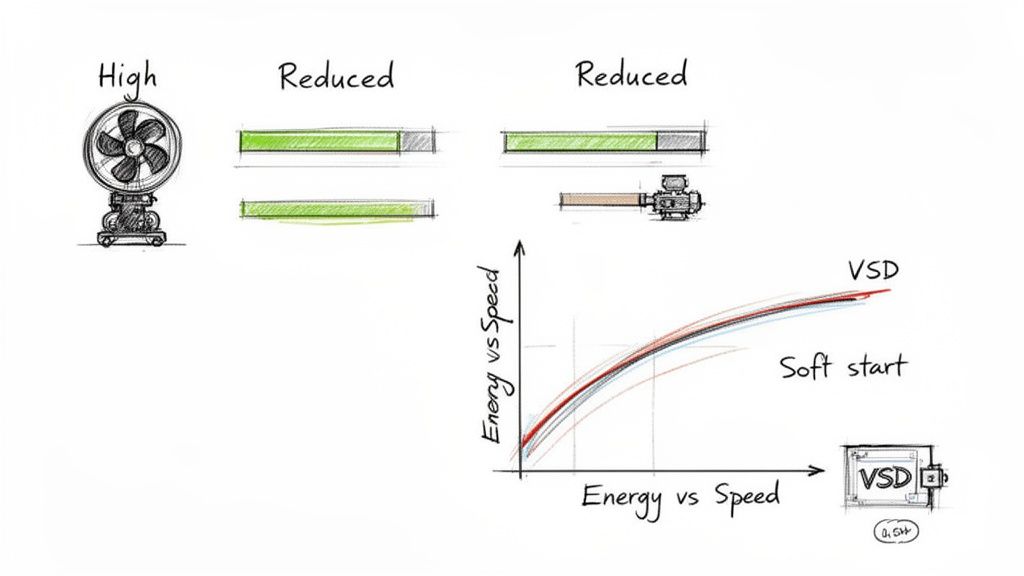
Massive Energy Savings: By modulating motor speed, VSDs slash electricity use. This is especially true for variable torque loads like pumps and fans, where a small 20% reduction in speed can cut energy consumption by nearly 50%.
Longer Equipment Life: A VSD acts as a soft starter, gently ramping up a motor instead of hitting it with a massive electrical and mechanical shock. This dramatically reduces wear on belts, gears, couplings, and the motor itself, extending its operational life and cutting down on maintenance calls.
Pinpoint Process Accuracy: Precise speed control means a better, more consistent end product. Whether you're maintaining exact pressure in a pipeline, managing material flow on a conveyor, or balancing airflow in a large HVAC system, VSDs deliver a level of control that mechanical methods simply can't match.
Understanding VSD Types And Control Methods
Let's clear the air on something you’ll hear thrown around the plant floor: the term Variable Speed Drive (VSD). While it’s often used as a catch-all, it really covers a family of technologies built to control motor speed. Getting a handle on the different types and how they work is the key to picking the right tool for the job.
The truth is, one type of drive completely dominates the modern industrial world: the Variable Frequency Drive (VFD). In fact, people use the terms VFD and VSD interchangeably so often that it’s easy to get them mixed up. Just think of it like this: every VFD is a VSD, but not all VSDs are VFDs.
You might still run into some older VSD technologies, especially in facilities with legacy equipment. These include:
DC Drives: These used to be the go-to for precise speed control, but they’ve mostly fallen out of favor because of the constant maintenance DC motors require.
Eddy Current Drives: A mechanical approach that uses a magnetic field to create a "slip" between the motor and the load. It works, but it's nowhere near as efficient as the electronic drives we have today.
Modern motor control really owes its existence to Nikola Tesla's 1888 patent for the three-phase AC induction motor. But it took almost a century for the electronics to catch up. Pioneers at GE developed the first thyristors in the 1960s, which finally gave us the inverters needed to control those tough, reliable AC motors.
The Dominance Of Variable Frequency Drives
So, when we talk about VSDs in a modern context, we're almost always talking about VFDs. The concept is brilliant in its simplicity. A VFD takes the standard, fixed-frequency AC power from the wall, converts it into DC power, and then digitally rebuilds a brand-new AC waveform where the frequency is completely adjustable.
Since an AC motor's speed is directly tied to the frequency it’s fed, the VFD gives you total command over the motor's RPM.
This graphic nails the core idea. The drive sits in the middle, acting as the brain that turns a simple motor into a highly efficient and precise machine. But what makes VFDs so versatile are the different control methods they use under the hood.
VFD Control Methods: A Practical Comparison
Not every application has the same needs, which is why VFDs offer a few different ways to control the motor. Choosing the right method is like picking the right transmission for a car—you wouldn’t put a basic one-speed gearbox in a high-performance race car, and you don’t need a complex system for a simple fan.
The control method you select determines how precisely the VFD manages the motor's torque and speed, directly impacting the performance and efficiency of your entire system.
Let's break down the two most common methods with a simple analogy.
Volts per Hertz (V/Hz) Control
The Analogy: Think of it as basic cruise control for driving on a long, flat highway. Simple and effective.
How It Works: This is the most straightforward control method out there. It keeps the ratio between voltage and frequency constant. As you command the drive to lower the frequency to slow the motor down, it lowers the voltage proportionally.
Best For: Simple applications with variable torque loads where pinpoint precision isn't the goal. We're talking about centrifugal pumps, fans, and blowers—anywhere the load is predictable. It's reliable, cost-effective, and gets the job done for most general-purpose tasks.
Flux Vector Control
The Analogy: This is the advanced traction control and torque-vectoring system in a modern sports car. It's all about precision and power.
How It Works: Vector control is a huge leap in sophistication. It uses a complex mathematical model of the motor inside its processor to control motor speed and torque independently. This is what allows a drive to deliver 100% rated torque even at zero speed.
Best For: Demanding, constant-torque applications that need tight control under heavy or fluctuating loads. Think of cranes that have to hold a heavy load perfectly still, conveyors that need to start smoothly under full weight, or extruders that demand exact torque.
If you want to go deeper on matching motors to the right control strategy, our guide on AC motor variable speed options is a great next step.
How To Size And Specify The Right VSD
I've seen it a hundred times on the factory floor: a brand-new VFD tripping out, a motor failing prematurely, or a project that never delivers its promised ROI. The culprit is almost always the same—a drive that was specified incorrectly from the start.
Let's be blunt. Picking a VSD isn't about just matching the horsepower on the motor nameplate. That's a rookie mistake that can cost you dearly. The idea of just "oversizing" the drive to be safe is another flawed approach; it's a lazy, expensive band-aid that masks the real problem and kills your efficiency gains.
Getting this right means digging a little deeper into the motor, the actual work it’s doing, and the world it lives in.
Start With The Motor And The Load
Your first stop is always the motor's nameplate. While there's a lot of data there, the single most critical number for sizing a VSD is the Full Load Amps (FLA). This is the current the motor pulls when it's giving everything it's got, and it should be your north star.
Always size a variable speed drive based on the motor's Full Load Amps (FLA), not just its horsepower. Amperage is the true measure of the work the drive needs to do.
With the FLA in hand, you next have to figure out what kind of load the motor is actually moving. In the industrial world, loads pretty much fall into two buckets, and they have very different appetites for power.
Variable Torque Loads This is where VSDs truly shine and where you'll find the biggest energy savings.
Examples: Think centrifugal pumps, fans, and blowers.
Characteristics: The torque needed to run these starts low and then ramps up exponentially with speed. They barely break a sweat to get going but demand a lot of power to run flat out.
VSD Sizing: For these applications, a "Normal Duty" drive is usually perfect. You can size them very closely to the motor's FLA because there are no massive torque demands at startup.
Constant Torque Loads These are the heavy lifters. They're much tougher on a drive and demand a more thoughtful selection.
Examples: We're talking conveyors, mixers, extruders, and positive displacement pumps.
Characteristics: The torque demand is the same whether the motor is barely turning or running at full speed. The drive has to deliver almost full power right from the get-go just to get things moving.
VSD Sizing: These applications absolutely require a "Heavy Duty" rated drive. These drives are built with a higher overload capacity—typically handling 150% of their rated current for up to a minute—which is a lifesaver for getting the load started and handling any sudden spikes.
Account For Environmental And Operational Factors
A VSD is a powerful piece of electronics, and like any electronics, it hates being in the wrong environment. Just because a drive works perfectly in a climate-controlled lab doesn't mean it will survive on your shop floor. Ignoring the real-world conditions is a surefire way to cook your investment.
This is where we talk about de-rating. It's a simple concept: you intentionally pick a bigger drive than the motor FLA suggests to make up for a harsh environment.
Here are the big factors that force you to de-rate:
High Ambient Temperature: Most drives are happy up to about 40°C (104°F). For every degree you go over that, the drive's ability to deliver current drops. A hot plant or a control panel baking in the sun is a classic case for de-rating.
High Altitude: The air gets thinner the higher you go, and thin air is terrible at cooling. Most drives need to be de-rated if they're being installed above 1,000 meters (3,300 feet).
Input Voltage Fluctuations: If the power in your facility sags and spikes, it can wreak havoc on a drive. A larger drive has a more robust internal power supply (its DC bus) that can help it power through those voltage dips without nuisance tripping.
To make this process foolproof, we've put together a checklist of the essential data points you need to gather. Use this to guide your conversations with suppliers and ensure you get the right drive, every time.
VSD Specification Checklist For Industrial Applications
Parameter
Information to Collect
Why It Matters
Motor Data
Motor Horsepower (HP) or kW
A starting point, but not the primary sizing factor.
Full Load Amps (FLA)
The single most important value for sizing the drive.
Motor Voltage & Frequency
Must match the drive's output capabilities and plant power.
Motor Speed (RPM)
Determines the base speed setting and required frequency range.
Application Load
Load Type (Variable or Constant Torque)
Dictates if you need a Normal Duty or Heavy Duty drive.
Required Starting Torque
Is high breakaway torque needed to get the load moving?
Speed Range
What is the minimum and maximum speed the process requires?
Overload Profile
Will the application experience sudden, heavy load spikes?
Environment
Ambient Temperature (Min/Max)
High temps require de-rating to prevent overheating.
Altitude
High elevations reduce cooling and require de-rating.
Enclosure / IP Rating
Is the drive in a clean panel or exposed to dust/moisture?
Power System
Incoming Line Voltage & Stability
Unstable power may require a larger drive or line reactor.
Grounding System
Is the system grounded, ungrounded, or high-resistance?
By moving past a simple horsepower match and using this more detailed approach, you're doing more than just buying a VSD. You're engineering a solution that will be reliable, efficient, and deliver value for years.
Integrating VSDs Into UL Control Panels
Picking the right variable speed drive is just the start of the journey. For OEMs and system integrators, the real work begins when you have to turn that VSD into a bulletproof solution that’s ready for the plant floor. This is exactly where integrating the drive into a pre-engineered, UL-listed control panel pays off.
You might think you can save a few bucks by buying a drive and just sticking it in a box yourself. In my experience, that’s a recipe for design blunders, compliance nightmares, and late-night calls from the field. A properly built panel is far more than just a metal shell—it’s an engineered system designed to protect the VSD, keep operators safe, and deliver the reliability you promised.
The smart move? Partner with a single-source integrator who lives and breathes this stuff. You offload the risk, the compliance headaches, and the intricate design work to a team that’s already mastered the process. It's the cleanest way to bridge the gap between buying a component and deploying a finished industrial control solution.
Critical Design Considerations Inside The Panel
A quality UL 508A panel isn’t just a collection of parts wired together. Think of it as a carefully balanced ecosystem where every component is placed to work in harmony, not against each other.
The high switching frequencies inside a modern VSD generate two major byproducts: heat and electrical noise. Managing them isn't optional; it's the core of good panel design.
An experienced integrator will handle key details like:
Heat Dissipation: VSDs get hot, and heat is the mortal enemy of electronics. A proper design starts with calculating the total thermal load from everything in the box. From there, we engineer the right cooling solution—whether it's fans and filters or a full-blown air conditioner—to keep the drive well within its happy operating temperature range.
Component Spacing: Drive manufacturers specify minimum clearances for a reason—airflow. Cramming components together not only traps heat but creates a perfect storm for electrical noise to jump from high-power cables to sensitive control wiring.
Proper Grounding: A solid, single-point grounding scheme is non-negotiable for safety and clean performance. I’ve seen more erratic drive behavior caused by bad grounding than almost any other issue. It’s a simple thing that can create serious hazards if done wrong.
A UL-listed control panel gives you more than a sticker. It represents a documented, tested, and safe system vetted against nationally recognized standards. It’s proof of a professional build.
Mitigating Harmonics And Electrical Noise
Beyond heat, VSDs introduce other electrical gremlins that have to be tamed inside the panel. If you don't use the right protective gear, a single VSD can wreak havoc on your plant's power grid and even damage the motor it’s supposed to be protecting.
Line reactors are a must-have for nearly any VSD panel. Bolted to the input side of the drive, they act as a buffer, absorbing spikes from the utility and cleaning up the electrical noise (harmonic distortion) the drive sends back out. This prevents the VSD from polluting the power for other sensitive equipment and protects the drive itself from sags and surges.
Smart wiring practices are just as critical. Low-voltage control signals, like a 4-20mA speed reference, must be run in shielded cable and physically separated from high-voltage motor wiring. If they run parallel, you’re just asking for induced currents to cause unpredictable and frustrating performance issues.
The Advantage Of Single-Source Integration
Look, the value of working with a dedicated panel builder goes way beyond the box itself. For anyone managing an industrial project—from plant engineers to procurement teams—the benefits are immediate.
Here’s what you really gain:
Guaranteed UL 508A Compliance: The integrator takes on 100% responsibility for hitting every UL standard, freeing you from trying to become a code expert overnight.
Streamlined Project Management: You get one phone number to call for the entire control system. It simplifies procurement, communication, technical support—everything.
Consistent Documentation: Every panel comes with a professional drawing package: schematics, panel layouts, and a bill of materials. This is gold for installation and future maintenance. To see what this involves, check out our guide on how to build a custom industrial control panel.
Faster Field Commissioning: The panel shows up at your site fully assembled and tested. All your field crew has to do is land the power and motor leads. This slashes installation and startup time from days to hours.
Getting Your Hands Dirty: VSD Installation And Commissioning
All the planning in the world won't matter if the drive isn't installed and commissioned correctly. This is where projects succeed or fail. A sloppy installation can turn a top-of-the-line drive in a beautifully engineered panel into a constant source of headaches. Getting these final steps right is the secret to a smooth startup and a long, productive life for your system.
Think of it like this: a solid installation comes down to clean work and smart separation. You have the heavy-duty power side and the sensitive control side. Both demand your full attention if you want to dodge the common gremlins that can haunt a system for years.
Core Installation Principles
Before you even think about pulling wire, the physical placement of the drive or its panel sets you up for success. Make sure the spot you've picked respects the environmental ratings we talked about earlier. That means keeping it away from killer heat, moisture, and corrosive atmospheres.
Most importantly, read the manual! Every manufacturer specifies clearance requirements around the drive for ventilation. Ignoring these is the fastest way to cook your brand-new VFD. Once it's securely mounted, it's time to wire it up. These aren't just friendly suggestions; they are hard-won rules from the field that will save you from a world of pain.
Keep Power and Control Wires Apart: This is the absolute golden rule. You cannot run your high-voltage motor cables in the same conduit or even the same tray as your low-voltage control signals (like your start/stop contacts or 4-20mA speed command).
Always Use Shielded Cable for Control: Any analog signals or network communication lines need to be run in shielded, twisted-pair cable. The shield’s job is to catch electrical noise and drain it away safely. To do that, it has to be grounded properly—and that almost always means at the drive end only to prevent creating a ground loop.
A Rock-Solid Ground is Non-Negotiable: The drive's chassis and the motor frame need a beefy, low-impedance connection to ground. This isn't just about performance; it's a critical safety issue. Bad grounding is a leading cause of bizarre VSD faults and dangerous touch potential.
By far, the most common culprit behind unpredictable VSD faults is electrical noise. Running motor and control wiring side-by-side is like trying to have a whispered conversation right next to a jet engine—the powerful motor lines will induce garbage signals in your control wires and create absolute chaos.
A Step-by-Step Commissioning Guide
With the drive wired up cleanly, it's time to bring it to life. Commissioning isn't about just flipping the breaker and hoping for the best. It's a careful, methodical process that tunes the drive to its specific motor and job, preventing nuisance trips and getting you the performance you paid for.
For any technician in the field, this checklist is your roadmap to a successful startup.
1. Run Your Pre-Power Checks Before you even think about energizing the system, grab your multimeter. Check for shorts—phase-to-phase and phase-to-ground—on both the incoming line side and the outgoing motor side of the drive. Once you're clear, apply control power only (if the drive allows) to see if the keypad and display light up as expected. Finally, with everything looking good, apply the main three-phase power and verify the DC bus voltage on the display is in the normal range.
2. Perform a Motor "Auto-Tune" This is probably the single most important—and most often skipped—step in commissioning a modern VSD. The auto-tune is where the drive "interviews" the motor, sending out small signals to measure its precise electrical characteristics like resistance and inductance. This builds a perfect mathematical model of the motor, which is what allows advanced features like vector control to work their magic. Skipping this step is like buying a race car and leaving it in first gear.
3. Lock in the Key Operating Parameters With the motor's personality logged, it's time to tell the drive how to do its job.
Set Accel and Decel Times: Be realistic here. Setting acceleration and deceleration ramps that are too aggressive is a classic way to trigger overcurrent or overvoltage trips.
Configure Your Control Method: Tell the drive where it's getting its orders from. Is it a simple button on the panel? A speed pot on the door? Or is it taking commands from a PLC over a network?
Check Motor Rotation: Before you couple the motor to the load, "bump" it at a very low speed (2-3 Hz is usually good) just to see which way it spins. If it's going the wrong way, shut down, lock out, and swap any two of the three motor leads (T1, T2, T3). Never, ever swap the incoming power leads to change rotation.
By treating installation and commissioning with the respect they deserve, you're not just plugging in a component. You're integrating a reliable, efficient workhorse into the very heart of your process.
Calculating Energy Savings and VSD Project ROI
Getting a VSD project approved always comes down to the numbers. Whether you're a project manager, engineer, or on the procurement team, you have to build a rock-solid business case. The good news is that the return on investment for VSDs is often so strong, it practically sells itself once you lay out the facts.
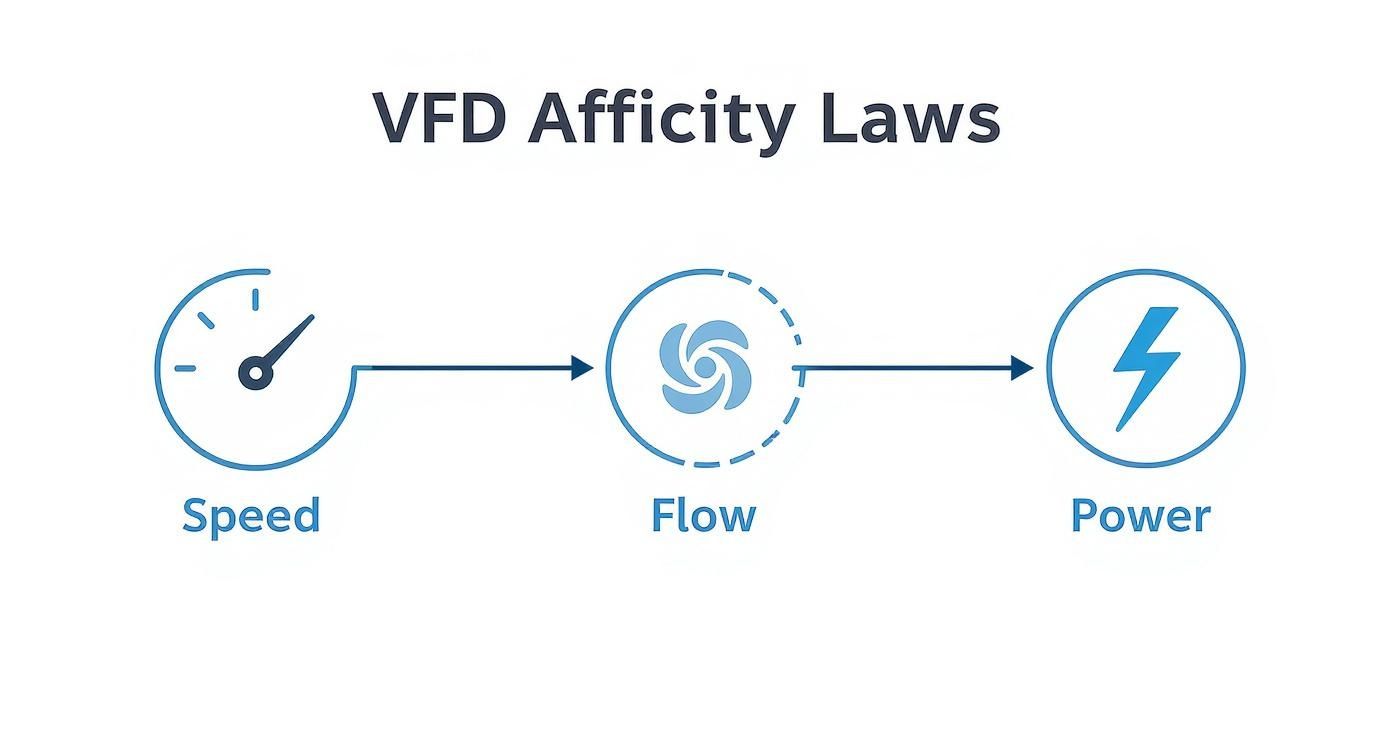
The magic behind the savings, especially for pumps and fans, is all thanks to a set of rules called the Affinity Laws. These laws connect motor speed, flow, pressure, and power in centrifugal systems. You don't need to get lost in the complex math—the main takeaway is simple but incredibly powerful.
The Affinity Laws show a cubic relationship between motor speed and power. This means even a small drop in speed creates a massive drop in energy consumption.
Think about it this way. If you slow a fan down by just 20% to run at 80% speed, you don't save 20% on power. Thanks to these laws, the power needed plummets to about 51% of what it was at full speed. This is the secret weapon for building an ROI calculation that gets immediate attention.
A Back-of-the-Napkin Formula for VSD Savings
You don't need to be a fluid dynamics expert to get a solid savings estimate. For a standard centrifugal pump or fan, you can use a straightforward formula to see the impact on your annual budget.
Let's run the numbers on a common scenario: A 100 HP pump is running around the clock. By adding a VSD, you can reduce its average speed to 80%.
Calculate Power Reduction: At 80% speed, the power draw is only 51% of the full load. That's a 49% reduction in power.
Figure Out the Power Saved: First, convert HP to kW (100 HP is about 74.6 kW). The savings work out to 74.6 kW x 49% = 36.55 kW.
Calculate Your Annual Savings: Running 24/7 (8,760 hours a year) with an electricity rate of $0.12/kWh, the savings are 36.55 kW x 8,760 hours x $0.12/kWh = $38,421 per year.
That's over $38,000 in savings from a single pump, year after year. In many cases, the project pays for itself in well under 12 months. We get into more of the details that can affect these numbers in our guide to VFD energy savings.
The 'Soft' ROI You Can't Ignore
Those hard dollar savings are just the beginning. A complete business case also includes the "soft" ROI—the operational benefits that cut costs and headaches across your facility.
Lower Maintenance Bills: A VSD’s soft start is a lifesaver for your equipment. It gets rid of the violent mechanical shock from across-the-line startups, drastically cutting wear and tear on belts, couplings, and gears.
Longer Equipment Life: Less mechanical stress and cooler motor operation mean your motor and the equipment it drives will simply last longer. It’s a direct path to deferring major capital expenses.
Better Product Quality: When you can dial in the exact speed you need, your process becomes more consistent. That means less scrap, higher-quality output, and better throughput.
The real power of VSDs is often unlocked when they're part of integrated energy management systems. When you combine the direct energy calculations with these crucial operational benefits, you’re not just proposing a project—you’re presenting a complete, undeniable business advantage.
Frequently Asked Questions About Variable Speed Drives
Even with a solid plan, a few key questions always seem to pop up in the field during a real-world project. We get it. Here are some straight answers to the most common things we hear from engineers, technicians, and project managers on the ground.
Can I Use A Variable Speed Drive On Any Standard AC Motor?
The short answer is mostly yes, but there’s a critical detail you absolutely cannot ignore. Most modern NEMA-frame motors are "inverter-duty rated." This just means their internal insulation is specifically built to handle the unique electrical stress—the high-frequency voltage pulses—that a VFD sends out.
Slapping a VFD on an older motor that isn't inverter-duty rated is a recipe for disaster. You’re essentially setting that motor up for premature failure and a costly burnout. The risk gets even worse at low speeds, where the motor's built-in fan isn't spinning fast enough to keep things cool. For an operation you can rely on, always pair a VFD with a motor that’s properly rated for the job.
Using an old motor with a new drive might seem like a cost-saver upfront, but it often leads to unexpected downtime and a much costlier motor replacement down the line. Always check your motor's rating before connecting a VFD.
What Is The Difference Between A Line Reactor And A Load Reactor?
Think of these as the bodyguards for your drive and motor. They both protect your equipment, but they stand guard in different places and watch for different threats.
Line Reactor: This gets installed on the input (the "line side") of the VSD. Its main job is to be a buffer. It smooths out the power coming from the grid, reducing harmonic noise that could mess with other equipment and protecting the drive's sensitive internal components from voltage sags and spikes.
Load Reactor: This one goes on the output (the "load side"), right between the VFD and the motor. You'll primarily see it used when you have long cable runs—typically anything over 50-100 feet. It works to absorb voltage spikes that can build up over long distances and damage the motor's insulation.
Your decision to use one, the other, or both comes down to your plant's power quality and how far apart the drive and motor are.
What Does A Bypass In A VSD Control Panel Do?
A bypass is your "get out of jail free" card. It’s a circuit that lets you run the motor directly off the main power line, completely going around the VSD. For any critical process where downtime is a four-letter word, a bypass is non-negotiable.
You’ll typically see two kinds:
Two-Contactor Bypass: This is the basic setup. It lets you run the motor at full speed if the VSD itself fails or needs to be taken offline for maintenance.
Three-Contactor Bypass: This adds an extra layer of safety and flexibility. It includes a third contactor that completely isolates the VSD from the circuit. This means a technician can safely service—or even replace—the entire drive while the motor keeps running on bypass power.
A bypass is the ultimate insurance policy for uptime, which is why it’s a standard feature in our custom UL control panels built for critical applications.
At E & I Sales, we don't just sell components; we engineer and build complete, UL-listed control panels that integrate variable speed drives for unmatched reliability and performance. For expert guidance on your next project, explore our custom solutions.
Think of it less like an on/off switch and more like the accelerator pedal for an industrial motor. Instead of just slamming the motor on or off, a VSD (often called a variable frequency drive, or VFD) gives you precise, granular control by adjusting the electrical frequency and voltage feeding the motor.
It’s the key to unlocking a whole new level of efficiency and control in modern industry.
Why VSDs are a Game-Changer
Picture this: you have a massive industrial fan, and your only control is a simple switch. It's either off or running at 100% power—no in-between. This all-or-nothing approach is incredibly wasteful and puts a ton of mechanical stress on your equipment every single time it lurches into action.
Now, imagine having that accelerator pedal. You can gently ramp up the speed, dial it in to the exact level needed for the job, and then smoothly ramp it down. That’s the power a VSD brings to the table.
For plant engineers, OEMs, and system integrators, a VSD isn't just another piece of hardware. It's a strategic tool for solving some of the biggest operational headaches. They are absolutely essential for:
Dialing in Performance: VSDs let you match motor speed perfectly to the process demand, giving you unmatched control over applications like pumps, fans, and conveyors.
Slashing Energy Costs: Why run a motor at full blast and then use a valve to choke the flow? It's like flooring the gas in your car while riding the brake. A VSD simply slows the motor down, resulting in massive energy savings.
Making Equipment Last Longer: That jarring, across-the-line start is brutal on machinery. A VSD’s "soft start" capability eliminates that mechanical shock, reducing wear and tear on belts, gears, and bearings.
A VSD changes equipment speed to provide the torque-energy input needed to supply the hydraulic-energy output to the process. The most efficient means of flow manipulation is pump-speed adjustment, which reduces pressure imparted to the fluid and, in return, reduces power consumption.
A Market Driven by Smarter Operations
Adopting VSDs isn't just a trend; it's a fundamental shift in how industries think about motor control. The global VFD market hit USD 28.38 billion in 2024, a clear sign of just how vital this technology has become in manufacturing, HVAC, and material handling.
And it’s not slowing down. That market is expected to climb to USD 39.67 billion by 2030, all thanks to the relentless push for better energy efficiency and lower operating costs.
With over 300 million motors running in industrial settings worldwide, the potential for improvement is staggering. For anyone involved in industrial capital projects, understanding this technology is no longer optional—it's how you stay competitive. You can read the full research about VFD market growth to see the numbers for yourself. This is about more than just a component; it's about a smarter, leaner way to power your operations.
How a Variable Speed Drive Actually Works
So, how does one of these drives actually get the job done? While the inner workings involve some pretty complex electronics, the core concept is refreshingly simple.
Think of a VSD as a power conditioning expert for your motor. It takes the raw, fixed "one-size-fits-all" power from the utility grid and meticulously reshapes it into the perfect, custom-tailored power your motor needs to run at any given speed.
This whole transformation happens in three key stages. Let's imagine you're managing a water supply: the AC power coming in is like a wild, unpredictable river, but your motor needs a perfectly steady and controlled flow to work right. The VSD is the sophisticated dam and valve system that tames that river.
Stage 1: The Rectifier – Taming the Current
First up, the incoming power hits the rectifier. Its only job is to take the alternating current (AC) from the grid and convert it into direct current (DC). In our water analogy, the rectifier is like a dam with a series of one-way gates (diodes) that capture the river's chaotic flow and funnel it into a large reservoir.
A typical three-phase VSD uses six of these diodes, two for each electrical phase. As the AC sine wave for each phase swings from positive to negative, the diodes open and close, letting only the positive voltage pass through. This creates a rough, pulsating DC voltage—like waves filling our reservoir.
Stage 2: The DC Bus – Smoothing Things Out
Once converted, that pulsating DC power flows into the DC bus. This is our reservoir. Its key components are large capacitors that act like shock absorbers, smoothing out the ripples from the rectifier. The capacitors store this electrical energy, soaking up the peaks and filling in the troughs.
What you're left with is a clean, stable DC voltage, primed and ready for the final step. It's worth noting that the voltage here is usually higher than what came in; for a 480V AC system, you'll often see around 650V DC on the bus. This stable reserve of power is absolutely vital for the drive's performance.
At its heart, a VSD is a power manipulator. It converts incoming AC power to a stable DC form, then flips that DC back into a brand new, perfectly controlled AC waveform. This gives you precise control over both the frequency and voltage sent to the motor.
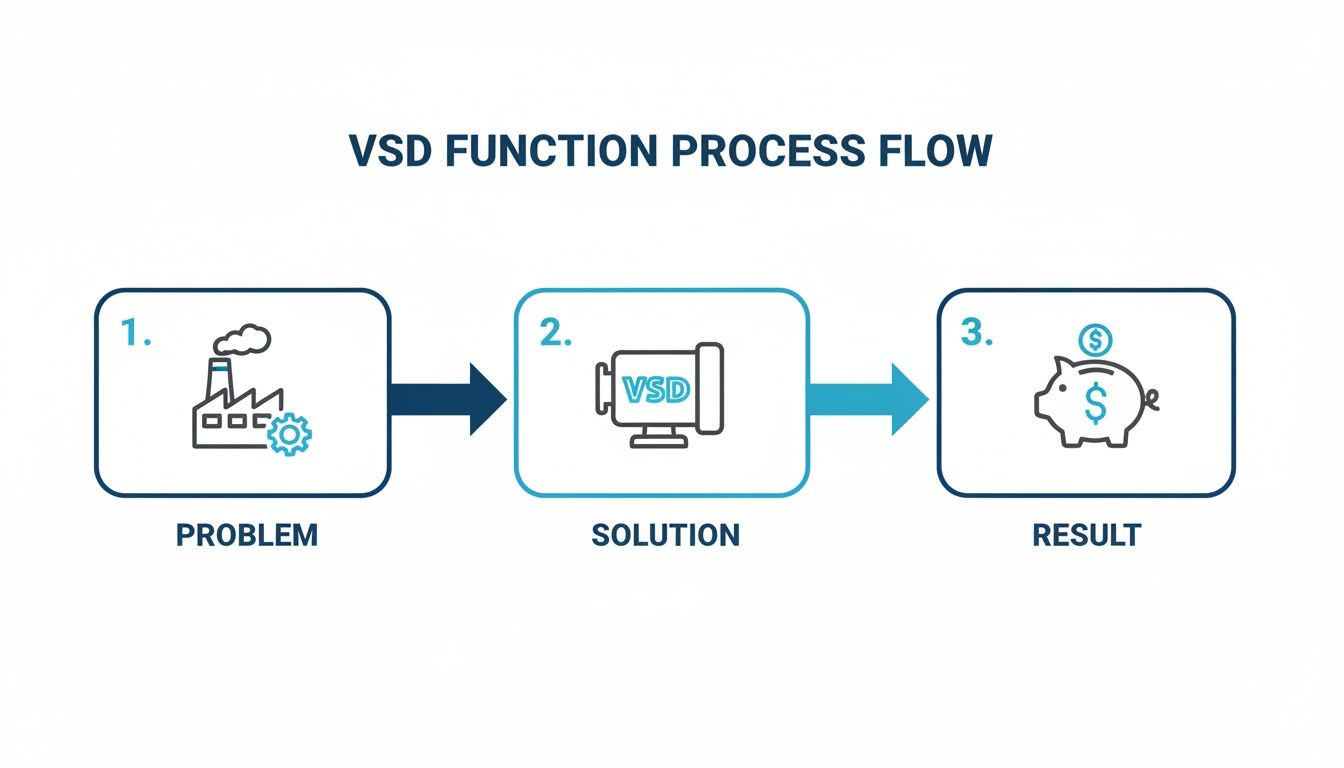
This simple flow shows how a VSD translates a common factory problem into a real, tangible cost-saving solution.
The path from the factory to the piggy bank makes it clear—this technology has a direct and positive impact on your bottom line.
Stage 3: The Inverter – Building the Perfect Waveform
The final and most critical stage is the inverter. This is where the magic really happens. The inverter takes that smooth DC power from the bus and skillfully converts it back into a variable AC output for the motor. Think of it as a set of highly advanced, computer-controlled valves on our reservoir, releasing water in precise, rapid-fire pulses to create a completely new, custom-designed river flow.
This section is built around powerful electronic switches, usually Insulated-Gate Bipolar Transistors (IGBTs), that can flip on and off thousands of times per second. By controlling the exact timing and duration of these pulses, the VSD constructs a simulated AC sine wave. This technique is known as Pulse Width Modulation (PWM).
What does this three-stage process give you?
Total Speed Control: By changing how fast the IGBTs switch, the inverter creates any frequency it wants. Since an AC motor's speed is tied directly to frequency, you now have complete control.
Optimized Voltage: By adjusting the width of the pulses (how long the switches stay on), the drive dials in the perfect output voltage, ensuring the motor gets just the right amount of power for any speed.
Pinpoint Precision: This ability to build a perfect AC waveform from scratch gives you unparalleled command over your motor's acceleration, deceleration, and running speed.
By mastering this AC-to-DC-to-AC conversion, a VSD turns a simple AC motor into a highly precise and incredibly efficient machine. To explore these foundational concepts further, check out our guide on variable frequency drive basics. This process is the secret behind a VSD's power and effectiveness.
What VSDs Actually Do for You on the Plant Floor
It’s one thing to understand the theory behind a variable speed drive, but it’s another thing entirely to see what it can do for your operation. This is where the real value hits home. The benefits go way beyond just changing a motor's speed—they deliver real, measurable returns that you can take to the bank.
Two advantages, in particular, are total game-changers for any industrial facility: massive energy savings and far superior process control. For any plant manager or engineer focused on the bottom line, these benefits are impossible to ignore. They offer a direct line to lower operating costs and a more reliable, productive plant.
Slashing Your Energy Bills
If there’s one single reason to get on board with VSDs, it’s the incredible potential for energy savings. Motor-driven systems are energy hogs, often accounting for 25% to 50% of a facility's total electricity bill. The old way of controlling a pump or fan was to run the motor at full tilt and then use a damper or valve to choke back the flow. It’s a brutally inefficient method.
Think of it like driving your car with one foot slammed on the gas and the other on the brake just to manage your speed. It's pure waste.
A VSD gets rid of that waste by simply slowing the motor down to match the exact demand. This is where the Affinity Laws for fans and pumps come into play, and they reveal a powerful truth about the relationship between speed and power. These laws show that a motor's power draw varies with the cube of its speed.
What does that cubic relationship mean? It means even a small drop in motor speed creates a huge drop in energy use. For instance, slowing a fan's speed by just 20% (to 80% of its max) can slash its energy consumption by nearly 50%.
That’s the secret sauce. Instead of fighting a full-speed motor, you’re only ever using the precise amount of power you need. This doesn't just cut your electricity bills; it shrinks your carbon footprint, helping you hit sustainability targets while boosting your bottom line. You can dig deeper into the numbers in our full guide on how VFDs generate substantial energy savings.
Extending Equipment Life Through Gentle Control
Beyond saving money on power, VSDs are just plain kinder to your equipment, reducing mechanical stress and making everything last longer. A standard motor starts "across-the-line," which means it gets hit with a massive, instant jolt of full voltage and current. It’s like hitting your machinery with a sledgehammer every time it starts up.
This sudden inrush of current—often 600% or more of the motor's normal running current—sends a shockwave of torque through the entire system, causing all sorts of wear and tear.
A VSD, on the other hand, provides a "soft start." It gently ramps the motor's speed up from a standstill to its target. This smooth acceleration eliminates the mechanical shock that destroys:
Belts and Couplings: Prevents them from stretching, slipping, and failing prematurely.
Gears and Gearboxes: Reduces the harsh stress on gear teeth and internal parts.
Bearings: Minimizes the impact that leads to pitting and eventual failure.
Piping Systems: Stops "water hammer" and other hydraulic shocks in fluid systems.
This gentle handling means less maintenance, fewer surprise breakdowns, and a longer, more predictable life for your most critical assets. The reduction in downtime alone is often enough to justify the investment in a drive.
Achieving Pinpoint Process Control
Finally, VSDs give you a level of precision that mechanical controls can't even dream of. By allowing you to make exact speed adjustments, a drive can fine-tune a process to boost quality, cut down on waste, and improve consistency across the board.
The table below breaks down how this plays out in a few common scenarios.
VSD Benefits Across Industrial Applications
Application Area
Primary Benefit
Operational Impact
HVAC & Pumping Systems
Energy Efficiency
Dramatically reduces power consumption by matching fan/pump speed to real-time heating, cooling, or flow demands.
Conveyor Systems
Synchronization
Ensures precise speed matching between different sections of a production line, preventing bottlenecks and material damage.
Mixers & Agitators
Product Quality
Allows for variable mixing speeds to achieve perfect consistency for different recipes or batch phases.
Winders & Unwinders
Tension Control
Maintains constant tension on materials like paper, film, or wire, preventing stretching, snapping, and waste.
This kind of control is invaluable in any application that needs to be just right. By integrating a VSD, you’re turning a dumb, fixed-speed motor into an intelligent, responsive part of your operation. You get better products, less waste, and a more agile facility all around.
How to Select the Right Variable Speed Drive
Picking the right variable speed drive isn’t as simple as matching the horsepower on the motor's nameplate. To get it right, you really have to dig into the details of the motor, the job it's doing, and the environment it lives in. Nailing these specifics is the key to a drive that performs reliably and safely for the long haul.
Get this part wrong, and you’re looking at nuisance trips, fried equipment, or worse. A systematic approach helps you specify a VSD that’s a perfect match for your application, saving you from costly mistakes and frustrating downtime. It’s all about building a solid, dependable motor control system from the ground up.
Match the Drive to Your Motor
First things first: look at the motor. Not all motors play nice with VSDs, and hooking one up to a motor that isn't ready for it is just asking for trouble. The simulated AC waveform a VSD creates—with its rapid-fire voltage pulses—is incredibly tough on standard motor windings.
This is exactly why you need to check if your motor is inverter-duty rated. These motors are built with beefed-up insulation systems designed to handle the high voltage spikes and fast switching that VFDs throw at them. If you use a standard motor, you risk the insulation breaking down and shorting out the motor way ahead of its time.
Once you’ve confirmed the motor’s rating, you need to grab some key data off the nameplate to program the drive correctly:
Full Load Amps (FLA): This is non-negotiable. The drive’s continuous current rating absolutely must be higher than the motor's FLA.
Voltage and Frequency: Make sure the drive’s voltage matches your system (like 480V) and the motor’s design frequency (usually 60 Hz in the US).
Motor Speed (RPM): This helps the drive dial in the V/Hz pattern for the best possible performance.
Analyze Your Application Load Profile
Next up, what kind of work is this motor actually doing? Different jobs put different demands on a motor, and VSDs are built to handle them differently. The two big categories you'll hear about are variable torque and constant torque.
A variable torque (VT) load is what you see with centrifugal pumps and fans. With these, the torque needed to spin the equipment skyrockets as the speed increases. Since you rarely need full muscle at low speeds, a VT-rated drive is the perfect, most economical choice.
On the flip side, a constant torque (CT) load needs pretty much the same amount of torque whether it's crawling or running full out. Think of a conveyor belt or a positive displacement pump. These applications need a drive with a much more robust overload capacity to handle that heavy lifting, especially at startup and low speeds. Luckily, many modern drives are dual-rated, so you can just select VT or CT mode during setup.
This choice is critical. A variable torque drive is a smart, cost-saving move for a fan, but putting that same drive on a heavy-duty conveyor is a recipe for constant overload faults and a system that just won't run.
Consider the Operating Environment
Where is this VSD going to live? The physical environment is a huge factor in a drive's lifespan and safety. You have to choose a drive with the right NEMA (National Electrical Manufacturers Association) enclosure rating to shield its sensitive electronics.
A NEMA 1 enclosure is fine for a clean, dry control room. But if the drive will be out on the floor where there’s dust or a risk of light splashing, you’ll need to step up to a NEMA 12 enclosure. And for places that get regular washdowns, like in food processing, a NEMA 4X enclosure is a must to protect against corrosion and high-pressure water.
Don’t forget about air. VSDs kick off a lot of heat, and overheating is one of the top reasons they fail. Make sure the spot you choose has enough airflow around the drive's heatsink, and always follow the manufacturer's specs for clearance space.
Address Power Quality Concerns
Finally, be aware that a VSD can introduce electrical "noise"—also known as harmonics—back into your power system. This can mess with other sensitive electronics in your facility. For big VSD installations, you might need a full-blown harmonic study, but for most smaller drives, there's a simple fix: a line reactor.
A line reactor is basically a big coil you install on the input side of the VSD. It helps smooth out the current the drive pulls from the line, which cuts down on harmonic distortion. It also adds a great layer of protection for the VSD against voltage spikes from the power grid. It's a cheap piece of insurance that adds a ton of stability.
While a VSD is great at managing motor acceleration, sometimes you might be interested in a different approach. You can learn more about what is a soft starter in our detailed guide.
Best Practices for VSD Installation and Commissioning
A top-of-the-line variable speed drive is only as good as its installation. You can have the best drive in the world, but without a solid installation and a methodical startup, you’re setting it up for premature failure. Getting these foundational steps right is non-negotiable for anyone looking to build a reliable system.
Frankly, even the most advanced VSD is vulnerable to common, everyday issues on the plant floor. A proper installation isn't just about hooking up wires; it’s about creating a stable home for the drive to do its job. That means paying just as much attention to electrical noise, heat, and physical placement as you do to the power connections.
Core Installation Guidelines
Before you even think about flipping the switch, a few installation basics will prevent the vast majority of problems down the line. Think of this as laying the groundwork. Time and again, we see nuisance trips and early component failures that trace back to skipping these simple but critical steps.
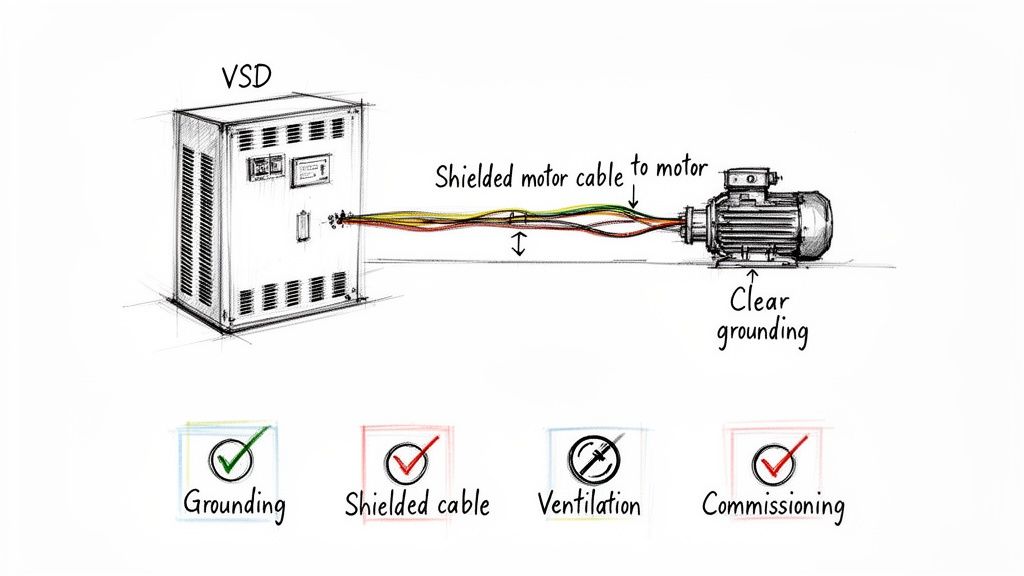
First and foremost, proper grounding is your number one defense against electrical noise. The high-speed switching inside a VSD is powerful, but it can create interference that messes with other sensitive equipment. A solid, low-impedance ground gives that noise a safe path away from everything else.
Next, you absolutely must use shielded motor cables. That cable running between the VSD and the motor is basically a giant antenna broadcasting electrical noise. Shielded VFD cable traps that interference, but only if you ground the shield correctly at both the drive and the motor.
Finally, you have to deal with heat. VSDs get hot, and cooking a drive with poor ventilation is one of the fastest ways to kill it. Always follow the manufacturer's clearance specs to give it breathing room. Getting cool, clean air flowing across the heatsink is the key to a long service life.
A Methodical Commissioning Process
Once the drive is installed right, it's time for commissioning—the startup. This is where you teach the drive how to play nice with your motor and application. Rushing this part is a classic mistake that leads to poor performance or, even worse, damaged equipment.
Follow these key steps for a startup that won't give you headaches later:
Initial Power-Up Checks: Before you go live, double-check that your input voltage is correct and every single connection is tight. A loose wire can cause arcing and catastrophic failure.
Enter Motor Nameplate Data: This is the most important part of programming. You have to accurately punch in the motor’s Full Load Amps (FLA), voltage, RPM, and horsepower. The drive uses this info for all its motor protection and control logic.
Perform an Autotune: Nearly all modern drives have an autotune function. Use it. This lets the VSD "learn" the motor's unique electrical profile, which allows it to build a super-accurate model for the best possible torque and current control.
Set Ramps and Speed Limits: Program your acceleration and deceleration times to match what the machine needs. A smooth ramp-up is easier on your mechanics, and setting min/max speed limits protects your process from running too fast or too slow.
Commissioning is not just about making the motor spin. It's about fine-tuning the drive to the specific load, ensuring the system runs efficiently, reliably, and safely under all operating conditions. Skipping steps here will lead to problems down the road.
When you put in the time for a thorough installation and a systematic startup, you’re building a foundation for a truly robust VSD system. That initial effort pays for itself many times over with less downtime, better performance, and a longer life for your entire system.
Keeping Your VSD System in Top Shape
A VSD that's installed properly is designed to go the distance, but like any piece of high-performance gear, its real-world reliability comes down to smart maintenance and quick troubleshooting. A little bit of proactive attention can make all the difference. In fact, a simple, repeatable maintenance routine is your best bet for preventing the most common failures and keeping your operations humming along without costly surprises.
And when problems do pop up? Knowing how to quickly read the drive's fault codes is the key to slashing downtime. Instead of playing a guessing game, you can let the VSD's own diagnostics point you straight to the issue. This guide is your playbook for doing both.
A No-Nonsense Preventive Maintenance Checklist
Think of regular inspections as your first line of defense. Most VSD issues don’t just happen out of the blue; they build up over time. Catching them early is how you avoid a full-blown breakdown down the road.
A good PM plan doesn't have to be complicated. It really just needs to focus on the three biggest enemies of any VSD: heat, contamination, and loose connections.
Here’s a simple checklist to get you started:
Look Around: Make a habit of visually checking for signs of overheating—things like discolored components or wiring. You'll also want to make sure the drive's internals are clean and free of dust, debris, or any moisture that could cause a short.
Check Your Connections: Vibration and normal heating and cooling cycles can work electrical connections loose over time. Get in there and routinely confirm that all the terminal screws for both power and control wiring are snug. A loose connection is just an arc waiting to happen.
Keep an Ear on the Fan: The cooling fan is absolutely critical. Listen for any weird noises, and make sure it’s spinning freely. A failing fan is one of the most common reasons for overheating, which is hands-down the #1 killer of VSDs.
What Your VSD Is Trying to Tell You: Common Fault Codes
When a VSD trips, it's not actually failing—it's doing its job by protecting itself and your motor. That fault code flashing on the display is an incredibly valuable clue. Understanding what these codes mean is the first step to becoming a troubleshooting pro.
A classic troubleshooting scenario is an overvoltage fault that happens during deceleration. This almost always means the motor is acting like a generator and pushing too much voltage back into the drive. The fix is often as simple as increasing the ramp-down time or adding a dynamic braking resistor.
Let's break down two of the most common faults you'll run into:
Overcurrent (OC): This code pops up when the drive detects a current spike that goes above its rated limit.
What's a Likely Cause? It could be a sudden, heavy change in the load, a short circuit somewhere in the motor or its cabling, or an acceleration ramp that’s just too aggressive for the application.
What Should You Do? Start by inspecting the motor wiring for any damage. Then, check the equipment being driven for any mechanical binding or jams. If everything looks good, try increasing the acceleration time to give the motor a smoother start.
Overvoltage (OV): This fault means the DC bus voltage inside the drive has climbed above its safe operating level.
What's a Likely Cause? Sometimes it's due to high incoming line voltage from the utility, but more often, it's caused by the rapid deceleration of a load with a lot of inertia (like a heavy fan or flywheel).
What Should You Do? First, measure your incoming AC voltage to make sure it’s within the drive's specified range. If the fault only happens during ramp-down, simply increase the deceleration time. For applications that genuinely need fast stops, you'll probably need to install a dynamic braking resistor to burn off that excess energy.
Got Questions About Variable Speed Drives? We’ve Got Answers.
Let's wrap up by tackling a few of the questions we hear all the time when folks are planning a VSD project. Getting these details straight can clear up a lot of confusion and make your implementation much smoother.
Can I Slap a VSD on Just Any Old Motor?
Not if you want it to last. Your standard, off-the-shelf motor just isn't built to handle the unique electrical stress from a VSD. The drive's high-frequency voltage pulses can eat away at the motor’s winding insulation over time, leading to premature failure.
For reliable, long-term operation, you absolutely need an inverter-duty rated motor. These are specifically designed with beefed-up insulation systems that can take the punishment.
What's the Real Difference Between a VSD and a VFD?
You'll hear these terms thrown around a lot, and honestly, they're often used to mean the same thing in the context of AC motors. VFD, or Variable Frequency Drive, is the more precise term because it describes how the drive controls speed—by changing the frequency of the power sent to the motor.
VSD, or Variable Speed Drive, is a broader umbrella that can also cover DC drives or other methods of speed control. But let's be practical: in today's industrial world, if someone says VSD, they're almost certainly talking about a VFD.
How Much Energy Can I Really Save with a VSD?
The potential here is huge, especially for fan and pump systems. It all comes down to a neat bit of physics called the Affinity Laws, which state that power consumption is tied to the cube of the motor's speed.
What does that mean in the real world? It means a small tweak in speed leads to a massive drop in energy use. For instance, dialing back a fan’s speed by just 20% can slash its energy consumption by nearly 50%. That's how you get a quick payback on your investment.
Do I Always Need a Line Reactor?
While it might not be strictly mandatory for every single installation, think of a line reactor as cheap insurance for your drive. We highly recommend it.
A reactor sits on the incoming power line and does two critical jobs: it protects your VSD from power surges and spikes, and it cleans up the harmonic distortion the drive sends back into your system. This simple addition boosts reliability and improves the overall health of your entire electrical network.
Ready to get precise control over your motors and start banking those energy savings? The team at E & I Sales has the expertise to help you select, design, and integrate the right VSD solution for your plant. Get in touch with us to start your project.
Think of a Variable Frequency Drive (VFD) as a smart throttle for your electric motors. Instead of running a motor at 100% speed all the time and using a mechanical valve or damper to choke the output, a VFD fine-tunes the motor's speed to match the exact demand of the moment. This simple but powerful principle is why VFDs consistently slash electricity consumption by 20% to 50% in the right applications.
Why VFDs Are a Must-Have for Industrial Energy Savings
Let's get practical and move past the textbook definitions. The old way of controlling motors in facilities with pumps and fans is just plain wasteful.
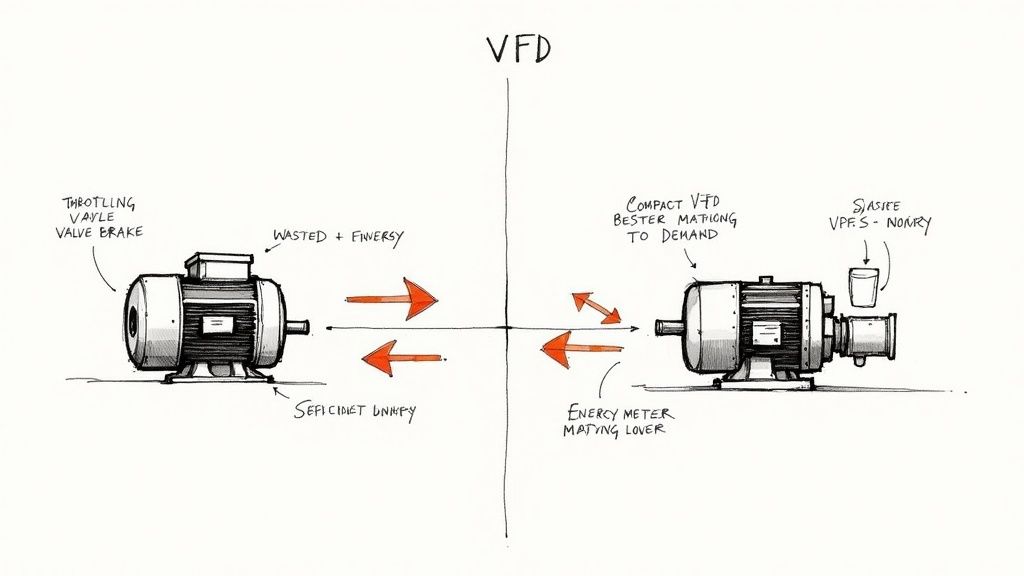
Imagine driving your car by flooring the gas pedal while simultaneously riding the brake to control your speed. You’d burn through a tank of gas in no time. That’s precisely what happens in a system where a motor runs full-tilt against a partially closed valve or damper. All that energy is just wasted as heat and noise.
A VFD completely flips that script. It gives you a precision accelerator for your motor, allowing it to ramp up or down to deliver only the power needed. This fundamental shift is the key that unlocks massive VFD energy savings.
The Sheer Scale of the Opportunity
The potential impact here is huge. Electric motors are the workhorses of industry, guzzling around 70% of all industrial electricity. This makes them the single biggest target for efficiency upgrades.
By intelligently matching motor output to the actual load, VFDs can take a serious bite out of that number. For instance, in common pump and fan systems, a seemingly small 20% reduction in motor speed can cut energy use by nearly 50%.
This guide will walk you through the science, the financial math, and the real-world best practices for putting VFDs to work. We'll cover everything from the basic principles to the common mistakes that can chip away at your return on investment.
Core Benefits of VFD Implementation
Installing VFDs delivers a lot more than just a smaller utility bill. The advantages ripple across your entire operation.
Drastic Energy Reduction: The most obvious win. VFDs directly cut kilowatt-hour (kWh) consumption by eliminating the wasted energy from running at a fixed, full speed.
Improved Process Control: Precision speed adjustments give you tighter control over your process, often leading to better product quality and more consistent system performance.
Reduced Mechanical Stress: The "soft start" capability of a VFD means no more jarring, across-the-line starts. This gentle ramp-up reduces wear and tear on motors, belts, and bearings, making your equipment last longer.
Lower Maintenance Costs: Less mechanical abuse means fewer breakdowns and lower maintenance spend over the life of the equipment. It’s that simple.
VFD Control vs Traditional Mechanical Control
To really see the difference, it helps to compare the two approaches side-by-side. The old method is about brute force, while the VFD approach is about intelligence and finesse.
Attribute
VFD Control
Throttling or Damper Control
Energy Efficiency
High; motor speed matches load, minimizing waste.
Extremely low; motor runs at full speed, excess energy is lost.
Control Precision
Excellent; allows for precise and dynamic speed adjustments.
Poor; offers crude, step-based control with high-pressure drops.
Mechanical Stress
Low; soft starting and stopping reduces wear and tear.
High; abrupt starts and stops cause significant mechanical shock.
System Flexibility
High; easily adapts to changing process demands.
Low; fixed-speed operation is rigid and inefficient.
Maintenance
Reduced; less stress on components leads to longer life.
Increased; higher stress accelerates wear on valves, bearings, and motors.
The table makes it clear: VFDs aren't just an upgrade; they represent a smarter, more sustainable way to manage motor-driven systems.
If you're just getting started, it helps to get a handle on the key components and how they work together. Our in-depth guide on Variable Frequency Drive basics is the perfect place to build that foundation.
How VFDs Turn Speed Reduction Into Big Savings
To really get why VFDs can slash energy bills, we have to look past the hardware and talk about a core principle in physics: the Affinity Laws. These laws are the playbook for how centrifugal equipment—think pumps and fans—operates. And they reveal a frankly stunning relationship between a motor's speed and how much power it guzzles.
You'd think that if you slow down a fan by 20%, you’d use 20% less energy, right? It seems logical, but that's not how it works. The relationship isn't a straight line; it's exponential, and that’s where the magic happens.
The Power of the Cube
The Affinity Laws lay it out clearly: the power a motor needs is directly proportional to the cube of its speed. This is the secret sauce behind the incredible savings a VFD delivers. A small tweak to the speed has an enormous impact on your power consumption.
Power ∝ (Speed)³. This is the key. That cubic relationship means even a modest drop in motor speed leads to a massive plunge in energy use. It's the whole reason VFDs are so effective for fans, pumps, and other variable torque applications.
This principle is what makes VFDs such a no-brainer. Instead of brute-forcing a system with mechanical dampers or throttling valves—which is like driving your car with one foot on the gas and the other on the brake—a VFD simply tells the motor to do less work. It's elegant and incredibly efficient.
A Real-World Ventilation Fan Example
Let’s put some real numbers on this. Picture a large ventilation fan in a factory. It’s designed to run full tilt, but for most of the day, the building only needs about 80% of its maximum airflow.
Without a VFD: The motor screams along at 100% speed, all day, every day. To cut the airflow, a mechanical damper closes, physically blocking 20% of the air. The motor is still working its heart out, fighting against that restriction, and all that wasted energy just turns into heat and noise.
With a VFD: Forget the damper. The VFD just slows the motor down to 80% of its full speed. Simple.
Now, let's plug that into the Affinity Law and see what happens to the power draw.
Speed Reduction:80% (or 0.8) of full speed.
Power Calculation: (0.8)³ = 0.8 x 0.8 x 0.8 = 0.512
By trimming the fan speed by just 20%, the VFD cuts the energy consumption all the way down to 51.2% of the original amount. That’s a jaw-dropping 48.8% reduction in power from a small change in output. This is exactly the kind of VFD energy savings that can completely change a facility's operating budget. If you want to dig deeper into the mechanics, our detailed article on https://eandisales.com/business/ac-motor-variable-speed/ is a great place to start.
Applications Beyond Industrial Fans
This powerful concept of matching speed to real-time demand isn't just for huge industrial machines. You see the same principle at play in all sorts of applications. For example, modern variable speed heat pumps use it to deliver huge comfort and efficiency gains in our homes.
The core idea is universal. Whenever demand isn't constant, adjusting speed is always smarter than running at full blast and choking the output. Whether it’s a massive water pump or a residential air conditioner, variable speed technology is the key. This is why understanding the Affinity Laws is so important—it takes the promise of VFDs from an abstract idea to concrete, bankable savings.
Calculating Your VFD Savings and Payback Period
Knowing the theory is one thing, but making a rock-solid business case requires real numbers. This is where we bridge the gap between the Affinity Laws and your facility's bottom line. By nailing down your potential VFD energy savings and the payback period, you can walk into any budget meeting with confidence.
The process isn't as complicated as it might sound. It's really just a "before and after" comparison. We'll figure out what a specific motor is costing you right now, then project the new, lower costs once a VFD is doing the work.
Let's run through a practical, real-world scenario to see exactly how the numbers shake out.
Step 1: Establish Your Baseline Energy Cost
First things first: you need to know your starting point. To do that, you’ll need to grab a few key pieces of data for the motor you’re looking to upgrade.
Motor Horsepower (HP): The rated power stamped right on the motor.
Operating Hours: How many hours per year that motor is actually running.
Electricity Rate: Your cost per kilowatt-hour (kWh), which you can find on your utility bill.
Motor Efficiency: The rated efficiency of your current motor, also usually on the nameplate.
To get the most accurate numbers, you have to track your energy use properly. Grabbing a good power consumption monitor is a smart move. It gives you the precise data you need for these initial calculations and for proving the savings later on.
A Worked Example: 100 HP Pump Motor
Let's put this into practice with a very common piece of equipment: a 100 HP pump motor that runs for 6,000 hours per year.
Here are our assumptions:
Motor HP: 100 HP
Conversion Factor: 0.746 kW per HP
Motor Efficiency: 94% (a standard for a premium efficiency motor)
Operating Hours: 6,000 hours/year
Electricity Rate: $0.12 per kWh
First, we calculate the power consumption in kilowatts (kW) when it's running flat out: Power (kW) = (100 HP * 0.746 kW/HP) / 0.94 efficiency = 79.36 kW
Next, let's figure out the total annual energy consumption in kWh: Annual kWh = 79.36 kW * 6,000 hours = 476,160 kWh
And finally, the total annual electricity cost without a VFD: Annual Cost (No VFD) = 476,160 kWh * $0.12/kWh = $57,139
That's right—running this single pump at full speed costs over $57,000 a year. That’s our baseline.
Step 2: Calculate Your VFD Energy Savings
Now, let's see what happens when we install a VFD. Let’s say that for half its run time (3,000 hours), the process only needs the pump to run at 70% speed. For the other 3,000 hours, it still needs to go full throttle.
This is where the magic of the Affinity Laws really kicks in.
As you can see, a small drop in speed creates a massive drop in power consumption. It's not a 1-to-1 relationship; it's a cubic one, which is what makes VFDs so powerful.
Let’s calculate the power draw at 70% speed using that cubed relationship (Power ∝ Speed³): Power at 70% Speed = 79.36 kW * (0.7)³ = 79.36 kW * 0.343 = 27.22 kW
Now we can calculate the new annual energy usage with the VFD in control:
New Total Annual kWh: 238,080 + 81,660 = 319,740 kWh
And the new annual cost: Annual Cost (With VFD) = 319,740 kWh * $0.12/kWh = $38,369
The savings are immediate and substantial: Total Annual Savings = $57,139 – $38,369 = $18,770
That's a 33% reduction in annual energy costs, just from matching the motor's speed to what the process actually needs. If you want to dive deeper into how different factors play into this, check out our resources on https://eandisales.com/tag/motor-efficiency/.
Step 3: Determine the Payback Period
The last step is the one everyone wants to see: how fast does this investment pay for itself? The simple payback period is just the total project cost divided by the annual savings.
Let's say the all-in installed cost for the VFD is $25,000. This covers the drive itself, any necessary filters, and professional installation.
Payback Period (Years) = Total Project Cost / Annual Energy Savings Payback Period = $25,000 / $18,770 = 1.33 years
A payback of just over 16 months makes this an incredibly compelling project. For some operations, it’s even faster. One ceramics factory in Poland, for instance, modernized its systems with VFDs and saw a payback in just seven months after achieving a 30% reduction in energy use. These kinds of results are becoming more and more common.
Common Mistakes That Undermine VFD Savings
Slapping a VFD on a motor isn't a silver bullet for your energy bills. While the potential for savings is huge, a few common and costly mistakes can chew right through your expected ROI, sometimes wiping it out completely. Getting real VFD energy savings means thinking about the drive as one part of a much bigger system.
Time and again, we see facilities make the same handful of errors, turning a promising efficiency project into just another frustrating expense. If you know what these pitfalls are ahead of time, you can steer clear and make sure your VFD project actually delivers the numbers you planned for. Let's walk through the four biggest mistakes we see out in the field.
Oversizing the Drive and Motor
It's a classic engineering impulse: build in a safety margin. But when it comes to VFDs and motors, "bigger" is almost never better. An oversized VFD—one rated for way more horsepower than the motor actually needs—ends up operating in a highly inefficient part of its performance curve. It wastes energy before it even gets to the motor.
It's the same story with an oversized motor. Forcing it to consistently run at less than 40% of its full rated load makes it incredibly inefficient. This habit doesn't just inflate your initial purchase price; it locks in an energy penalty that you'll pay for the entire life of the equipment.
The real secret is to size the VFD and motor for the actual work being done, not some theoretical maximum load that might happen once in a blue moon. Doing accurate load profiling before you buy anything is the single best way to dodge this expensive mistake.
Implementing a Poor Control Strategy
A VFD is only as smart as the instructions it gets. One of the most common ways we see savings evaporate is through a sloppy control strategy. This can show up in a few different ways, but each one chips away at your potential savings.
Running in "Hand" Mode: You'd be surprised how often a technician leaves a VFD in manual (or "Hand") mode, forcing it to run at a fixed speed. Often, that speed is 100%. This effectively turns your sophisticated VFD into a dumb motor starter, killing any chance of saving energy.
Incorrect Setpoints: If you set a pressure or flow setpoint higher than the system actually requires, you're forcing the VFD to run the motor faster than needed, 24/7. It's a constant, silent energy drain.
Forgetting About the Bypass: Most VFDs have a bypass contactor to run the motor across the line if the drive fails. If that bypass gets left on by mistake, all your potential savings are gone. The VFD is just an expensive box on the wall.
Proper commissioning from the start and regular check-ins are essential. You have to make sure the control logic is still optimized for savings and hasn't been overridden for convenience.
Ignoring the Broader System Context
A VFD can't fix a fundamentally flawed system. It’s a tool that optimizes a motor's performance within the existing mechanical setup. If that setup is inefficient, the VFD's impact will be severely limited.
Think of it like dropping a high-performance engine into a car with flat tires and a clogged exhaust. The engine has plenty of power, but the rest of the car is holding it back.
Here are some common system-level problems that hamstring VFDs:
High static head in pump systems: If a pump has to fight gravity just to lift water to a certain height, it has a high static head. This creates a hard floor on how much you can slow the pump down, which puts a ceiling on your potential savings.
Inefficient ductwork or piping: Clogged filters, undersized pipes, and poorly designed ductwork create a ton of resistance. This forces the motor to work harder than it should. A VFD can help, but you'll save far more if you fix these mechanical issues first.
You have to look at the whole picture. Before you even think about a VFD, analyze the entire mechanical loop to find and fix the blockages that will kill your savings potential.
Overlooking Power Quality Issues
Finally, don't forget that a VFD is a complex piece of electronics that has a real impact on your facility's electrical network. By their very nature, VFDs create harmonic distortion as a byproduct of how they work. Without the right mitigation, these harmonics can cause serious problems that erode your efficiency and reliability.
Harmonics can lead to transformers and wiring overheating, circuit breakers tripping for no apparent reason, and interference with other sensitive electronic gear. Every one of these issues introduces waste and eats into the VFD energy savings you were counting on.
Installing the right line reactors or harmonic filters isn't an optional add-on. It's a non-negotiable step to protect both your VFD investment and the health of your entire electrical system.
Getting Your VFD Installation and Verification Right
Realizing the full VFD energy savings you've been promised takes more than just bolting a drive to the wall. It’s all about a smart approach—thoughtful planning, a clean installation, and actually proving the results. Let’s walk through the playbook that separates a successful VFD project from a disappointing one.
The first, and most important, step happens before you ever order a drive. You have to get intimate with the application. Is it a fan or a pump? What’s the real-world operating load profile look like—not just the motor's nameplate rating? Answering these questions first confirms a VFD is even the right tool for the job and helps you size it for peak efficiency.
Smart Installation Strategies
Once you’ve got the green light, the focus shifts to a safe, reliable installation. This isn't the place to cut corners. Rushing the install is a fast track to performance headaches, safety risks, and equipment that dies an early death.
A hugely effective strategy is to opt for pre-engineered, UL-listed control panels. These aren't just boxes; they're integrated systems. The VFD, circuit protection, controls, and any necessary filters are all packaged together in a single, tested enclosure. This move ensures you're up to code, but just as importantly, it makes the field installation faster and drastically cuts down on the chance of wiring mistakes.
Don’t forget about harmonic mitigation. It’s easy to overlook, but VFDs naturally create electrical "noise" (harmonics) that can wreak havoc on other sensitive equipment on your network. Installing the right line reactors or harmonic filters isn't an optional upgrade. It's a non-negotiable part of a professional install that protects your entire facility.
The Make-or-Break Role of Commissioning
This is where the magic happens. Proper commissioning is the process that turns theoretical savings into actual dollars. It involves a skilled technician dialing in the VFD’s parameters to perfectly match what your system needs. They’ll tweak things like acceleration/deceleration ramps, set proper speed limits, and fine-tune PID loop controls so the motor runs as lean as possible.
This is absolutely not a "set it and forget it" task. Commissioning is about making sure your control strategy perfectly mirrors your system’s real demands. It prevents common energy-wasters like running at a setpoint that’s too high or having the motor constantly "hunt" for the right speed. Skipping this is like buying a race car and never taking it out of first gear.
Prove Your Savings: Measurement and Verification
So, how do you actually know if the VFD is saving you money? You prove it. That’s what Measurement and Verification (M&V) is all about—tracking performance to put a hard number on your savings. This step is critical for calculating your ROI and making the case for the next efficiency project.
You can tackle M&V in a few ways:
Onboard VFD Data: Most modern drives are smart enough to log key data like kWh consumed, run hours, and operating speeds. It’s a simple, built-in way to keep tabs on energy use.
External Power Meters: For rock-solid, undeniable proof, installing a dedicated kilowatt-hour meter on the VFD’s input is the gold standard. The numbers don't lie.
Baseline Comparison: The whole point of M&V is to compare the "after" with the "before." By putting your new energy numbers up against the baseline data you gathered pre-VFD, the reduction in consumption becomes crystal clear.
This isn't just theory. A project in the mining sector found that swapping to VFD-controlled pumps slashed their energy costs by nearly 20%. That added up to over $3 million in cumulative savings in 15 years. This is the power of verifying your results—it confirms the financial win and the benefit of longer equipment life. You can dig into the case study on these VFD savings in mining operations.
Answering Your Top Questions About VFDs
When you start digging into VFDs for your facility, a lot of practical questions pop up. It’s only natural. Here, we'll tackle the most common ones we hear from plant managers and engineers in the field, using what we've already covered to give you straight, clear answers. The goal is to help you feel confident about the decisions you’re making to unlock real energy savings.
Will a VFD Save Energy on Any Motor?
This is a fantastic question, and the short answer is no—at least, not in the same way. The real savings potential from a VFD comes down to what kind of work the motor is doing.
VFDs shine brightest when they're paired with "variable torque" loads. Think of your centrifugal pumps and fans. These machines are a perfect match for the Affinity Laws we talked about earlier, where a small drop in speed leads to a massive drop in energy consumption. This is the VFD sweet spot, where cutting energy use by 30% to 50% is a totally realistic goal.
Then you have your "constant torque" loads. This includes equipment like conveyors, positive displacement pumps, or industrial mixers. The savings here are much more straightforward and directly proportional to the speed reduction. If you slow a conveyor down by 20%, you’ll save roughly 20% on energy. Those savings are definitely worth having, but you won't see the same exponential impact you get with fans and pumps.
The Bottom Line: Before you do anything else, identify your load type. Knowing if you have a variable or constant torque application is the single most important factor in figuring out if a VFD project will pay off.
So, How Much Energy Can I Actually Save?
The honest-to-goodness answer? It all comes down to your application's load profile. A VFD only saves you money when your process allows it to slow the motor down. The more time that motor spends running below full speed, the more cash you'll see back in your operating budget.
Let's imagine two scenarios with the exact same fan motor:
The High-Variation System: A building's ventilation system runs at 60% speed for 12 hours overnight and then ramps up to 100% for 12 hours during the day. This setup is going to see huge savings because it's leaning heavily on those Affinity Laws for half its life.
The Low-Variation System: A process fan has to run at 95% speed nearly all day, only kicking up to 100% every so often. A VFD will still give you great control, but the energy savings will be pretty slim because the speed reduction is just too small.
The key isn't just bolting on a drive; it's understanding how much your process really needs to vary. A good, hard look at your system's demand cycle is the only way to get a realistic savings forecast.
Doesn't the VFD Itself Use Power?
It sure does. A VFD is a complex piece of power electronics, and just like any other electronic device, it has some minor efficiency losses. It's constantly converting AC power to DC, then chopping it back up into a simulated AC waveform to control the motor.
A modern, high-quality VFD is typically about 97-98% efficient. That means it consumes a small slice—around 2-3%—of the power that passes through it.
But here’s the crucial part: that tiny internal loss is a drop in the bucket compared to the massive system-level savings the VFD makes possible. For any well-chosen variable torque application, the energy you save by slowing the motor down will absolutely dwarf the small amount the drive itself uses. The net result is always a big win for your energy bill.
What Are the "Hidden Costs" of a VFD Project?
Budgeting for a VFD means looking past the sticker price of the drive itself. A handful of other components and services are almost always needed to get the job done right and ensure the system is reliable for the long haul. Getting these on your radar from the start gives you a much more accurate picture of the total project cost.
Here are the usual suspects to account for:
Professional Installation: A VFD isn't a toaster you just plug in. It needs proper wiring, grounding, and controls integration by a qualified electrician who knows what they're doing.
Shielded Motor Cable: To keep the VFD from creating electrical "noise" (EMI/RFI) that can mess with other sensitive equipment in your plant, you'll often need special shielded cable running from the drive to the motor.
Harmonic Mitigation: As we've covered, VFDs can pollute your electrical system with harmonics. Depending on the existing power quality in your facility, you might need to add a line reactor or a harmonic filter to keep everything running smoothly.
Commissioning & Programming: This is a big one. A qualified technician needs to program the drive's parameters to perfectly match your motor and application. This step is what truly optimizes performance and makes sure you hit your VFD energy savings targets.
Bypass Contactors: For critical processes that can't ever go down, a bypass is often installed. This lets you run the motor directly off the line if the VFD ever fails, guaranteeing uptime.
Factoring in these items ensures your project isn't just up and running, but that it's also safe, reliable, and built to last.
At E & I Sales, we don’t just sell VFDs out of a box. We engineer complete solutions inside UL-listed control panels, designed and built to make your project a success from day one. If you're ready to stop talking about savings and start seeing them, let's have a conversation.