Walk down any aisle in an electrical supply house, and you'll see a dizzying array of electrical boxes. They come in all shapes and sizes, from simple plastic junction boxes meant for tucking away wire splices to heavy-duty steel device boxes built to hold switches and outlets securely for decades.
But what do they all do? At their core, their job is to safely wrap up electrical connections. They’re the first line of defense, protecting wires from getting damaged and, just as importantly, protecting us from accidental contact that could lead to shocks or fires.
The Hidden Backbone of Safe Electrical Wiring
Think of electrical boxes as the silent, essential hubs of your building's entire nervous system. They’re not just simple containers; they're the critical junctions where the flow of electricity is safely managed and directed. You'll find them in every single electrical system, from the light switch in your living room to a massive industrial motor control center.
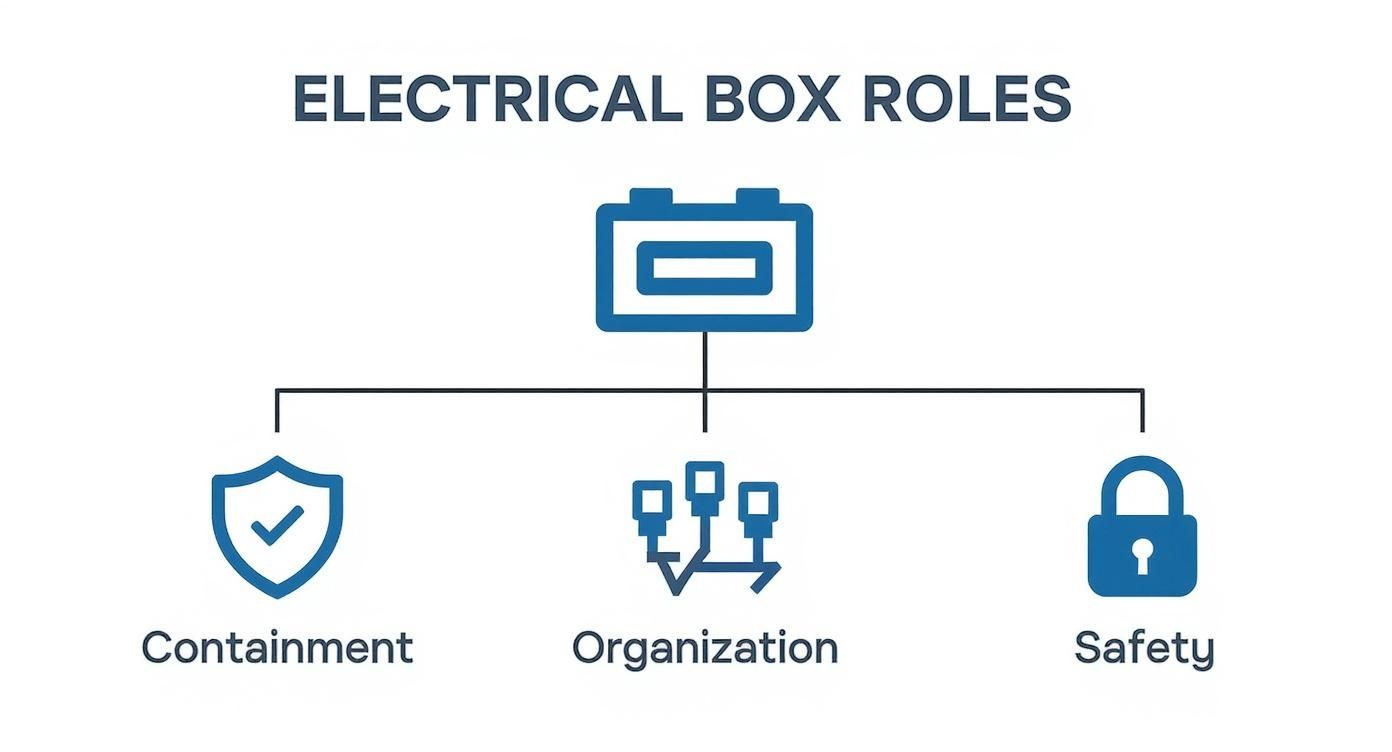
Every box, no matter its shape or material, serves three fundamental roles. It's this trifecta of duties that ensures a system is not only functional but also reliable and up to code.
The Critical Roles of an Electrical Box
Let's break down what these enclosures are really doing behind the scenes:
Containment and Protection: First and foremost, a box houses wire connections. If a connection ever arcs or sparks—and it can happen—the box contains it. This simple act prevents those sparks from reaching flammable materials like wood studs or insulation, which is a massive factor in fire prevention.
Organization and Accessibility: Wires need a clean, logical place to terminate or be spliced. Boxes provide that structure. For any electrician coming in later to troubleshoot a problem or add a new circuit, this organization is a lifesaver. It makes the job faster, safer, and a whole lot less frustrating.
Safety and Grounding: This is a big one. When you're working with metal boxes and metal conduit, the box itself becomes a key part of the grounding system. If a hot wire somehow makes contact with the metal box, this ground path provides a direct route for the fault current, instantly tripping the circuit breaker and shutting down the danger.
An improperly installed or undersized electrical box is a ticking time bomb. When you cram too many wires into a small space, you get heat buildup. That heat breaks down wire insulation over time, creating the perfect recipe for a short circuit and an electrical fire.
Quick Guide to Common Electrical Box Types and Uses
To get a clearer picture, it helps to see how different boxes are used in the real world. This table gives a quick rundown of the most common types you'll encounter and where they typically fit in.
Box Type
Primary Use
Common Material
Junction Box
Enclosing wire splices and connections
Steel, PVC, Fiberglass
Switch/Device Box
Mounting switches, outlets, and dimmers
Steel, PVC
Octagon/Round Box
Mounting ceiling lights and smoke detectors
Steel, PVC
Conduit Body
Providing pull points and turns in conduit runs
Aluminum, Steel
Weatherproof Box
Outdoor outlets, switches, and lighting
Die-cast Aluminum
This is just a starting point, of course. The specific needs of a residential, commercial, or heavy industrial project will dictate the best choice, but knowing the basics is the first step.
Ensuring a Safe Work Environment
Before you even think about touching a wire, your first priority is always safety. No exceptions. Shut off the power at the main circuit breaker that controls the circuit you're working on. Then, double-check that the power is actually off.
You can't trust that a switch is off just because it's in the down position. Always verify with a tester. Tools like non-contact voltage detectors are perfect for this—they'll tell you instantly if there's any live current present without you having to touch a single wire.
This guide will be your roadmap to navigating the world of electrical boxes. We’ll cover everything from the standard boxes in your walls to the rugged, specialized enclosures that keep critical industrial systems running, giving you the practical knowledge you need for your next project.
Diving Into the Most Common Electrical Boxes for Any Job
Once you get past the high-level theory, the world of electrical boxes opens up into a whole cast of specialized players, each built for a very specific role. Think of it like a mechanic's toolbox; you don't use a sledgehammer to tighten a small bolt. In the same way, an electrician picks the right box for the job to make sure every connection, switch, and fixture is housed correctly and safely.
Getting to know these common workhorses is the first step to making smart, code-compliant choices on any project. Each box has a specific purpose, whether it's just protecting a few spliced wires or providing a rock-solid anchor for a heavy ceiling fan.
This diagram breaks down the fundamental jobs of any electrical box, showing how it provides containment, organization, and safety all at once.
As you can see, a box isn't just a simple container. It's an active safety component that provides structure, protection, and a hub for keeping everything up to code.
Junction Boxes: The Unsung Heroes
The junction box is probably the most essential type of electrical box out there. Its job is straightforward but absolutely critical: to house and protect wire splices. Any time you need to connect wires together—whether to extend a circuit, branch off in a new direction, or join different types of cable—those connections have to be made inside a junction box.
Think of it as a secure meeting point for electrical conductors. The wires come in, get safely connected with wire nuts, and the box is sealed up with a blank cover. This simple setup prevents anyone from accidentally touching a live wire, keeps dust and debris away from the delicate connections, and even contains potential sparks. The National Electrical Code (NEC) is very clear that every splice must remain accessible, which means you can never bury a junction box behind drywall or plaster.
Device Boxes: The Interactive Hub
Next up are device boxes, which you probably know better as switch boxes. These are the rectangular boxes you see every day holding light switches, dimmers, and electrical outlets. They're designed specifically to mount these devices securely, with threaded holes for screws and enough internal space for both the device and all the wiring behind it.
Device boxes come in a few common configurations, often described by "gangs."
Single-Gang Box: The standard size, built to hold just one device, like a single light switch or outlet.
2-Gang Box (or Multi-Gang): These are wider boxes made to hold two or more devices right next to each other—perfect for a switch and an outlet combo or a bank of light switches.
4-Square Box: A versatile 4×4 inch metal box that can act as a large junction box or be fitted with a special cover (called a mud ring) to mount one or two devices.
One of the biggest mistakes people make is cramming too many wires into a device box. You always have to calculate your "box fill" to make sure you have enough cubic-inch capacity. Overcrowding can lead to dangerous heat buildup and is a major fire hazard.
Octagon and Round Boxes: The Overhead Mounts
Look up at your ceiling, and you're probably looking at the handiwork of an octagon box or its sibling, the round box. These uniquely shaped enclosures are the go-to choice for mounting ceiling fixtures like lights, smoke detectors, and ceiling fans. Their shape gives you plenty of angles to secure the fixture's mounting bracket.
While a standard octagon box works great for a lightweight light fixture, you need something much tougher for a ceiling fan or a heavy chandelier. For those jobs, you must use a box that is specifically fan-rated. These are usually made of steel and are designed to mount directly to a ceiling joist or a heavy-duty brace, giving them the strength to handle the weight and dynamic forces of a spinning fan.
You'll also find a super-shallow version called a "pancake box." These are thin, round boxes used for light fixtures when there's no room inside the wall or ceiling for a standard box. They provide just enough space for the connections while sitting almost flush against the surface. Each of these box types has a clear-cut role, making your selection process a lot easier once you know what you're trying to accomplish.
Choosing the Right Materials and Construction
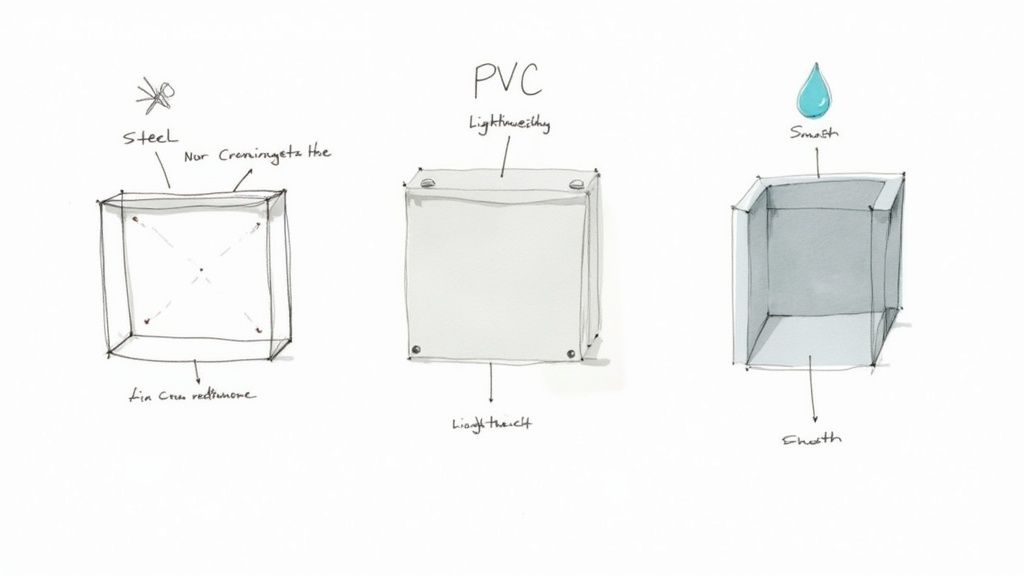
Ever wondered why some electrical boxes are metal and others are plastic? It’s not just about what’s cheapest. The material you choose is a critical decision based on the job site, the kind of wire you're running, and the safety codes you have to meet.
Think of it like picking the right gear for the job. What works perfectly in a wood-framed house would be a total liability in an industrial plant. Getting a handle on the differences between metallic and non-metallic boxes is the first step toward a safe, solid, and up-to-code electrical system.
Metallic Boxes: Steel and Aluminum
For as long as anyone can remember, metal boxes have been the go-to for commercial and industrial work. There's a good reason for that. Their natural toughness and ability to conduct electricity make them non-negotiable for certain installations.
Steel boxes are the undisputed heavyweights. Their biggest advantage is brute strength and the fact that they don't burn. This rugged build is a must-have in places where a box might take a hit. More importantly, when you're working with metal-sheathed cable (like MC) or running wires through metal conduit, a steel box is a key part of the grounding system. The box itself completes the ground path, which is a massive safety feature.
Aluminum boxes are the lighter-weight cousin to steel, which makes them a bit easier to wrangle. You'll often see them as die-cast conduit bodies or those familiar weatherproof boxes for outdoor outlets, where their built-in resistance to corrosion really shines.
Non-Metallic Boxes: PVC and Fiberglass
Lately, plastic boxes have taken over, especially in residential construction. They're just plain easier and more cost-effective for a lot of jobs.
PVC (Polyvinyl Chloride) boxes are what you'll find in most new homes today. They're cheap, light, and a breeze to install—a quick tap with a screwdriver is all it takes to pop out a knockout. Since PVC doesn't conduct electricity, the box itself doesn't need to be grounded. This makes wiring with standard non-metallic (NM) cable much simpler.
This choice between metal and plastic isn't just a job-site debate; it's big business. The global market for electrical boxes is currently valued at USD 6,992.4 million and is expected to climb to USD 10,682.4 million by 2033. PVC boxes are the clear leader, holding over 59.84% of the market thanks to their low cost and perfect fit for residential wiring.
Fiberglass boxes are a definite upgrade from standard PVC. They're tougher and won't get brittle or flex in extreme hot or cold, making them a great pick for demanding spots like unfinished basements, workshops, or even some light industrial areas where you still want a non-conductive box. When you're dealing with more advanced systems, material selection becomes even more critical, as we cover in our guide to industrial control panel design.
Making the Right Choice for Your Project
So, metal or plastic? The decision really comes down to a few straightforward factors.
Your Wiring Method: This is the golden rule. If you're running wire in metal conduit or using metal-clad cable, you must use a metal box. No exceptions. It's essential for proper grounding. For standard non-metallic (Romex) cable, a plastic box is usually the path of least resistance.
The Environment: Think about where the box will live. Is it going to be exposed to rain or moisture? You'll need a weatherproof box made of PVC, fiberglass, or die-cast aluminum. Is it in a garage or workshop where it might get bumped? A tough steel box is the way to go.
Cost and Labor: On a large residential build, the savings from using inexpensive PVC boxes and the speed of installing them really add up. But for a commercial job, the priority shifts to long-term durability, making steel the smarter investment, even if it takes a bit longer to install.
Going Beyond the Basics: A Look at Specialized Electrical Enclosures
While the standard junction boxes and device boxes are the bread and butter of most wiring jobs, some situations call for something much tougher. When you’re taking a project outdoors, running conduit underground, or trying to wrangle massive conductors, you need an enclosure that was built for the job.
Think of it like the difference between your daily driver and a purpose-built off-road truck. Both will get you from A to B, but only one is engineered to handle mud, rough terrain, and brutal weather. Specialized electrical enclosures are the heavy-duty off-roaders of the electrical world, built to protect critical connections where ordinary boxes would quickly fail.
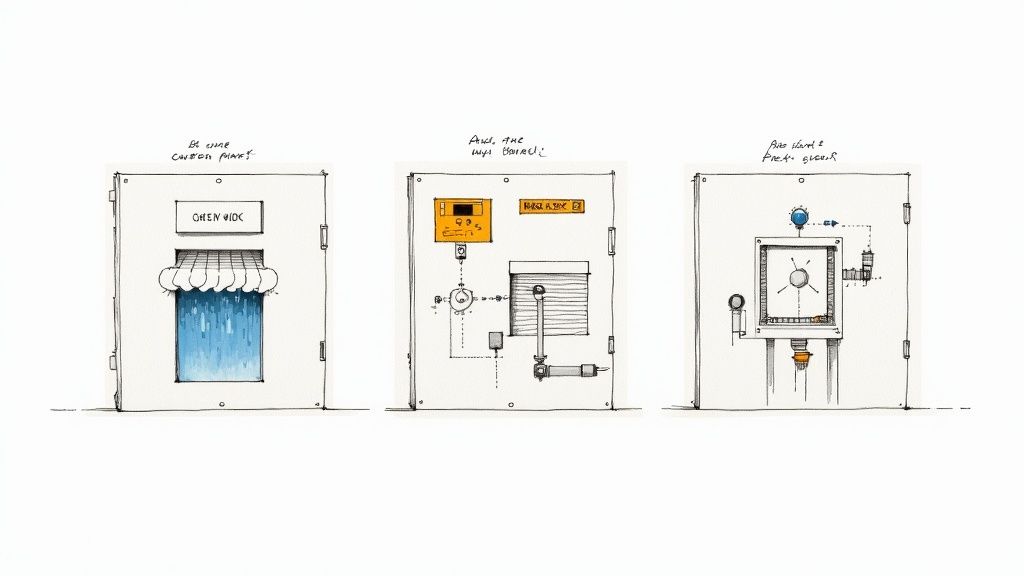
Weatherproof Boxes: Your First Line of Defense Against the Elements
Any electrical connection outside is in a constant fight with moisture, dust, and wild temperature swings. That's where weatherproof boxes step in. These aren't just regular boxes with a slightly better cover; they're complete systems engineered from the ground up to create an impenetrable seal against the environment.
Usually made from die-cast aluminum or heavy-duty, non-corrosive PVC, their design hinges on a few key features that keep moisture out:
Gasketed Covers: A thick rubber or foam gasket gets compressed between the box and the cover plate, forming a watertight seal that blocks rain, sleet, and snow.
Sealed Hubs: Threaded hubs combined with watertight connectors ensure that any point where conduit enters the box is completely sealed off from moisture.
Durable Construction: The materials themselves are chosen for their ability to resist corrosion and stand up to years of UV exposure without turning brittle.
These features make weatherproof boxes non-negotiable for outdoor outlets, landscape lighting systems, and mounting security cameras, ensuring those connections stay safe and reliable for years to come.
The demand for these rugged solutions is growing fast. The North American market for plastic electrical boxes is projected to grow at a compound annual rate of 6.3% between 2025 and 2030, hitting an estimated USD 10.34 billion. The weatherproof and outdoor segment is a major part of that story, expected to expand at an even faster 6.8% CAGR. This trend highlights a clear shift toward more robust, specialized enclosures, as detailed in this Grand View Research industry analysis.
Pull Boxes: Making Big Conductor Jobs Manageable
On large-scale commercial and industrial jobs, electricians are often tasked with pulling incredibly thick and heavy conductors through hundreds of feet of conduit. Trying to pull those massive cables through multiple bends or over extremely long distances in one go is a recipe for frustration and failure. This is exactly what pull boxes were invented to solve.
At its core, a pull box is a strategically placed junction box that gives you an access point in the middle of a long conduit run. It provides a straight shot for pulling, letting the crew pull one section of cable, neatly coil it inside the box, and then start the next pull from that point. It turns an overwhelming task into a series of smaller, manageable steps.
The National Electrical Code (NEC) actually mandates pull boxes in conduit runs with more than 360 degrees of bends between access points. The code also strictly governs their size to make sure there's enough room to work with the cables without kinking them or damaging their insulation.
Floor Boxes: Discreet Power Where You Need It
In today's open-concept offices, sprawling conference centers, and even high-end custom homes, getting power and data access right where it's needed—without a mess of cords—is a huge design challenge. Floor boxes are the elegant solution, putting outlets and data ports directly into the floor.
These aren't your average boxes. They have to be incredibly tough to withstand constant foot traffic and the weight of heavy furniture. They usually feature a solid metal construction with a heavy-duty cover that sits perfectly flush with the flooring. Many models have recessed connections and pop-up lids, allowing you to plug in cords while keeping the cover mostly closed to minimize tripping hazards.
From industrial control panels to specialized instrument housings, the world of enclosures extends far beyond the common boxes. Here's a quick look at how different types are deployed in demanding settings.
Specialized Electrical Enclosures and Their Industrial Applications
Enclosure Type
Key Feature
Typical NEMA Rating
Industrial Application Example
Hazardous-Location
Explosion-proof or intrinsically safe construction
NEMA 7, 8, 9, 10
Protecting controls in an oil refinery or chemical processing plant.
Conduit Body
Provides access for pulling conductors around bends
NEMA 3R (outdoor)
Connecting rigid conduit runs at a 90-degree angle on an exterior wall.
Meter Box
Houses and secures the utility power meter
NEMA 3R
Standard residential and commercial utility service entrance.
UL-Listed Control Enclosure
Pre-certified to house complex automation systems
NEMA 12, 4, 4X
Housing a PLC, VFDs, and motor starters for an automated conveyor system.
Each of these enclosures solves a specific set of challenges, proving that in the electrical world, having the right box for the job is critical for safety, reliability, and code compliance.
Decoding NEMA Ratings and UL Safety Listings
When you're looking at different types of electrical boxes, you'll see a string of codes and symbols stamped right on them. These aren't just random characters; they're a critical language telling you exactly what that enclosure can handle and how safe it is.
Getting fluent in this language is non-negotiable. It's how you ensure a system is reliable, up to code, and most importantly, safe for everyone involved.
The two names you absolutely need to know are the National Electrical Manufacturers Association (NEMA) and Underwriters Laboratories (UL). Think of NEMA ratings as a toughness score, defining an enclosure's ability to protect what's inside from the outside world. A UL Listing, on the other hand, is the ultimate seal of approval, confirming the product passed a battery of independent safety tests.
Understanding NEMA Ratings
NEMA ratings are a straightforward way to classify how well an enclosure protects its contents from environmental hazards like dust, water, and corrosion. In the industrial world, this is huge. Electrical boxes face everything from fine airborne particles to high-pressure chemical washdowns.
Here’s a quick look at some of the most common ratings you'll run into:
NEMA 1: This is your basic indoor-use rating. It’s designed to keep fingers and tools from touching live parts but doesn't offer much protection against dust or water.
NEMA 3R: Built for the great outdoors, this rating protects against rain, sleet, and ice. You’ll see these everywhere, from utility meter housings to outdoor junction boxes.
NEMA 4X: Now we’re talking serious protection. This rating is watertight against direct hose spray (like a NEMA 4) but adds a critical layer of corrosion resistance. That makes it the go-to choice for punishing environments like wastewater treatment plants, food processing facilities, and marine applications.
NEMA 12: Back indoors, a NEMA 12 enclosure is perfect for the factory floor. It’s built to keep out dripping liquids (non-corrosive ones), circulating dust, and falling dirt.
If you want to go deeper into how these ratings play out in the real world, check out our detailed guide covering NEMA standards. Knowing these inside and out is the key to picking the right box for the job, every time.
The Importance of a UL Listing
While a NEMA rating tells you what an enclosure is designed to do, a UL Listing is your guarantee that it's been independently tested and proven to do it safely. Underwriters Laboratories is a world-renowned safety science organization, and they don't mess around.
A UL Listing is so much more than a sticker—it’s a mark of trust. It means that an electrical box has been rigorously evaluated for potential fire, electric shock, and other hazards. For OEMs and system integrators, specifying UL-listed components is absolutely critical for ensuring the entire system is safe and compliant.
The demand for certified enclosures is exploding. The global market is on track to grow from USD 54.2 billion to a massive USD 87.4 billion by 2035. Junction boxes, which often need specific NEMA and UL ratings, are leading the charge, making up 38.2% of the market thanks to their ability to shield components from dust and moisture.
This growth isn't just a number; it highlights a massive industry-wide shift toward prioritizing safety and reliability, all driven by certifications like those from NEMA and UL.
Your Checklist for Selecting the Right Electrical Box
With so many types of electrical boxes out there, picking the right one can feel a little overwhelming. But it doesn't have to be. By asking yourself a few simple questions, you can cut through the noise and land on the perfect choice for your project.
Think of this as your roadmap. Just follow these questions in order, and you'll find they naturally narrow down your options to the box that’s safe, compliant, and built for the job at hand.
1. What’s This Box Actually Doing?
First things first, what's its purpose?
Are you just making wire connections that need to be safely contained inside a wall? That's a classic job for a junction box.
Or, will this box hold a switch, an outlet, or a dimmer that you'll interact with every day? In that case, you need a device box.
If you're hanging a light fixture or a ceiling fan, you'll want an octagon or round box. And for anything that moves or has significant weight, like a fan, make absolutely sure you grab a model that is specifically fan-rated.
2. How Are You Running Your Wires?
The type of cable or conduit you're using is a huge deciding factor. If you're running metal-clad (MC) cable or using a metallic conduit system, you have to use a steel box. No exceptions. This is critical for maintaining the system's ground path.
For the standard non-metallic (NM) cable you see in most homes, a non-conductive PVC or fiberglass box is the go-to choice. It’s simple, effective, and often makes the material decision for you.
Remember, the goal is system integrity. Mismatching materials, like pairing a plastic box with metal conduit, breaks the ground continuity. That’s not just a code violation—it’s a serious safety hazard.
3. Where Is the Box Going to Live?
The environment dictates your next move.
Anything installed outdoors or in a location that gets wet—like a wash-down area—demands a weatherproof box. These come with gaskets and sealed hubs to keep moisture out.
Working in an unfinished basement, a garage, or an industrial space where the box might get knocked around? The durability of a steel box is what you need. For standard interior walls in a dry, protected location, a basic PVC box will do the trick just fine.
4. How Much Stuff Are You Putting Inside?
Finally, it’s time to do a little math. You need to calculate the "box fill," which is the total volume required for everything you're stuffing inside.
You have to account for every wire, the device itself (like the switch or outlet), any internal clamps, and all the grounding conductors. This calculation ensures the box has enough cubic-inch capacity to prevent overcrowding, which can lead to dangerous heat buildup and damaged wire insulation.
Getting this right is absolutely critical for passing an electrical inspection. Proper box fill is also essential for making sure overcurrent protection systems, like the ones in our guide to miniature circuit breakers, can do their job correctly.
Common Questions from the Field
When you're dealing with electrical boxes, a few questions pop up time and time again, especially when you're trying to keep things safe and up to code. Whether you’re on a residential job site or mapping out a complex industrial system, getting these details right is crucial.
Let's break down some of the most common head-scratchers we hear from electricians and engineers out in the field.
How Do I Figure Out the Right Size for an Electrical Box?
This is one of the big ones. The official term is box fill, and it’s not just about making sure everything fits. It’s a critical safety calculation designed to prevent wires from being crammed together, which can lead to dangerous heat buildup and create a serious fire hazard. The National Electrical Code (NEC) lays out the rules for this.
It's basically an addition problem. You have to account for the volume of everything going into the box:
Every wire starting or ending in the box
Any internal cable clamps
The devices themselves (like a switch or receptacle)
All grounding conductors
Once you add all that up, the total volume in cubic inches absolutely cannot be more than the capacity stamped inside the box. My rule of thumb? If your calculation is even close to the limit, just grab the next size up. It's not worth the risk.
Can I Use a Plastic Box with Metal Conduit?
The short answer is no. You really can't, and you shouldn't. The reason boils down to one critical word: grounding.
A metal conduit system isn't just a pipe for wires; it's an essential part of the grounding path that runs all the way back to the panel. The metal boxes are a key link in that conductive chain. When you insert a plastic box, you break that chain. You’ve created a gap in the safety system, and that's a serious hazard.
So, stick to the basics: metal conduit gets a metal box. If you're running non-metallic PVC conduit, then a plastic box is the perfect partner.
When you're choosing an electrical box, material compatibility isn't just a suggestion—it's a hard and fast rule. Mixing a plastic box with metal conduit is a clear code violation that completely undermines the grounding system.
What’s the Real Difference Between NEMA 3R and NEMA 4X?
Both of these ratings are for outdoor enclosures, but they are built for very different environments. Think of a NEMA 3R enclosure as your standard, reliable outdoor protection. It’s designed to keep out falling rain, sleet, and prevent ice from forming on the outside. It's a great workhorse for general outdoor spots where it won't be getting blasted with a hose.
A NEMA 4X enclosure, on the other hand, is a whole different beast. It's built for toughness. It’s completely watertight and can handle being sprayed down with a high-pressure hose, which is why you see them in washdown areas. The "X" is the key part—it means the enclosure also has corrosion resistance. This is non-negotiable for harsh environments like food processing plants, coastal salt-air locations, or chemical facilities where equipment gets eaten alive.
At E & I Sales, we live and breathe this stuff. We specialize in providing the right enclosures and components for the toughest industrial jobs. From UL-listed control panels to motor control centers, our team has the hands-on expertise to help you specify, design, and integrate solutions that are reliable, code-compliant, and built to last.
See how our turnkey integration services can help your next project at https://eandisales.com.
When you need to protect an electrical circuit, you might think of a fuse. But what if you could have a smarter, reusable fuse? That's essentially what a miniature circuit breaker, or MCB, is. It’s an automatic switch built to shield electrical circuits from the damage that excess current can cause.
Instead of blowing and needing a replacement, an MCB simply trips—shutting off the power. Once you've sorted out the underlying problem, you just flip it back on.
What a Miniature Circuit Breaker Really Does
At its heart, an MCB is the unsung hero in your electrical system. Whether it's tucked inside a complex UL control panel or on a manufacturing line, this little device is your first line of defense. Its job is simple but critical: watch the current flowing through a circuit and cut the power the second it detects danger.
Getting to grips with miniature circuit breakers is non-negotiable for real electrical safety. Without them, a minor wiring mistake or a failing motor could spiral into catastrophic equipment failure, a fire, or worse, a serious injury.
The MCB's Role in Industrial Control Panels
In the world of industrial controls, the stakes are even higher. These panels are packed with sensitive, high-value components like PLCs, VFDs, and motors that are incredibly vulnerable to electrical hiccups. This is where an MCB truly proves its worth.
To get a clearer picture of what an MCB is actually doing inside a control panel, let's break down its core protective duties.
MCB Core Functions at a Glance
Protective Function
Description
Typical Scenario
Overload Protection
Trips when a circuit draws slightly too much current over a period of time. This is a slow-acting response.
A conveyor belt motor is struggling under a heavy load, causing it to pull more amps than it's rated for.
Short-Circuit Protection
Trips almost instantly when it detects a massive, sudden surge of current, interrupting power in milliseconds.
A frayed wire makes contact with a metal enclosure, creating a direct path for current to flow to the ground.
Selective Coordination
Ensures only the breaker closest to a fault trips, isolating the issue without killing power to the entire system.
An issue with a single sensor's power supply trips its dedicated MCB, but the main panel breaker stays on.
These functions ensure that a localized problem doesn't cascade into a full-system shutdown, saving immense amounts of time and money in a production environment.
The growing reliance on these devices is clear in the market trends. The global miniature circuit breaker market has already ballooned past USD 5.7 billion. Industry analysis projects that number to more than double, hitting around USD 14.4 billion by 2034, all thanks to the increasing demand for dependable circuit protection.
An MCB is far more than a simple on/off switch; it’s a precision-engineered safety instrument. Its real magic lies in its ability to tell the difference between a harmless inrush of current—like a motor kicking on—and a genuinely dangerous fault. That intelligence is what makes it indispensable.
This guide is for the industrial buyers, panel builders, and engineers who need to go beyond the basics. We're going to dive into how they work, how to read their ratings and trip curves, and most importantly, how to choose the right one for your application to maximize both safety and uptime.
How an MCB Protects Your Circuits
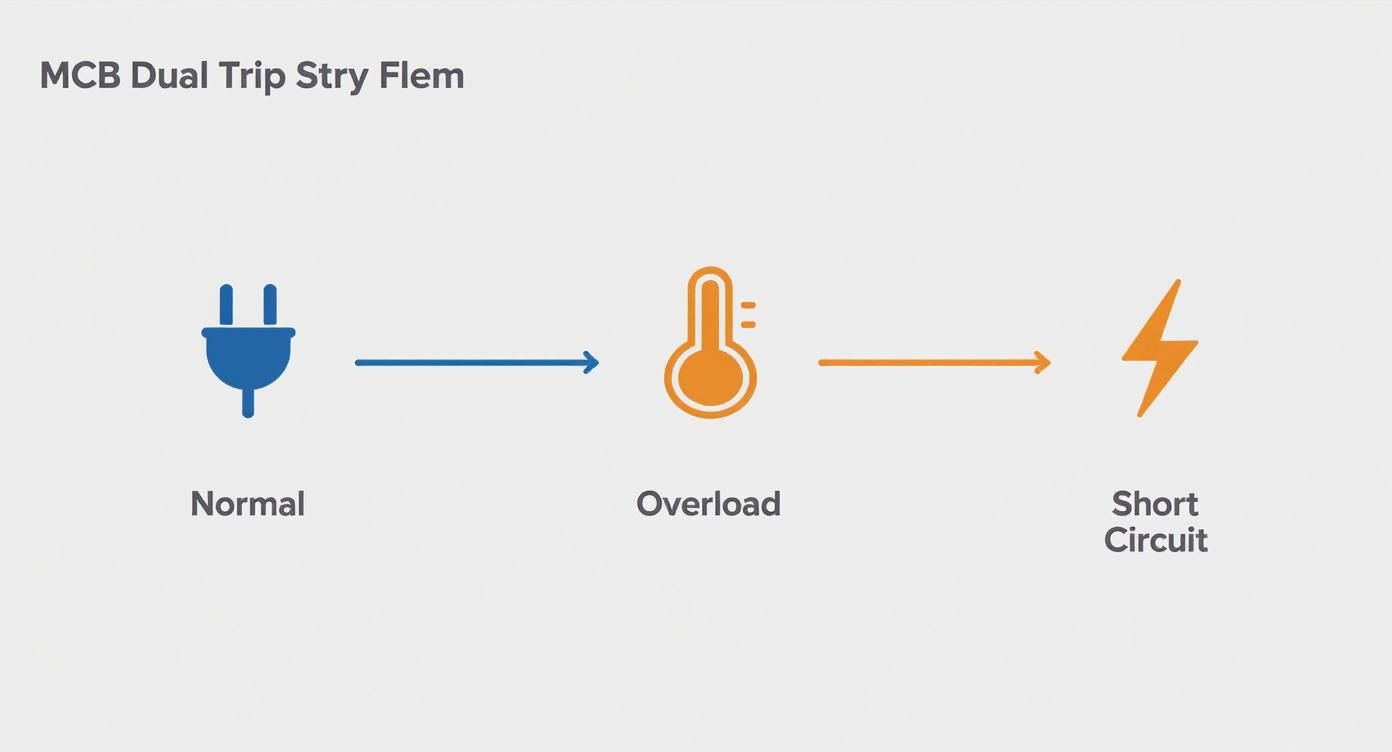
On the outside, a miniature circuit breaker looks like a simple on/off switch. But tucked away inside that compact housing is a clever, two-part safety system built to stop two very different kinds of electrical threats: slow-building overloads and lightning-fast short circuits. This dual-action approach is what makes the MCB such a reliable defender of sensitive industrial equipment.
Think of it like having two security guards on duty. One is patient, always watching for trouble that builds up over time. The other is a hyper-alert sentry, ready to jump into action in a split second. Together, they ensure your circuits are protected from the full range of common electrical faults.
These two jobs are handled by two distinct but linked components: a thermal element and a magnetic element. Let's break down how each one works to keep your systems safe and sound.
The Thermal Trip for Overload Protection
The first line of defense is the thermal trip mechanism, which is designed to handle overloads. An overload is what happens when a circuit is forced to carry more current than it's rated for over a period of time—it's not a dead short, but it's still dangerous. A classic example is a pump motor straining under a heavy load or simply too many machines plugged into one line.
The magic behind this mechanism is a surprisingly simple part: a bimetallic strip.
How It Works: This isn't just one piece of metal. It's two different metals fused together, each one expanding at a different rate when it gets hot. As current passes through the strip, it naturally generates some heat.
Detecting an Overload: When an overload occurs, the extra current makes the strip get much hotter than usual. Because one metal expands faster than the other, this heat forces the strip to bend.
Tripping the Breaker: If the overload doesn't stop, the strip will bend far enough to physically shove a trip lever. That lever unlatches the switch contacts, breaking the circuit and shutting off the power.
This whole process is deliberately slow. This design prevents nuisance trips from brief, harmless current spikes, like the inrush current when a large motor kicks on. It only reacts to sustained overcurrents that signal a real risk of overheating, which could damage equipment or even start a fire. This is our patient guard, taking its time to correctly identify a problem that develops over seconds or minutes.
The Magnetic Trip for Short Circuit Protection
While the thermal trip patiently handles slow-burn problems, the magnetic trip mechanism is all about raw speed. Its only job is to react instantly to the catastrophic danger of a short circuit. A short happens when a low-resistance path forms between conductors, causing current to spike to hundreds or even thousands of times its normal level in an instant.
This kind of emergency demands a response far faster than a warming bimetallic strip can offer. That’s where an electromagnet comes in.
A short circuit is an electrical emergency. The magnetic trip function of a miniature circuit breaker is designed to react in milliseconds—often less than 10 milliseconds—to disconnect power and prevent catastrophic damage, arc flashes, and fires.
Inside the MCB, a coil of wire acts as an electromagnet. During normal operation, its magnetic field is negligible. But the moment a short circuit occurs, the massive surge of current flowing through the coil generates a powerful magnetic field.
This magnetic force is strong enough to yank a small plunger or armature, which in turn strikes the trip lever with incredible speed. The contacts are forced apart, and the power is cut—all in the blink of an eye. This is our fast-acting sentry, whose immediate action is absolutely essential for protecting people and equipment from the violent energy of a short-circuit event.
By combining these two distinct yet complementary trip mechanisms, a single MCB provides comprehensive protection. It intelligently differentiates between a motor starting up, a dangerously overloaded circuit, and a critical short-circuit fault, applying the right level of protection at exactly the right time.
Decoding MCB Trip Curves for Industrial Loads
Picking the right miniature circuit breaker goes way beyond just matching the amperage to the load. The real secret to bulletproof protection lies in understanding its reaction time—what we in the industry call its trip curve. This single characteristic defines how quickly an MCB shuts down under different fault conditions, and it's absolutely critical in an industrial setting.
Think of a trip curve as the MCB's "personality." Some are hair-trigger sensitive, reacting to the smallest hiccup. Others are more patient, built to ignore the brief, massive current spikes that are just part of a normal day for heavy machinery. Get this choice wrong, and you're staring down one of two barrels: constant nuisance tripping that kills production, or far worse, a breaker that doesn't act fast enough, leading to catastrophic equipment failure.
This behavior all comes down to the dual-trip system inside every MCB. A thermal element handles the slow-burn overloads, while a magnetic element reacts in a flash to dangerous short circuits.
The trip curve is all about tuning the sensitivity of that magnetic response. Let's break down the common types you'll find in the field.
Type B: The Sensitive Protector
A Type B MCB is the quickest on the draw. It’s designed to trip magnetically the moment the current hits 3 to 5 times its normal rating. This lightning-fast response is perfect for protecting purely resistive loads or circuits where you expect virtually no startup surge.
Best For: Heating elements, standard lighting circuits, and sensitive electronics that don't have big, beefy power supplies.
Industrial Scenario: A Type B is the perfect choice for the control wiring going to a PLC or for a small heating coil in a process machine. It gives you immediate protection without having to worry about a big inrush current.
But try to use a Type B on a motor, and you’re just asking for headaches. The motor's normal startup kick would blow right past that low magnetic threshold, tripping the breaker every single time you turn it on.
Type C: The Industrial Workhorse
The Type C curve is what you'll find in the vast majority of industrial control panels, and for good reason. It’s engineered to trip magnetically when the current spikes to 5 to 10 times its rating. That wider window gives it just enough breathing room to handle the normal inrush from most industrial loads without causing false alarms.
For general-purpose industrial use, the Type C curve strikes the perfect balance. It's tough enough to manage the startup demands of small-to-medium motors and inductive loads, yet it still provides rock-solid protection against true short-circuit faults.
Its versatility makes it the go-to for a huge range of equipment. This is a big plus for panel builders and maintenance crews because it simplifies stocking and specifying. We get into the nitty-gritty of sizing these correctly in our complete guide to the protection of motors.
Type D: The Heavy-Duty Specialist
When you're dealing with the real brutes of the industrial world—equipment with massive startup demands—you need a Type D MCB. This heavy-hitter is designed to hold on until the current reaches an incredible 10 to 20 times its rated amperage.
This high threshold allows it to completely ignore the huge, temporary current draw from large-scale industrial machinery firing up.
Best For: Large electric motors, transformers, industrial welders, and X-ray machines.
Industrial Scenario: Think about a giant conveyor system powered by a high-torque motor. It's going to pull an insane amount of current for a split second. A Type D breaker is built for exactly that, letting the motor start without a fuss while staying armed and ready for a genuine short circuit.
Matching the trip curve to your load’s electrical signature is the final, crucial step in specifying a reliable MCB. Get it right, and you ensure uptime by eliminating false trips while guaranteeing the device does its job when it counts.
Picking the Right MCB for Your UL Control Panel
Specifying a miniature circuit breaker for a UL 508A industrial control panel isn't just about grabbing something off the shelf that fits the DIN rail. It’s a job that demands precision. Every choice you make impacts the safety, compliance, and long-term reliability of the entire panel.
Think of it as the pre-flight checklist for your panel's electrical system. Get it right, and you've built a solid, safe foundation. Get it wrong, and you're setting yourself up for costly mistakes or, worse, dangerous failures down the line.
The first hurdle—and one of the most common trip-ups in panel design—is getting the UL standard right.
UL 489 vs. UL 1077: The Critical Distinction
These two UL standards look similar, but they define two very different jobs a circuit protector can do inside a panel. They are absolutely not interchangeable.
UL 489 Circuit Breakers: These are your heavy hitters, certified for branch circuit protection. A UL 489 breaker is built to be the first line of defense, capable of stopping the massive fault currents that can come from the main power feed. They’re required for protecting the main wiring and everything downstream.
UL 1077 Recognized Components: These are supplementary protectors. Think of a UL 1077 device as a specialist providing extra, more sensitive protection for a specific component, like a PLC or a power supply. It must be installed downstream of a primary UL 489 breaker.
Dropping a UL 1077 device into a spot where a UL 489 is required is a major code violation. It will instantly fail a UL inspection and, more importantly, it's a serious safety hazard. A supplementary protector simply isn't engineered to handle the raw energy of a major branch fault.
Calculating the Right Amperage Rating
Once you’ve locked in the correct UL listing, it's time to size the breaker’s amperage. This isn't as simple as matching the number on the nameplate of the load. The National Electrical Code (NEC) requires a built-in safety margin to prevent nuisance trips and overheating.
For most non-motor loads, the rule of thumb is to size the breaker for 125% of the continuous load current. For motors, things get a bit more complex, often starting at 250% of the motor's full-load amperes (FLA) and then adjusting for other factors. Nailing these load calculations is a cornerstone of good industrial control panel design and is non-negotiable for a safe system.
Don't Overlook the Short Circuit Current Rating (SCCR)
The Short Circuit Current Rating (SCCR) might be the single most important safety rating on an MCB. It tells you the maximum fault current the breaker can interrupt without literally blowing itself apart.
Your chosen MCB must have an SCCR that is equal to or greater than the available fault current at the point of installation. No exceptions.
Never install a miniature circuit breaker with an SCCR lower than the available fault current. Doing so creates a significant risk of an arc flash explosion, as the device could fail violently when attempting to clear a major short circuit.
Figuring this out is a system-level task. If you're not absolutely certain what the available fault current is, you need to have a qualified engineer perform a study to determine it.
This need for properly specified components is a global issue. As industrialization ramps up, especially in regions like Asia Pacific, the demand for reliable circuit protection has skyrocketed, making it the largest market for miniature circuit breakers. It’s a clear sign that modern electrical systems, no matter where they are, depend on getting these fundamental choices right.
MCB vs. Other Overcurrent Protection Devices
A miniature circuit breaker doesn't work in a vacuum. It's just one player on a much larger team of protective devices, and knowing where it fits is absolutely critical for designing a safe and reliable electrical system.
Each device has a very specific job to do. Mixing them up or assuming they're interchangeable is a recipe for disaster, leaving dangerous gaps in your system's safety net. To build a truly bulletproof panel, you need to understand how an MCB stacks up against the other common devices you'll find in any industrial facility. Let's break down the distinct roles of fuses, MCCBs, and RCDs/GFCIs so you're always grabbing the right tool for the job.
MCB vs. The Classic Fuse
For decades, the humble fuse was the king of overcurrent protection. It’s brilliantly simple: a small piece of wire engineered to melt and break the circuit when current gets too high. But that simplicity is also its greatest weakness.
Once a fuse blows, it's done. You have to replace it. That means stocking spares, dealing with downtime while someone hunts for the right one, and running the risk of an operator grabbing a fuse with the wrong rating just to get the machine back online.
This is where the miniature circuit breaker really shines:
It's Reusable: When an MCB trips, you just flip a switch to reset it. In a production environment where every minute counts, this is a massive advantage over digging through a parts drawer for a new fuse.
It's Smarter: A fuse just melts from heat. An MCB, on the other hand, has two distinct trip mechanisms working together—thermal for slow, creeping overloads and magnetic for sudden, dangerous short circuits.
It's Obvious: A quick glance at the panel tells you which circuit has tripped. No need for a multimeter to test a row of fuses.
While fuses definitely still have their place, especially in some high-rupture capacity applications, the MCB's convenience and superior, dual-action protection have made it the modern standard for branch circuits.
MCB vs. Molded Case Circuit Breaker (MCCB)
At first glance, an MCB and a Molded Case Circuit Breaker (MCCB) look like they do the same thing. They're both reusable breakers, right? Yes, but the difference is all about scale.
Think of it this way: an MCB is the security guard for a single office, while the MCCB is the security guard for the entire building lobby.
Your typical MCB is designed for lower-current applications, usually topping out at 125 amps. Its job is to protect the final branch circuits—the individual lines feeding a motor, a PLC, or a set of lights.
The MCCB is a completely different beast. It's a much beefier, more industrial device built for the heavy-lifting.
An MCCB is engineered to handle much higher currents, with ratings that can range from around 15 amps up to 2,500 amps. They are used to protect main feeders, distribution panels, and large-scale industrial equipment where the available fault current is significantly higher.
Another key difference is that many MCCBs have adjustable trip settings. This allows engineers to dial in the protection characteristics to precisely match the needs of a large motor or complex system. An MCB, by contrast, has fixed trip points set at the factory. If you're sizing protection for a main feed or a large piece of machinery, you should be looking at options like an ABB circuit breaker of the MCCB variety.
MCB vs. RCD and GFCI
Pay close attention to this one, because it's the difference between protecting equipment and protecting people. It's the most common and dangerous point of confusion.
An MCB is an overcurrent protection device. Period. Its entire purpose is to prevent fires and equipment damage when too much current flows.
A Residual Current Device (RCD), or its North American cousin, the Ground Fault Circuit Interrupter (GFCI), is a personnel protection device. It couldn't care less about overcurrent. Instead, it does something far more sensitive: it constantly measures the current flowing out on the hot wire and compares it to the current returning on the neutral.
If that difference is as tiny as 4-6 milliamperes, it knows that current must be leaking somewhere it shouldn't be—potentially through a person. It then trips the circuit in a fraction of a second, long before a fatal shock can occur. An MCB would be completely blind to a fault that small.
A truly safe system never forces you to choose. It uses both. The MCB protects the wires from melting, and the RCD/GFCI protects the operator from a lethal shock.
Getting Installation and Maintenance Right
A miniature circuit breaker is only as reliable as the hands that installed it. Getting the mounting, wiring, and routine checks right isn't just "best practice"—it's the only way to guarantee the device will do its job when it counts. Cut corners here, and you're setting the stage for overheating, premature failure, or worse.
This is where theory meets the real world. For the technicians and facility managers tasked with turning a box of components into a reliable, long-lasting asset, these practical steps are what truly matter.
Proper Installation Procedures
Solid installation is the foundation of electrical safety. Rushing these steps can create hidden problems that only show up during a fault condition—exactly when you need the protection to work. To build a rock-solid and safe connection from the start, focus on these key points.
Secure DIN Rail Mounting: Make sure the breaker snaps firmly onto the DIN rail. A loose MCB will vibrate, which can lead to iffy connections and wear out the terminals over time.
Use the Right Wire: Always match the wire gauge to the breaker's amp rating and what the load demands, following NEC guidelines. Undersized wires are a classic cause of overheating, creating the very fire hazard the MCB is there to prevent.
Get the Torque Right: This is one of the most critical and easily overlooked steps. Use a calibrated torque screwdriver to tighten the terminal screws to the manufacturer's exact spec. Over-tightening can crack the terminal, but under-tightening is just as bad—it creates a high-resistance hot spot.
Before energizing any system, running through a comprehensive electrical rough-in inspection checklist is a crucial final step. It’s your last chance to verify that every component is installed correctly and up to code.
A Simple, Effective Maintenance Schedule
Once it's in the panel, an MCB isn't a "set it and forget it" device. A little proactive maintenance turns a passive component into a verified safety asset. This simple schedule helps you spot trouble long before it becomes a critical failure.
A regular inspection routine is the cheapest insurance you can buy for system safety and longevity. Finding a loose connection early prevents major downtime and costly equipment damage down the road.
A basic but effective maintenance plan doesn't have to be complicated:
Quarterly Visual Checks: Just look for signs of trouble. Is there any discoloration or melting on the breaker's housing? That’s a dead giveaway for overheating. Check the wires connected to it for insulation that looks brittle or cracked—another symptom of too much heat.
Annual Terminal Check: During a planned shutdown, re-torque the terminal connections. Over months of operation, the normal heating and cooling cycles can cause screws to slowly loosen.
Annual Mechanical Test: While the power is off, just flip the MCB's switch on and off a few times. This simple action ensures the internal mechanism hasn't gotten stiff or seized, confirming it can physically trip when needed.
This straightforward approach to installation and maintenance will get the most life out of every MCB and, more importantly, reinforce the safety of your entire electrical system.
A Few Common Questions We Hear About MCBs
When you're in the weeds of a project, the practical questions always start to pop up. How you handle the small details around application, safety standards, and environmental conditions is what separates a reliable system from a problematic one.
We get these questions all the time from engineers and buyers in the field. Let's clear up a few of the most common points of confusion to make sure your electrical installations are safe, compliant, and built to last.
Can You Use a DC-Rated MCB on an AC Circuit?
This question comes up a lot, and the answer is a hard no. It's easy to think of a circuit breaker as just a simple switch, but the physics behind interrupting AC and DC power are worlds apart. The real challenge is snuffing out the electrical arc that forms when the contacts pull away from each other.
In an AC circuit, the current naturally drops to zero 120 times every second. This zero-crossing gives the breaker a built-in opportunity to kill the arc. DC current, on the other hand, is a constant flow with no zero-crossing point, which makes the arc incredibly stubborn and much harder to extinguish. Putting a DC breaker on an AC circuit (or vice versa) is a serious safety risk because the arc-quenching system just isn't designed for that type of current.
What's the Real Difference Between UL 489 and UL 1077?
If you're building control panels, this is a distinction you absolutely have to get right. These two UL standards define completely different roles for a protective device, and they are not interchangeable.
UL 489 Circuit Breakers: Think of these as the main line of defense. They are certified for branch circuit protection and are built tough enough to handle the massive fault currents that can come from a main power feed.
UL 1077 Supplementary Protectors: These are designed for more targeted protection within a piece of equipment. They sit downstream from a UL 489 device, offering more sensitive protection for specific components, but they simply don't have the muscle to interrupt a major branch fault.
How Does High Temperature Affect an MCB?
Heat is the natural enemy of an MCB’s thermal trip mechanism. Inside the breaker, a bimetallic strip is engineered to bend at a specific temperature generated by overcurrent, causing it to trip. When you install that breaker in a hot control panel or a high-ambient-temperature environment, that external heat gives the tripping process a head start.
This phenomenon is called thermal derating. It means the breaker will trip at a current well below its nameplate rating. To prevent frustrating nuisance trips, manufacturers provide derating curves that help you calculate the MCB's true operating capacity at elevated temperatures.
Should I Replace an MCB After a Major Fault?
Absolutely, yes. The safest and smartest move is to replace the breaker after it has interrupted a significant short-circuit. It might look perfectly fine on the outside and may even reset, but the violent forces at play during a major fault can cause serious, unseen internal damage.
A severe short circuit puts incredible stress on the internal components. It can weaken the contacts, damage the arc chute, or compromise the trip mechanism. Trusting a breaker that's been through that kind of event is a gamble you can't afford to take—it might not be there for you during the next fault.
An ABB circuit breaker is a whole lot more than just a switch. Think of it as the ever-vigilant guardian of your entire electrical system, a critical piece of hardware designed to protect your equipment, prevent disastrous downtime, and keep your people safe. It does this by instantly and automatically cutting the electrical flow the moment it detects an overcurrent or a short circuit.
Why Your Electrical System Depends on the Right Breaker
In any industrial plant or commercial building, your electrical infrastructure is the absolute bedrock of productivity. When it goes down, everything grinds to a halt. The circuit breaker is your first line of defense against electrical faults that can fry expensive machinery, spark fires, or trigger catastrophic system-wide failures.
This makes choosing the right one more than just a minor technical detail—it's a foundational business decision.
An inadequate or poorly chosen breaker is a ticking time bomb. It might fail to trip during a major fault, letting a destructive surge of energy rip through your system. On the flip side, it could be too sensitive and trip unnecessarily, causing those frustrating nuisance shutdowns that kill efficiency and waste man-hours.
The Real Cost of Electrical Downtime
The fallout from a system failure goes way beyond the immediate repair bill. For a manufacturing plant, just one hour of downtime can easily translate to tens of thousands of dollars in lost production. In a data center, it could mean wiping out critical services and information.
A properly specified ABB circuit breaker is designed to mitigate these exact risks by delivering reliable, predictable protection you can count on.
This need for reliability is a major reason for the sector's incredible growth. The global circuit breaker market, valued at a massive USD 25.2 billion in 2025, is projected to hit USD 57.5 billion by 2035, a surge driven by industrial expansion and infrastructure upgrades. You can dive deeper into this market growth on futuremarketinsights.com.
A Roadmap for Reliable Protection
Consider this guide your practical roadmap to understanding and selecting the perfect ABB circuit breaker for your application. We're going to cut through the complex jargon and focus on what really matters: real-world scenarios and actionable insights.
Think of circuit protection as an insurance policy for your electrical assets. A premium breaker like an ABB Tmax XT or Emax 2 doesn't just prevent damage; it preserves operational continuity and safeguards your bottom line.
Throughout this guide, we'll walk you through:
ABB's Core Families: We’ll break down the differences between Molded Case Circuit Breakers (MCCBs) like the workhorse Tmax XT and the powerful Air Circuit Breakers (ACBs) like the Emax 2.
Essential Specifications: You’ll learn how to read a technical data sheet like a pro and understand which ratings and specs are critical for your needs.
System Integration: Discover how these breakers connect with motor controls and panelboards to create a cohesive, safe, and fully integrated system.
Best Practices: We’ll cover the essentials of installation, maintenance, and system upgrades to guarantee long-term performance and reliability.
Navigating the ABB Circuit Breaker Portfolio
Diving into the world of ABB circuit breakers can feel like walking into a massive, highly specialized workshop. With rows upon rows of models and series, it's easy to feel a bit lost.
The secret? Don't try to memorize every part number. Instead, let's simplify the entire landscape by splitting it into two main categories. Each one serves a distinct, vital role in keeping an electrical system safe and running.
Think of it like building a fortress. You need guards patrolling the individual corridors and rooms, and you also need massive walls protecting the entire compound. Both are essential, but they operate on completely different scales.
Molded Case Circuit Breakers: The Guardians on Patrol
The first line of defense in any distribution system is the Molded Case Circuit Breaker (MCCB). These are the versatile workhorses, the guardians on patrol. You'll find them protecting individual circuits, feeders, and specific pieces of equipment.
ABB's Tmax XT series is a perfect example. These are the breakers standing guard over the motors, lighting panels, and machinery on a factory floor. They handle the everyday protection jobs, dealing with currents typically ranging from 15A up to around 3200A.
They get their name from their construction—all the critical components are housed inside a compact, sealed "molded case" made of a tough insulating material. This design makes them incredibly reliable.
What makes an ABB MCCB a go-to choice?
Compact Footprint: They are built to fit. Their smaller size is perfect for panelboards and switchboards where every inch of real estate counts.
Sealed for Reliability: The sealed case keeps dust, moisture, and prying fingers out. This ensures they work when you need them to, with almost no maintenance required.
Intelligent Protection: These aren't just simple on/off switches anymore. Many come equipped with sophisticated electronic trip units, like ABB's Ekip line, giving you precise, adjustable control over protection settings.
This blend of versatility and advanced protection is a big reason why ABB is a leader in the field. They've consistently developed circuit protection that meets the real-world needs of industrial facilities and commercial buildings. In fact, you can find more on ABB's market leadership at marketsandmarkets.com.
Air Circuit Breakers: The Fortress Walls
Now, let's zoom out. When you're not just protecting a single motor, but an entire facility—a hospital, a data center, a sprawling factory—you need the fortress walls. That’s the job of the Air Circuit Breaker (ACB).
ACBs, like ABB’s powerful Emax 2 series, are the heavy-duty protectors installed at the main service entrance. They are the first and last line of defense where power enters the building.
Built for massive currents, often from 800A up to 6300A and even higher, ACBs are fundamentally different from their molded-case cousins. They use the surrounding air to extinguish the enormous electrical arc that forms when interrupting a major fault. This requires them to be physically larger, more robust, and fully serviceable.
An ACB is your system's ultimate safety net. It’s engineered to handle the immense energy of a catastrophic short circuit right at the source, preventing a fault from cascading through your system and causing a complete shutdown.
What sets ACBs apart?
Massive Interrupting Capacity: They can safely stop fault currents that would vaporize smaller breakers, protecting the entire downstream network.
Built for the Long Haul: Their open construction is designed for maintenance. Key components can be inspected, serviced, and even replaced, giving them an incredibly long operational life.
More Than a Breaker: The Emax 2, for instance, is also a full-fledged power manager. It integrates measurement, protection, and communication features to help you monitor and optimize your facility's energy consumption.
To help you see the big picture, here’s a quick breakdown of how these families compare.
ABB Circuit Breaker Families at a Glance
This table offers a high-level comparison of ABB's primary circuit breaker series, highlighting where each one fits best. It's a great starting point for quickly identifying the right category for your needs.
Compact size, advanced electronic trip units (Ekip)
SACE Emax 2
ACB
Main service entrance, large industrial incomers, data centers
High interrupting capacity, power management functions
Formula
MCCB
Commercial and residential panels, smaller machinery (OEM)
Simplicity, reliability, and cost-effectiveness
SACE Isomax
MCCB (Legacy)
Older industrial installations and distribution panels
Robust, established performance (often subject to retrofit)
Ultimately, choosing between an MCCB and an ACB is the first and most critical step. Once you know which "fortress" component you need, you can drill down into the specific series and ratings.
Of course, getting the right hardware is only half the battle. Navigating the procurement channels is just as important. For that, it often helps to connect with electrical supply sales representatives who live and breathe this stuff every day.
How to Select the Perfect Breaker for Your Needs
Picking the right ABB circuit breaker is about more than just matching a few numbers on a spec sheet. It's about translating that technical jargon into a real-world understanding of how the device will protect your equipment, your facility, and your people. Let’s break down the specs that matter so you can make the right call, every time.
First up is a common point of confusion: the difference between Ampere Frame (AF) and Ampere Trip (AT). Think of it like this: the Ampere Frame is the physical size of the breaker, like the diameter of a water pipe. It sets the absolute maximum amount of current the hardware can handle.
The Ampere Trip, on the other hand, is the adjustable valve on that pipe. It's the specific setting that tells the breaker when to shut everything down. This is why you can have an ABB breaker with a 250A frame (the pipe) fitted with an interchangeable trip unit rated for 150A, 200A, or 225A (the valve). This gives you the flexibility to precisely match the breaker's protection to the load it's guarding.
Understanding Your System's Ultimate Safety Net
Beyond basic current ratings, the single most critical safety spec you'll encounter is the Interrupting Capacity, often labeled as kAIC (kiloampere interrupting capacity). This number tells you the maximum amount of fault current the breaker can stop cold without failing—or worse, exploding.
Imagine a dam holding back a river. The river's normal flow is your everyday operating current. A fault current is a flash flood—a violent, uncontrolled surge of energy. The interrupting capacity is that dam's ultimate strength rating. It absolutely must be strong enough to contain the worst-case flood.
A breaker's kAIC rating must be equal to or greater than the available fault current at its point of installation. Getting this wrong is one of the most dangerous mistakes in electrical design, creating a serious fire and safety hazard.
For example, a breaker sitting right next to a massive utility transformer might need a 65 kAIC rating or higher. Another one installed way downstream in a small sub-panel, where the potential fault current is much lower, might only need 25 kAIC. There's no room for guesswork here.
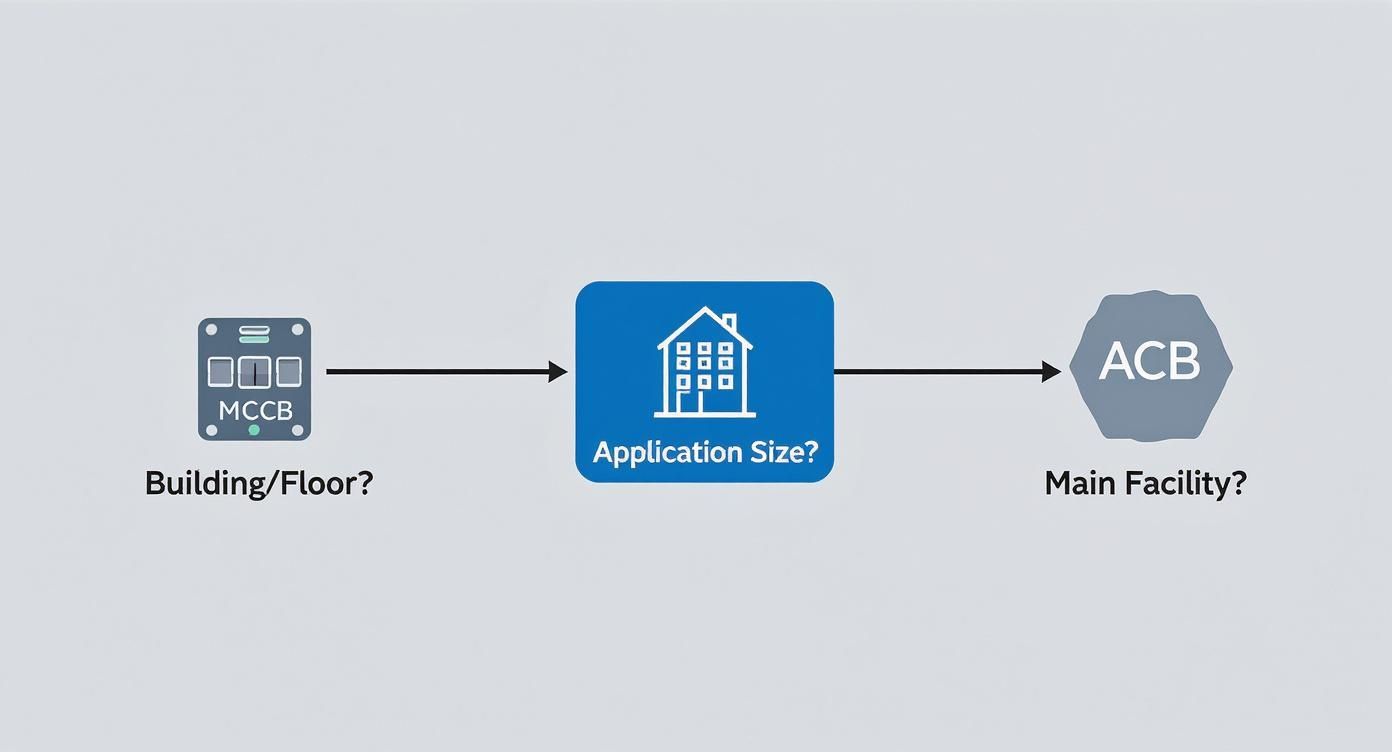
This diagram shows how the scale of your application—from a single floor's distribution panel to an entire facility's main switchgear—helps guide that initial choice between a molded-case (MCCB) or an air circuit breaker (ACB).
As you can see, the MCCB handles branch-level protection, while the heavy-duty ACB stands guard at the main service entrance. This visual makes that first big decision much clearer.
Choosing the Right Brains for the Operation
The final piece of the puzzle is the trip unit—the "brain" of the ABB circuit breaker. This is the component that actually senses an overload or short circuit and gives the command to trip. The two main types offer very different levels of control.
Thermal-Magnetic Trip Units: These are the reliable, workhorse standard. The "thermal" part uses a bimetallic strip that heats up and bends during a long, slow overload. The "magnetic" part reacts instantly to the huge current spike of a short circuit. They’re perfect for straightforward jobs like protecting lighting circuits or simple resistive loads.
Electronic Trip Units: When you get into industrial settings with motors and sensitive machinery, electronic trip units like ABB's Ekip series are in a league of their own. These are microprocessor-based brains that give you incredible control. You can fine-tune the trip settings for long-time (overload), short-time, and instantaneous (short-circuit) events. This precision is key for proper system coordination, ensuring the breaker closest to a fault opens first without taking down an entire production line.
For instance, you can program an electronic trip unit with a slight delay to ride through the normal inrush current of a large motor starting up. A basic thermal-magnetic unit might just see that as a fault and cause a nuisance trip. That's the kind of granular control that keeps a complex facility running smoothly.
Critical ABB Breaker Specifications Explained
This table provides a quick-reference guide to the essential ratings you'll find on any ABB breaker spec sheet and why they are so important.
Specification
What It Means
Why It Matters for Selection
Ampere Frame (AF)
The maximum continuous current the breaker's physical structure can carry.
Defines the breaker's physical size and ultimate current limit. You pick a frame that can house your required trip rating.
Ampere Trip (AT)
The current level where the breaker trips due to an overload.
This has to be matched to the load being protected (e.g., wire ampacity or motor full-load amps) to prevent damage.
Interrupting Capacity (kAIC)
The maximum fault current the breaker can safely interrupt without catastrophic failure.
This is a non-negotiable safety rating. It must be higher than the calculated available fault current where it's installed.
System Voltage
The nominal voltage of the electrical system (e.g., 480V, 600V).
The breaker's voltage rating must always be equal to or greater than the system voltage it's protecting.
By carefully evaluating these four key elements—frame size, trip rating, interrupting capacity, and trip unit technology—you can confidently choose an ABB circuit breaker that delivers the exact safety and performance your system demands.
Weaving Breakers Into Your Industrial Systems
An ABB circuit breaker doesn't work in isolation. You really unlock its value when it becomes a seamless, intelligent part of your larger electrical ecosystem. Think of it less like a standalone gadget and more like a key player on a team, constantly communicating and coordinating to keep your entire system robust, reliable, and safe.
This integration is absolutely crucial in two specific areas of any industrial facility: UL-listed panelboards and Motor Control Centers (MCCs). In these applications, the breaker isn't just a simple safety switch; it's a foundational building block that your operational continuity depends on.
Breakers in the Heart of the Operation: Motor Control Centers
Motor Control Centers are the central nervous system for a plant's machinery. They house the starters, drives, and protective gear for countless motors. The circuit breaker's job here is incredibly specific: protect very expensive motors from electrical faults without causing unnecessary downtime.
This is exactly where an advanced ABB circuit breaker with an electronic trip unit proves its worth. It gives you the granular control needed to tell the difference between a dangerous short circuit and the harmless (but high) inrush current you get when a big motor kicks on. This smart distinction prevents the kind of nuisance tripping that can grind production to a halt.
Here’s the bottom line: coordinated protection is everything. In a properly designed system, a fault on one motor circuit should only trip its dedicated breaker. This isolates the problem instantly, letting the rest of the facility run without missing a beat.
Getting Your System to Talk: Coordination and Communication
Modern industrial plants need more than just basic overcurrent protection; they demand data and communication. The latest ABB breakers come equipped with communication protocols like Modbus and Profibus, allowing them to "talk" directly to your central control system, whether it’s a PLC or SCADA.
This digital link completely changes the game, turning the breaker from a passive device into an active source of intel. It can report on:
Energy Consumption: Pinpoint exactly how much power individual machines are using to spot inefficiencies.
Operational Status: Get real-time feedback on whether the breaker is open, closed, or has tripped.
Fault Diagnostics: When a trip does happen, the breaker can tell you why—overload, short circuit, or ground fault. This slashes troubleshooting time for your maintenance crews.
This level of integration opens the door to predictive maintenance and much smarter energy management. By keeping an eye on a breaker’s performance data, your engineers can spot trends that might signal a developing problem with a motor long before it fails catastrophically.
This push for smart, interconnected electrical gear is a global trend. The Asia Pacific region, for instance, represents the largest piece of the pie, commanding about 45.7% of the total circuit breaker market revenue in 2024, largely driven by massive power grid projects in China and India. You can dig into more insights on the global circuit breaker market on mordorintelligence.com.
The Non-Negotiable: UL-Listed Assemblies
Finally, proper integration isn't just about clever features; it's about certified safety. When you install an ABB circuit breaker in a panelboard or switchboard, the entire finished assembly has to meet incredibly strict safety standards. A UL-listed assembly is your guarantee that the breaker, the enclosure, and all the internal wiring have been tested to work together safely as a single unit.
Mixing and matching components without that certification is a huge gamble. It can easily lead to overheating, bad connections, and a total failure to contain an electrical fault, creating serious fire and arc flash hazards.
For any system integrator or facility manager, specifying a fully tested and UL-listed assembly is simply non-negotiable. It ensures:
Code Compliance: Your system will meet national and local electrical codes, sailing through inspections without the headache of costly rework.
Verified Performance: The breaker's interrupting capacity and thermal limits are guaranteed to perform as expected within that specific enclosure.
Enhanced Safety: The assembly is proven to handle fault conditions safely, protecting both your people and your property.
By focusing on smart coordination, open communication, and certified assemblies, you can leverage the full power of an ABB circuit breaker and make it the cornerstone of a safe, efficient, and incredibly reliable industrial system.
Getting Installation and Maintenance Right
Here’s the thing about even the most advanced ABB circuit breaker: it's only as good as its installation and the care it receives afterward. Think of it like a high-performance race car engine. All that power is worthless without a flawless setup and regular tune-ups. Following best practices isn't just a recommendation; it's the only way to guarantee the long-term safety and performance of your entire electrical system.
This is about more than just ticking a box on a work order. It’s about actively fighting the two biggest enemies of any electrical gear: heat and neglect. A single loose connection or a bit of conductive dust is all it takes to spark a catastrophic failure, turning a critical asset into a dangerous liability.
Let's walk through a practical field guide for getting it right from day one.
Nailing the Installation the First Time
A breaker’s entire life story is written in the first few moments of its installation. When you rush this part, you introduce tiny, hidden weaknesses that might not show up for months or even years. When they do, it’s always a serious problem.
Pay close attention to three things: proper mounting, secure connections, and adequate clearance. Each one is non-negotiable for the breaker to do its job safely, both under normal load and during a fault.
Key Installation Steps:
Check Your Clearances: Make sure there's enough room around the breaker for air to circulate freely. Overheating is the number one killer of circuit breakers, and boxing it in without ventilation basically turns the enclosure into an oven.
Inspect for Damage: Before you even think about installing it, give the breaker a thorough once-over. Look for any cracks or defects in the case and terminals that might have happened during shipping. A compromised case means its structural and insulating properties are shot.
Torque to Spec. No Exceptions: This is the big one. Use a calibrated torque wrench and tighten every line and load connection to the exact manufacturer's spec. Too loose, and you create resistance and heat. Too tight, and you can crack the terminal and damage the breaker.
And of course, always follow the established safety standards. To make sure your work is fully compliant, you should always consult the relevant building codes and regulations.
Proactive Maintenance for Unshakeable Reliability
Once it's installed, an ABB circuit breaker isn't a "set it and forget it" device. A proactive maintenance schedule is your insurance policy against sudden failures and crippling downtime. While a well-cared-for breaker can last 30 to 40 years, that lifespan gets cut short fast in a harsh environment or without regular attention.
Maintenance is all about shifting your mindset from reactive (fixing things when they break) to predictive (spotting trouble before it starts). This means a smart mix of visual checks, mechanical tests, and more advanced diagnostics.
A well-maintained circuit breaker is a predictable asset. A neglected one is an unpredictable risk. Regular maintenance isn't a cost—it's an investment in operational stability and personnel safety.
Your maintenance plan needs to be built around your facility's unique conditions. Is it dusty? Damp? Full of vibration? For a deeper look at what that entails, especially for complex machinery, our guide to motor control center maintenance is a great resource.
Your Essential Maintenance Checklist
Here’s a practical, tiered approach for building out your maintenance schedule, starting with simple routine checks and moving to more involved annual tasks.
Annual Maintenance Tasks:
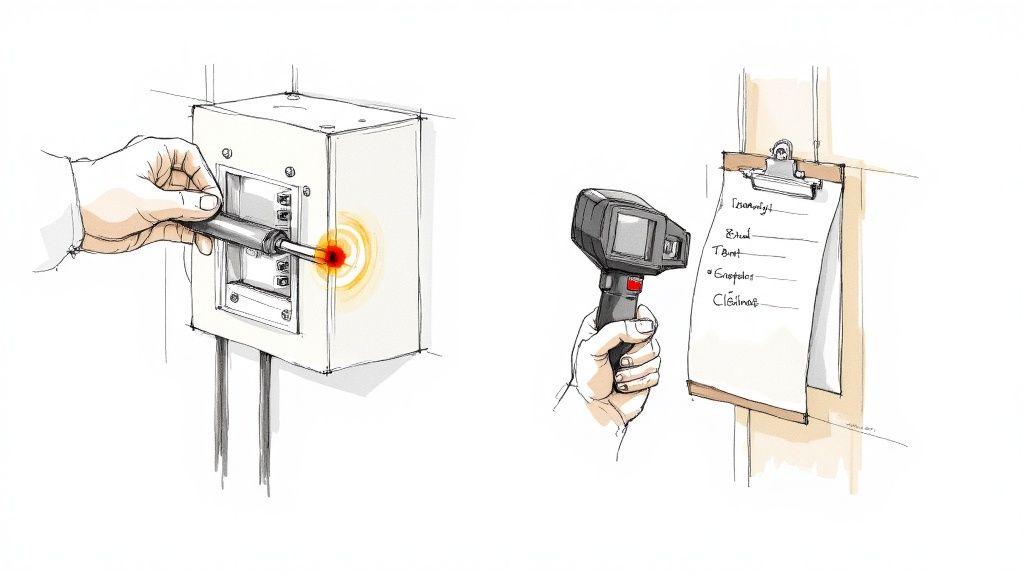
Infrared (IR) Scanning: Get an IR camera on the breaker while it’s under load. This is the fastest way to spot hot spots at terminals and connections before they can turn into a major failure.
Mechanical Testing: Manually switch the breaker on and off a few times. "Exercising" the mechanism like this ensures the internal lubricants don't gum up and seize.
A Thorough Cleaning: De-energize the system completely and use a vacuum (not compressed air, which just blows dust around) to clean out the breaker and its enclosure. This prevents electrical tracking and flashovers.
Connection Re-Torquing: Heat and vibration can cause connections to loosen slightly over time. After the initial settling-in period, it's smart to verify that all terminals are still torqued to the original spec.
Let's be honest—your facility's electrical system won't last forever. Components get old, technology marches on, and safety standards become more stringent. But what happens when your switchgear is showing its age, but a full, multi-million-dollar replacement just isn't in the budget? It’s a tough spot many facility managers find themselves in.
The good news? You don't always have to rip everything out and start from scratch. A smarter, more targeted approach is to upgrade the single most important component: the circuit breaker. This strategy, known as retrofitting, lets you infuse modern protection and intelligence into your existing gear.
By swapping out those old, tired breakers for a modern ABB model like the Tmax XT or Emax 2, you can give your entire system a new lease on life. You get the benefits of today's tech without the massive cost and downtime of a complete overhaul, stretching the reliable life of your switchgear for years.
Choosing Your Retrofit Strategy
When it's time to upgrade an older breaker, you've really got two main paths: a direct replacement or a full-on retrofit solution. Which one is right for you boils down to the age and model of your existing equipment.
Direct Replacement: This is the easiest route. For breakers from lines ABB recently acquired (like GE Industrial Solutions), you can often find a direct, form-fit replacement. A classic example is swapping an old GE Spectra breaker for a new Tmax XT with very little modification needed.
Retrofit Kits: For ancient or obsolete breakers from other manufacturers, a simple swap is off the table. This is where engineered retrofit kits are a lifesaver. These kits come with custom-designed hardware—think busbar adapters and mounting plates—that allow a modern ABB circuit breaker to be installed safely and securely inside an older switchgear cabinet.
Retrofitting isn't just a patch-up job; it's a strategic modernization. It lets you tackle the highest-risk parts of your system first, boosting safety and reliability in a big way while pushing massive capital spending further down the road.
Weighing the Costs and Benefits
The decision to retrofit or replace always comes down to a hard look at the costs and benefits. A full switchgear replacement is a massive capital project that almost always involves extended downtime—the kind that can bring production to a grinding halt.
A targeted breaker retrofit, on the other hand, is more like a surgical procedure. It can often be done in a fraction of the time, usually during a planned maintenance window, keeping operational disruptions to a minimum. While a high-tech breaker and a custom retrofit kit aren't cheap, the cost is almost always just a fraction of a full system replacement.
And just look at the tangible benefits you get:
Enhanced Safety: Modern breakers are simply better at what they do, offering far superior arc flash mitigation and more dependable fault interruption.
Improved Reliability: New components mean you're no longer gambling on old, worn-out mechanical parts. A well-cared-for breaker can last 30 to 40 years, and a retrofit essentially resets that clock.
Advanced Monitoring: When you upgrade to a breaker with an electronic trip unit, like an Emax 2, you suddenly unlock communication capabilities. That old switchgear can now feed you critical data on energy consumption and system health.
Simplified Maintenance: New breakers, especially the plug-in models, can slash maintenance time and effort by getting rid of the need to constantly re-torque connections.
Ultimately, retrofitting an ABB circuit breaker into your existing system is a powerful move. It delivers the most important safety and performance upgrades right where they count, buying you invaluable time and extending the life of your most critical electrical assets.
Got Questions About ABB Breakers? We've Got Answers.
Even after you've done your homework, a few specific questions always seem to pop up when it's time to choose, install, or upgrade an ABB circuit breaker. We get it. That's why we’ve put together some quick, straightforward answers to the questions we hear most often from engineers and facility managers out in the field.
Think of this as your go-to guide for getting clear on the details so you can make decisions with confidence.
What's the Real Difference Between an ABB MCCB and an ACB?
The biggest distinction boils down to three things: where it's used, how it's built, and how much power it can handle.
A Molded Case Circuit Breaker (MCCB), like ABB's workhorse Tmax XT series, is what you'll find protecting individual circuits, feeders, and motors all over a facility. They typically handle currents up to 3200A. Just like the name says, all its guts are sealed inside a compact, non-serviceable molded case.
On the other hand, an Air Circuit Breaker (ACB), like the beastly Emax 2, is the guardian at the gate. You'll find it at the main service entrance of a large facility, where it protects the entire building from a catastrophic fault. These are rated for massive currents, up to 6300A or even more. An ACB uses the surrounding air to extinguish the huge electrical arc when it trips and is designed with components that can be serviced, giving it a much longer operational life.
How Do I Pick the Right Trip Unit?
Choosing the right trip unit—the "brain" of the breaker—is absolutely crucial. It's what matches the protection to the exact piece of equipment it's supposed to be guarding.
Thermal-Magnetic Trip Units: These are the dependable, cost-effective standard for basic overload and short-circuit protection. They are the perfect fit for simpler, less critical loads like lighting panels or resistive heaters.
Electronic Trip Units: When you need precision and flexibility, you step up to an electronic unit like ABB’s Ekip series. These let you fine-tune everything—long-time, short-time, and instantaneous trip settings. This level of control is essential for protecting expensive motors and getting selective coordination right in a complex system.
Here's a simple rule of thumb: If you just need basic protection, thermal-magnetic will do the job. But if you're protecting motors, coordinating a multi-layered system, or you need advanced diagnostics and communication, an electronic trip unit is a must.
Can I Swap Out Another Brand's Breaker for an ABB Model?
This is a question we hear all the time, especially when dealing with older facilities. A direct, one-for-one physical swap is almost never possible because of differences in size and how they mount. But the answer is still usually yes—with a retrofit.
ABB has engineered retrofit solutions that come with custom adapter plates and busbar connections. These kits allow a modern, feature-rich ABB circuit breaker to be installed safely into an older switchgear cabinet that was built for a competitor's breaker that is now obsolete. It’s a smart way to bring your system's protection and reliability into the 21st century without the staggering cost and downtime of replacing the entire switchgear.
At E & I Sales, this is what we do day in and day out. Whether you’re just selecting a new breaker, planning a full-scale retrofit, or designing a complete UL-listed control panel from scratch, our team has the hands-on expertise to make sure you get a reliable, code-compliant solution that just works. Reach out and let's talk about your project at https://eandisales.com.
A microgrid control system is the command center—the digital brain—of a localized power grid. It’s what manages all the moving parts, from energy generation and storage to final distribution.
Think of it like the conductor of an orchestra, making sure every instrument—whether it’s solar panels, backup generators, or battery banks—plays its part in perfect harmony to deliver clean, reliable power.
The Brains Behind Resilient Power
Picture a hospital, a bustling manufacturing plant, or a mission-critical data center. For them, a sudden outage from the main utility isn't just an inconvenience; it can be catastrophic. This is exactly where a microgrid, guided by its intelligent control system, proves its worth. It can operate as a self-sufficient energy island, completely disconnected from the main grid when needed.
The microgrid control system is the decision-making engine that makes this all possible. It’s constantly watching grid conditions, tracking energy prices, and anticipating the facility’s power needs. If it senses a problem, like a voltage dip that signals an impending blackout, it can seamlessly switch the entire facility over to its own power sources.
This transition happens in milliseconds—so fast that sensitive equipment keeps running without a single hiccup.
Why This Control Is So Important
At its core, a control system’s job is to maintain that delicate balance between electricity supply and demand. This gets a lot more complex inside a microgrid, which often has to juggle multiple, variable energy sources.
Here's what it handles:
Ensuring Grid Stability: It actively manages voltage and frequency to maintain high-quality power, whether you're connected to the utility or running on your own.
Optimizing Energy Costs: The system is smart enough to decide when to use stored battery power, pull from the grid when rates are low, or even sell excess solar energy back to the utility. It's all about minimizing what you spend.
Integrating Renewables: It smooths out the peaks and valleys of solar and wind power by coordinating them with battery storage and other generators, guaranteeing a consistent and predictable energy supply.
A microgrid's true value isn't just in its physical assets like batteries and generators. It's in the intelligence of the control system that orchestrates them. This digital layer is what unlocks real resilience, efficiency, and sustainability.
A Rapidly Growing Market
It's no surprise that demand for these advanced systems is surging. As more industries look for greater energy independence and reliability, the market is taking off.
The global microgrid control systems market shot up from an estimated $4.05 billion to a projected $4.74 billion in just one year. This explosive growth is being driven by the need for a more modern grid and better ways to manage renewable energy. You can dig deeper into these market dynamics over at Mordor Intelligence. This trend really highlights the critical role these systems play in building a more resilient energy future.
Core Architectures of Microgrid Control
Just like there are different ways to run a company, microgrid control systems have a few distinct blueprints. The architecture you choose dictates how decisions get made, how information flows, and ultimately, how fast the system can react when things change. Getting this right is fundamental, whether you're managing a single factory or a sprawling campus.
We generally see three main approaches: centralized, hierarchical, and distributed. Each has its own operational logic, and understanding the trade-offs is the first step toward building a system that’s both smart and tough.
The controller's job is a constant balancing act. It has to juggle the competing demands of resilience, renewable energy integration, and cost management. Every decision tips the scales one way or another.
This constant push and pull between reliability, sustainability, and economics is at the heart of what a good control system does.
Centralized Control: The Single Commander
The centralized model is the classic, top-down approach. Think of it like a military command center with one all-powerful brain—the Microgrid Central Controller (MGCC). This single unit pulls in data from every generator, battery, and load, crunches the numbers, and sends out direct orders.
This design makes management straightforward since all the intelligence lives in one place. It’s fantastic for system-wide optimization because the MGCC has a bird's-eye view, allowing it to make the most efficient and cost-effective calls.
But there's a catch: this design has a glaring vulnerability. If that central controller goes down, the whole microgrid can go dark with it. This single point of failure makes it a risky choice for applications where uptime is everything.
Hierarchical Control: A Team of Managers
A hierarchical setup offers a more layered and robust structure. You still have a central controller at the top, but it delegates authority to local controllers that manage specific zones or groups of equipment. For example, one local controller might handle a solar array and its battery, while another is in charge of a block of industrial machinery.
It’s a lot like how a big factory is run—a main supervisor oversees several floor managers. The top controller sets the big-picture strategy (like "let's save money today"), and the local units handle the second-by-second execution. This takes a huge load off the main controller and speeds up response times.
Many large-scale systems are built this way, often blending technologies like SCADA and DCS. If you want to dive deeper into those, we have a guide that breaks down the SCADA and DCS control systems.
The real beauty of this layered approach is the built-in redundancy. If a local controller fails, it only affects its own little zone. The rest of the microgrid keeps on running, guided by the central brain.
Distributed Control: The Collaborative Network
The distributed, or decentralized, architecture is the most modern and resilient of the bunch. Here, there’s no single boss. Instead, intelligent controllers embedded in each device talk directly to one another on a peer-to-peer network.
Imagine a highly skilled team where every member makes autonomous decisions based on what their colleagues are doing. A solar inverter, a battery system, and a generator all adjust their own output to keep the grid stable, all without waiting for orders.
Enhanced Resilience: With no single point of failure, the system is incredibly tough. If one component drops out, the others automatically pick up the slack.
Scalability: Adding a new solar panel or battery is a breeze. The new device simply joins the network and starts contributing.
Rapid Response: Decisions are made locally and instantly. This is perfect for handling the fast-changing conditions common with renewable energy.
This "plug-and-play" nature makes distributed microgrid control systems exceptionally flexible and robust—a perfect fit for complex sites with a diverse mix of energy assets.
Comparing Microgrid Control Architectures
Each architecture brings something different to the table. Choosing the right one depends entirely on your project's specific needs for resilience, cost, and scalability.
Architecture
Control Logic
Key Advantages
Key Disadvantages
Best For
Centralized
Top-down; one master controller (MGCC) makes all decisions.
Simple to manage; optimal for system-wide economic dispatch.
Single point of failure; communication bottlenecks can slow response.
Small, simple microgrids where cost optimization is the primary goal.
Hierarchical
A central controller coordinates multiple local controllers.
Balanced approach; improved reliability and faster local responses.
More complex to design and implement than a centralized system.
Large industrial campuses or utility microgrids with distinct zones.
Distributed
Peer-to-peer; intelligent devices communicate and decide locally.
Highest resilience (no single point of failure); easily scalable.
Complex control algorithms; system-wide optimization is more challenging.
Mission-critical facilities and microgrids with many diverse energy sources.
Ultimately, the goal is to match the control philosophy to the operational reality. A simple system might thrive with a centralized brain, while a complex, dynamic one will benefit from the collaborative intelligence of a distributed network.
Essential Microgrid Operating Modes
A microgrid’s real value comes from its ability to adapt. The control system is the brain behind this flexibility, constantly ready to shift its behavior to keep the lights on, no matter what’s happening on the main utility grid. Think of it as a seasoned musician who can play in a full orchestra, lead a small ensemble, or perform a stunning solo at a moment's notice.
This operational agility is the bedrock of microgrid resilience. The controller has to fluidly transition between these modes to guarantee stability, whether it’s running in sync with the utility or standing entirely on its own.
Grid-Following: The Synchronized Player
Most of the time, a microgrid operates in grid-following mode. While connected to the utility, it behaves like a disciplined musician in a large orchestra. The main grid is the conductor, setting the tempo—the voltage and frequency—and the microgrid’s inverters simply follow that lead.
The focus here is purely economic. The control system is busy with tasks like:
Managing Power Flow: It intelligently decides when to push surplus solar power back to the grid for credits or pull power from the utility when rates are low.
Optimizing Local Assets: It juggles its own generators and batteries to slice the facility's energy bills, a practice we call economic dispatch.
This is the standard, efficient mode for daily operations. But it’s completely dependent on a stable utility grid. If the conductor falters, the microgrid must be ready to switch roles instantly or risk going down with it.
Grid-Forming: The Conductor
When the microgrid disconnects from the utility, it immediately enters grid-forming mode. Now, it has to become the conductor. It must create its own stable rhythm from scratch. The control system instantly assigns one or more of its inverters—usually those tied to a battery system—to generate and maintain a clean, stable voltage and frequency for the entire site.
This is a much tougher job. The grid-forming inverters become the undisputed source of power quality. They establish the beat that all other generators, solar arrays, and equipment on the microgrid must sync to. This is the crucial function that transforms a collection of individual assets into a cohesive, self-sufficient power system.
Islanding: The Solo Performance
The act of separating from the grid is known as islanding. This is the critical moment when the microgrid executes a flawless, planned break from the utility during an outage and begins its solo performance. A high-speed breaker at the point of common coupling (PCC) physically opens in milliseconds to create the "island."
The ability to seamlessly island is the hallmark of a resilient microgrid. It’s the planned, controlled separation from a failing utility grid that ensures critical loads—like hospital equipment or manufacturing lines—never experience an interruption.
Once islanded, the microgrid control system takes complete command. It has to perfectly balance its internal power generation with the site's real-time energy demand. The microgrid can continue this solo act for as long as needed—hours, days, or even weeks—until the utility grid is stable again. At that point, it can safely resynchronize and return to its normal grid-following role.
The growing demand for this kind of sophisticated control is obvious in the market. The global microgrid controller software market is projected to skyrocket from $5.06 billion to $33.90 billion in just a decade, a massive annual growth rate of 23.55%. You can explore more insights into this expanding market at Precedence Research. This explosion in growth shows just how vital this advanced software is to achieving true energy independence and resilience.
Talking the Talk: Microgrid Communication Protocols and Standards
A microgrid controller is like the conductor of an orchestra. But what happens if the conductor only speaks English, the strings speak French, and the brass section speaks German? You get noise, not music. The same chaos happens in a microgrid when devices from different manufacturers can't communicate effectively.
This is where communication protocols and industry standards become the unsung heroes of the project. Protocols are the common languages that allow all the equipment—from inverters to generators—to share data and commands. Standards are the rulebooks that ensure everything is connected safely and plays nice with the larger utility grid. Without them, you don't have an intelligent, unified system; you just have a very expensive collection of parts.
The Languages of Industrial Control
Over the years, a few key protocols have become the go-to languages for the energy and industrial worlds. A truly capable microgrid control system needs to be multilingual, speaking the native tongue of every asset you connect to it.
IEC 61850: Think of this as the high-speed, modern language of substations and smart grid devices. It’s built for the rapid-fire, peer-to-peer communication needed for protective actions that keep a microgrid stable during a fault. Its structured, object-oriented approach to data is a huge win for simplifying integration.
DNP3 (Distributed Network Protocol 3): A long-time favorite of North American electric utilities, DNP3 is the rugged, reliable choice. It's fantastic for SCADA systems talking to remote equipment over networks that might not be perfect, ensuring critical messages get through no matter what.
Modbus: This one is the old, reliable workhorse. As one of the most widely adopted industrial protocols ever, Modbus is your key to connecting with all sorts of factory equipment, sensors, and meters. Its simplicity is its strength, making it a must-have for bringing older, legacy assets into your microgrid.
And you can't forget about BACnet, which is incredibly common in building management systems. If your microgrid needs to integrate with a facility's HVAC or lighting controls, you'll need to know your way around it. For a deeper dive, check out our complete guide to the BACnet communication protocol.
The diagram below shows how a standard like IEC 61850 organizes this communication traffic into logical layers, from the equipment on the ground floor all the way up to the central control room.
This layered design is what keeps everything organized and prevents a communication free-for-all, ensuring data flows where it needs to, when it needs to.
The Rulebook for Playing with the Grid
Beyond just speaking the right language, a microgrid has to follow a strict set of rules, especially when it’s connected to the main utility. In the United States, the single most important rulebook is IEEE 1547.
IEEE 1547 is the master standard that lays out all the technical requirements for connecting distributed energy resources (like your microgrid) to the electric grid. This isn't just a suggestion—compliance is your ticket to legally and safely interconnecting with the utility.
Following this standard means your microgrid acts like a good neighbor. It dictates exactly how your system must react to grid problems, how it should support overall grid stability, and—most critically—how it must stop sending power back to the utility's lines during an outage to keep line workers safe. Making sure your inverters and controllers are certified to the latest version of IEEE 1547 isn't just a box to check; it’s a fundamental part of a safe and successful project.
The push for this kind of intelligent, compliant technology is driving some serious market growth. The global microgrid controller market is forecast to explode from USD 3 billion to USD 22.4 billion over the next decade, a blistering annual growth rate of 22.3%. This incredible expansion is a direct result of the growing demand for real-time, smart energy management. You can discover more insights on this market growth at Global Market Insights Inc.
Alright, let's get this section sounding like it was written by a seasoned pro who's been in the trenches, designing these systems for years.
Here is the rewritten section, following the specified style, tone, and requirements.
Designing and Integrating Your Microgrid System
Getting a microgrid from the drawing board to a fully operational reality is where the rubber meets the road. For an industrial site, this is a serious undertaking, and every bit of planning you do upfront will pay you back tenfold down the line. It all starts with getting to know the unique energy heartbeat of your facility.
This isn't just about picking out shiny new hardware. It’s about building a finely tuned ecosystem where every single component pulls in the same direction, delivering the resilience and efficiency you’re after.
Start with a Detailed Load Profile
Before you even think about specifying a single piece of equipment, you absolutely have to know how, when, and where your facility uses electricity. This is what we call load profiling, and it's non-negotiable.
Think of it as an energy audit on steroids. You’ll dig into your consumption data over a long period to pinpoint critical loads, identify those costly peak demand windows, and truly understand your operational patterns. This data becomes the bedrock for every other decision you make, from sizing your battery bank to choosing the right control architecture. A solid load profile tells you exactly what must stay running during an outage and what can be shed to conserve precious power.
Sizing Your Energy Resources and Control
With that load profile in your back pocket, you can start sizing your Distributed Energy Resources (DERs). This is a careful balancing act, weighing your operational needs against the hard realities of your budget.
Battery Energy Storage System (BESS): This needs to be big enough to carry your most critical loads for a set amount of time during an outage and to help you shave those expensive demand peaks.
Generation Assets: Whether it's solar panels or generators, they need enough muscle to meet your demand and recharge your batteries—even on cloudy days or during a multi-day grid failure.
Control System Selection: Your choice between a centralized, hierarchical, or distributed control system really depends on your site’s complexity. For mission-critical industrial operations, we often lean toward a distributed model simply because of its built-in redundancy.
A classic mistake is getting the sizing wrong. Go too big, and you've wasted capital. Go too small, and the system will fail you when you need it most. Proper sizing, guided by your load profile, is the key to hitting that sweet spot.
Smart Procurement for Faster Integration
How you buy your components can make or break your project timeline. Instead of sourcing every little part and trying to build it all from scratch on-site—a recipe for delays and headaches—a much smarter approach is to use pre-engineered, packaged solutions.
Specifying a UL-listed control panel is a huge step in the right direction. This certification means the panel has been built and tested to strict, nationally recognized safety standards. It shows up on your site ready to go, which dramatically cuts down on field wiring, testing time, and commissioning nightmares. This approach to industrial controls and automation is how you get a faster, safer, and more reliable deployment.
Commissioning and Verification Checklist
The last mile is commissioning. This is the systematic, step-by-step process of testing every component and function to prove the system does what you designed it to do. This is where you find out if your microgrid can actually handle the scenarios you’ve been planning for.
A rock-solid commissioning plan must include:
Component-Level Testing: Confirming every inverter, generator, and battery is talking correctly to the controller.
Full System Functional Tests: Running simulations of different operating conditions, including a planned islanding event.
Black Start Capability Test: Proving the system can bring itself back online from a total shutdown with zero help from the utility grid.
Compliance Verification: Making sure the system checks all the boxes for your utility's interconnection requirements. It’s also vital to ensure you're aligned with any applicable national standards and UK grid regulations like G98, G99, and G100.
Only when your system passes these grueling tests with flying colors can you finally be confident that your microgrid is ready to deliver the resilience and control you paid for.
Securing Your Microgrid from Cyber Threats
As microgrids get smarter and more connected, they also show up more brightly on the radar of cyber attackers. The very things that make them so powerful—remote access, live data streams, and automated controls—unfortunately double as open doors for disruption.
Common-sense oversights like internet-exposed controllers, lax remote access for vendors, and unmonitored industrial protocols are the low-hanging fruit for bad actors. Let’s be clear: cybersecurity for your microgrid control system isn’t an add-on anymore. It’s a fundamental operational requirement.
A Layered Defense-in-Depth Strategy
The old "castle-and-moat" security model is dead. Building a strong perimeter and trusting everything inside is a recipe for disaster. Once an attacker is inside that wall, they have free rein. The modern playbook calls for a "defense-in-depth" strategy, which assumes a threat can originate from anywhere, inside or out.
This approach involves several critical layers:
Network Segmentation: This is about creating bulkheads in your ship. You divide the control network into smaller, isolated zones. If one area is breached, the damage is contained and can’t sink the entire system.
Strict Access Control: Every remote access point needs multi-factor authentication, period. It's also crucial to operate on the principle of least privilege—users and devices should only have the absolute minimum access required to do their job. Nothing more.
Data Encryption: Think of this as sealing your communications in an envelope. All data flying between controllers, inverters, and other devices must be encrypted. This stops attackers from listening in on commands or, worse, injecting their own malicious data.
Modern security philosophies like a robust Zero Trust Architecture are quickly becoming the standard for stopping sophisticated attacks. The premise is simple but powerful: never trust, always verify. Every single connection, every single data packet gets verified.
Adhering to Cybersecurity Frameworks
There's no need to start from scratch. Proven, battle-tested frameworks give you a roadmap for building a resilient operation. The NIST Cybersecurity Framework is one of the most respected guides out there for protecting critical infrastructure.
The Framework provides a structured, risk-based approach to cybersecurity, organizing activities around five core functions: Identify, Protect, Detect, Respond, and Recover. It helps you understand, manage, and reduce cybersecurity risk in a way that’s aligned with your business objectives.
What makes the framework so effective is that it creates a common language and a repeatable methodology that everyone—from the engineer on the plant floor to the executive in the boardroom—can understand and follow.
NIST visualizes these five functions as a continuous cycle, not a one-and-done checklist.
This integrated approach drives home the point that security isn't a project with an end date. It's a constant process of improvement and adaptation to whatever new threats come next.
By building a layered defense, locking down access, and following established standards like the NIST Framework, you can develop a security posture that’s truly robust. This proactive stance is the only way to safeguard your microgrid control system, ensuring it remains an asset for resilience, not a point of failure.
Frequently Asked Questions
When you start digging into microgrid controllers, a few common questions always seem to pop up. Let's tackle some of the most frequent ones to clear up the details, especially when you're comparing technologies or planning future upgrades.
Controller Versus Building Automation
What’s the real difference between a microgrid controller and a building automation system (BAS)?
Think of them as two different managers running the same facility, each with a very specific job. The microgrid control system is your power czar. It’s completely focused on energy generation, storage, and grid stability. Its prime directive is to keep the lights on with reliable power, no matter what—especially if it has to island from the utility.
A Building Automation System (BAS), on the other hand, is the efficiency guru. It looks inward, managing all the building loads like HVAC and lighting to keep everyone comfortable while cutting energy waste. While these two systems absolutely can and should talk to each other, the microgrid controller always has the final say on power, while the BAS handles the building's internal climate and environment.
Integrating with Existing Solar
Can I add a microgrid control system to the solar panels I already have?
Absolutely. In fact, this is one of the most common and powerful ways to upgrade a facility. A modern microgrid controller can be retrofitted to work with existing assets like solar arrays and backup generators, essentially giving them a new, much smarter brain.
The controller steps in as the new command center, coordinating your legacy equipment with new components like a battery energy storage system (BESS). This creates a cohesive, fully functional microgrid. The most important step is just making sure the controller you pick can "speak the same language" by supporting your existing equipment's communication protocols.
This ability to integrate what you already own is a huge deal for making microgrids more accessible. It means facilities can upgrade their energy systems in phases, adding advanced control and storage to unlock the full potential of equipment they’ve already paid for.
The Role of AI and Machine Learning
How are AI and machine learning changing microgrid control systems?
Artificial intelligence and machine learning are giving microgrid controls a crystal ball. Instead of just reacting to what’s happening right now, these advanced systems can predict what's coming next—and that’s a total game-changer for efficiency and cost savings.
Here’s how they make a real difference:
Predictive Forecasting: AI algorithms can chew through weather data to predict, with surprising accuracy, how much solar energy your panels will produce tomorrow.
Load Prediction: By analyzing historical consumption data, machine learning models can forecast your facility’s energy demand with incredible precision.
Having this kind of foresight lets the microgrid control system make much smarter, proactive decisions. It can store excess solar power when it knows a cloudy day is on the horizon or pre-charge batteries right before a predicted spike in demand. This isn't just clever tech; it directly optimizes your operating costs and makes the entire system run better.
At E & I Sales, we specialize in designing and delivering the robust, UL-listed control panels that are the heart of any reliable microgrid. From initial spec to final commissioning, our team delivers the integrated solutions that bring your energy resilience goals to life. See how our expertise can power your next project at https://eandisales.com.
A control panel builder is a specialized company that designs, builds, and tests the electrical control systems for industrial machinery. Think of them as the architects of your equipment’s nervous system. They take your operational goals and translate them into a physical control system that’s safe, efficient, and ready to work.
What Does a Control Panel Builder Really Do?
Sure, they build panels. But their real job is to be a critical engineering partner. They take a list of your needs—controlling motor speeds, reading sensors, activating safety locks—and turn it into a functional piece of hardware. This isn't just about connecting wires; it's a careful mix of electrical engineering, deep knowledge of regulations, and hands-on craftsmanship.
These builders create a unified system that becomes the command center for your entire operation. Their work is what ensures every button press and automated sequence happens exactly when and how it should, protecting both your expensive machinery and your people.
The Core Mission of a Builder
When you get right down to it, a builder's main job is to provide certainty. Partnering with a professional builder means handing off a highly specialized and critical task to experts who live and breathe electrical code and automation logic. They handle the complexity so you can focus on running your business.
This breaks down into a few key areas that show their true value:
Turning Ideas into Hardware: They take your P&IDs (piping and instrumentation diagrams) or even just a functional description and engineer a tangible solution that works in the real world.
Keeping Things Safe and Legal: A good builder knows the standards inside and out. They design and build panels to meet strict requirements from organizations like UL (Underwriters Laboratories), ensuring the final product is safe, reliable, and insurable.
Choosing the Right Parts for the Job: They select the best components—from PLCs and VFDs to breakers and terminals—to make sure the panel can handle the specific demands of your operation without fail.
Supporting You from Start to Finish: The job doesn't end when the panel is built. The best builders provide complete documentation, rigorous testing, and even on-site commissioning to make sure everything integrates smoothly.
A skilled control panel builder is the bridge between your operational vision and the physical hardware that makes it happen. They turn abstract requirements into a robust, safe, and fully functional electrical system.
This isn't a niche market, either. The global industrial control panels market was valued at USD 13.5 billion in 2023 and is on track to hit around USD 20.8 billion by 2032. That growth shows just how much modern industries rely on automation to stay competitive and safe. You can explore more about these market trends and their drivers.
In the end, a control panel builder delivers more than just a box with wires. They provide a critical asset engineered for dependability, forming the very backbone of modern industrial automation.
From Blueprint to Operation: Core Builder Services
A professional control panel builder does a lot more than just screw components onto a backplate. They take a project on a structured, multi-stage journey, turning a simple operational need into a control system that’s functional, safe, and built to last.
Think of it like getting a custom suit made. You don't just hand over fabric; you work with a master tailor who measures, designs, cuts, and stitches everything with precision. They ensure the final product fits perfectly and looks sharp. That’s what a great panel builder does for your industrial controls.
Each phase demands a specific mix of engineering know-how, deep regulatory knowledge, and old-fashioned hands-on craftsmanship. Let's walk through the four core services that separate the pros from the amateurs.
Collaborative Design and Engineering
It all starts with an idea. The journey begins by turning your concept into a concrete, manufacturable plan. Honestly, this is the most critical phase—every decision made here ripples through the panel's final performance, safety, and cost.
A skilled builder works with you to nail down the exact operational requirements. This isn't just about taking orders; it’s a deep-dive conversation where they ask the tough questions to head off problems before they start:
Where will this panel live? Is it indoors, outdoors, or in a hazardous location?
What are the real power requirements and motor loads we're dealing with?
What communication protocols need to play nicely together, like Ethernet/IP or Modbus?
What specific safety interlocks are non-negotiable for protecting people and machinery?
Armed with this information, their engineers draft detailed electrical schematics, enclosure layouts, and a full bill of materials (BOM). This blueprint becomes the single source of truth for the entire project, ensuring every part is specified and placed for peak function and easy servicing down the road.
Precision Fabrication and Assembly
Once the design is locked in, the project moves from the screen to the shop floor. This is where expert craftsmanship truly shines. The fabrication happens in a controlled environment, carried out by certified technicians who live and breathe industrial control panels.
The whole process is methodical and precise. Technicians mount the backplate, lay down DIN rails, and carefully place every single component—from the main breaker and PLC right down to the terminal blocks and wire ducts. The wiring itself is practically an art form. Each connection is cut to the perfect length, clearly labeled, and torqued to spec. A clean, well-organized panel isn't just nice to look at; it's a thousand times easier to troubleshoot and safer to maintain.
A messy, disorganized panel is a huge red flag. The level of care a builder puts into wire management and labeling speaks volumes about their commitment to quality and long-term reliability.
This stage is all about bringing the schematics to life with an uncompromising focus on the small stuff.
UL Listing and Regulatory Compliance
One of the single most important services a qualified panel builder offers is ensuring the final product meets all industry standards—especially UL 508A. This certification is the gold standard for industrial control panel safety in North America.
A UL 508A Listed panel means it was built in a certified shop, using approved components, and following a strict set of construction rules. This isn't just about getting a sticker for the enclosure. It provides a few critical guarantees:
Safety Verification: It confirms the panel was designed and built to protect against fire and electrical shock.
Code Acceptance: Inspectors and regulators across the country recognize the UL mark, which can save you massive headaches and delays during project approvals.
Insurability: Good luck getting a policy without it. Many insurance providers require critical electrical equipment to be UL Listed.
When a builder maintains an active UL 508A certification, it shows a serious commitment to safety and quality. It gives you peace of mind that your panel isn't just going to work, but it's going to be fundamentally safe.
Commissioning and Field Support
A great builder knows their job isn't done when the panel ships out the door. The final, crucial step is making sure it integrates smoothly into your facility and performs exactly as designed. That’s where commissioning and field support come in.
Commissioning means on-site technicians power up the panel, verify every I/O point, check motor rotations, and confirm all automated sequences run flawlessly. They troubleshoot any hiccups that pop up during startup, working right alongside your team to fine-tune the system. This final check makes the transition from installation to full-throttle operation as smooth as possible.
Beyond that, a reputable builder provides comprehensive documentation—we’re talking as-built drawings and operation manuals—that becomes invaluable for future maintenance. Exploring the full scope of custom controls and their lifecycle support will give you a much deeper insight into what to expect from a true partner.
Decoding Technical Specifications and Standards
To get the most out of a partnership with a control panel builder, you need to speak their language. Don't worry, this isn't about becoming an electrical engineer overnight. It's about understanding the core technical specs and standards that shape your project's safety, reliability, and final cost.
Getting these details right from the very beginning is the single best way to prevent expensive rework down the road. Think of your specifications as the DNA of your control panel—they define everything from the toughness of its steel box to the "brain" running the whole show. A vague request gets you a generic panel, but a precise spec sheet lets a builder craft a system that fits your operation like a glove.
This precision is more important than ever. The global electric control panel market was valued at around USD 7.48 billion in 2025 and is on track to hit USD 11.1 billion by 2032. That growth is all about automation and tighter safety rules, making clear, accurate specs non-negotiable. You can learn more about the electric control panel market growth and its drivers.
NEMA And UL Ratings Explained
When you're talking about enclosures, you'll hear NEMA and UL ratings thrown around a lot. They aren't the same thing, but they both tell you how well an enclosure can protect the sensitive electronics inside from the outside world.
Think of a NEMA rating as the enclosure’s "armor class." It tells you exactly what kind of abuse it can handle. A NEMA 1 enclosure is perfectly fine in a clean, dry office, but it would fail in a heartbeat in a washdown area. On the other hand, a NEMA 4X enclosure is built to shrug off corrosion and high-pressure water jets, making it the go-to for food processing plants or marine environments.
UL ratings, specifically UL 508A, take it a step further. While NEMA sets the performance standard, a UL Listing is proof that a control panel builder has actually built and tested a panel to meet that standard, certifying it's safe from fire and electrical hazards.
To help you get started, here's a quick rundown of some common NEMA ratings you'll encounter.
NEMA Enclosure Ratings Explained
NEMA Rating
Protection Against
Common Application Environment
NEMA 1
Falling dirt, dust, and accidental contact
Indoor, non-hazardous locations like offices or labs.
NEMA 3R
Rain, sleet, snow, and external ice formation
Outdoor locations that are generally protected.
NEMA 4X
Corrosion, windblown dust, rain, and hose-directed water
Food processing, marine, or chemical plants.
NEMA 12
Dripping non-corrosive liquids, falling dirt, and dust
Indoor industrial settings like factories or warehouses.
Knowing just these four ratings will give you a solid foundation for specifying the right enclosure for almost any job.
This entire process, from the first sketch to long-term support, is critical for delivering a system that’s not just functional, but also safe and compliant.
Core Components And Their Functions
Inside the box, a few key components do all the heavy lifting. Knowing what they are and what they do will help you have much smarter conversations with your builder.
A Motor Control Center (MCC) is a perfect example. Instead of having individual motor starters and controllers scattered all over your plant floor, an MCC neatly centralizes them in one floor-standing cabinet. This makes maintenance a breeze, improves safety, and saves a ton of space.
Of course, inside the panel, you'll find the brains of the operation:
Programmable Logic Controllers (PLCs): These are tough, industrial-grade computers that run your automated processes. You program them to read inputs (like a sensor seeing a box) and control outputs (like telling a conveyor belt to start moving).
Variable Frequency Drives (VFDs): A VFD gives you precise control over an AC motor’s speed by changing the power it receives. This is huge for fine-tuning operations, enabling soft starts that reduce mechanical wear, and saving a significant amount of energy compared to just running a motor at full blast all the time.
Choosing the right components is a balancing act. An experienced control panel builder will help you select devices that offer the necessary performance without over-engineering the solution and driving up costs.
This careful selection is the heart of good system architecture. For a closer look at these early planning stages, check out our guide on industrial control panel design.
Ensuring Safety And Lifecycle Support
Finally, every good specification covers safety and testing. This means calling out requirements for emergency stops, safety relays, and proper grounding. Before a panel ever leaves the shop, your builder should conduct a thorough factory acceptance test (FAT). This is where they power everything up and check every single circuit, input, and output to make sure it works exactly as designed.
Lifecycle support is the last piece of the puzzle. A great builder won’t just ship you a panel; they’ll provide a complete documentation package with as-built electrical drawings, a bill of materials (BOM), and all the component manuals. This information is gold for future troubleshooting, maintenance, and upgrades, making sure your investment serves you well for years to come.
How Custom Control Panels Solve Real-World Problems
It’s one thing to talk about technical specs and industry standards. It’s another to see how they come together to solve messy, real-world problems. That’s where the true value of a custom control panel builder shines. These panels are the unsung heroes of modern industry, the brains behind the brawn, making sure complex operations run smoothly, safely, and efficiently.
Think of it like this: an off-the-shelf control solution is like buying a suit off the rack. It might do the job, but it’ll never fit perfectly. A custom panel, on the other hand, is a bespoke suit—tailored by an expert to fit your exact operational needs, your specific environment, and your business goals.
Let's look at a few places where this custom-tailored approach is a game-changer.
The Automotive Assembly Line
Picture a high-speed automotive assembly line—a ballet of robots, conveyors, and human-operated stations all needing to work in perfect harmony. A split-second timing error isn't just a minor hiccup; it can cause costly defects or, far worse, a serious safety incident. The custom control panel is the central nervous system that keeps this entire symphony in sync.
A good control panel builder designs a system from the ground up for this demanding environment, focusing on:
High-Speed Processing: Using a powerful PLC that can juggle thousands of I/O points in milliseconds, ensuring every robotic arm and conveyor belt moves with absolute precision.
Integrated Safety: Weaving light curtains, e-stops, and safety relays directly into the control logic. This isn't an afterthought; it's a core function that creates a failsafe system to protect people on the floor.
Precision Motor Control: Implementing Variable Frequency Drives (VFDs) to dial in conveyor speeds, perfectly matching the pace of production to maximize throughput without sacrificing quality. Dig into the details in our article on variable frequency drive basics.
The global automotive control panel market is already a massive industry, valued at around USD 118.99 billion in 2024 and expected to hit USD 217.35 billion by 2034. This explosive growth is fueled by the need for these kinds of sophisticated, integrated systems, especially as the world shifts to electric vehicles. You can discover more insights about the automotive control panel market and what's driving the technology forward.
The Water Treatment Plant
Now, shift gears to a municipal water treatment facility. This is critical infrastructure that has to run 24/7/365, no exceptions. The stakes are incredibly high, so the control system needs to be bulletproof, with layers of redundancy and options for remote oversight.
Here, the top priority isn't just speed; it's unwavering reliability. The panel has to survive its environment and give operators total visibility, whether they’re standing in front of it or miles away.
A builder will craft a panel to meet these specific demands by:
Building in Redundancy: This could mean dual power supplies or even a hot-standby PLC, ensuring that if one component fails, another takes over instantly without a system-wide shutdown.
Enabling Remote Access: The panel is fitted with secure communication modules, allowing engineers to monitor everything—pump status, chemical levels, alarm conditions—from a central control room or even a tablet.
Choosing a Durable Enclosure: A NEMA 3R or NEMA 4 rated enclosure is non-negotiable here. It shields the sensitive electronics inside from the moisture, dust, and temperature swings that are a given in these facilities.
The Food Packaging Facility
Finally, let’s walk into a food packaging plant where hygiene is king. Everything gets washed down, often with high-pressure, high-temperature water and harsh cleaning agents. A standard control panel would be toast in this environment, quickly leading to contamination risks and costly downtime.
The solution is a custom-built panel designed to NEMA 4X standards. The builder uses a stainless-steel enclosure with specialized gaskets and waterproof conduit entries, creating a fortress that is completely sealed against corrosion and water ingress.
This purpose-built solution allows the plant to uphold the strictest sanitation protocols without ever having to worry about its automation systems. It's a perfect example of how a skilled control panel builder goes beyond just wiring components to deliver a solution that solves a business's unique operational reality.
Your Checklist for Vetting a Control Panel Builder
Choosing the right partner for your control panel build is single-handedly the most important decision you'll make in the entire project. It's a big deal. The quality of their work directly echoes in your uptime, your team's safety, and what you’ll be spending on maintenance for years to come.
A rock-bottom quote might look tempting, but it can quickly become an expensive headache if the builder cuts corners on components or quality control.
To make a smart choice, you have to look past the price tag. It's about digging into a builder's true capabilities, their processes, and their real-world experience. This means asking sharp questions and knowing what a good answer sounds like. A methodical approach ensures you find a partner who will deliver a reliable, compliant, and well-documented system.
Verify Certifications and Technical Expertise
First things first, you need to confirm their core qualifications. This isn't just about feeling good about your choice; it's about getting verifiable proof that they meet industry-wide standards for safety and quality. Without these basic credentials, everything else is just talk.
Start with the big one: UL 508A. Don't be shy—ask for their file number and check that it's active. This certification is your assurance that they operate a facility and follow strict procedures that meet demanding safety standards recognized across the country.
Next, get a feel for the depth of their in-house engineering team. You're looking for a partner, not just an assembly line. Ask about the background of their engineers and designers. Do they have people who specialize in PLC programming, HMI development, or—most importantly—your specific industry? A solid engineering team can spot design flaws you might miss, recommend better components, and add incredible value far beyond just building to a print.
Scrutinize Quality Control and Project Management
Consistent quality doesn't just happen, especially when you're ordering more than one panel. It’s the product of a deliberate, documented system. Any reputable control panel builder should be able to walk you through their quality management system (QMS) without hesitation.
Ask them to lay out their process. You'll want to zero in on a few key areas:
Component Sourcing: How do they guarantee they're using authentic, high-quality parts and not gray-market knockoffs?
In-Process Checks: What specific verification steps do they take during fabrication and wiring to catch mistakes early?
Final Testing: Do they perform a full factory acceptance test (FAT) on every single panel before it leaves their shop? Ask for a copy of their standard FAT checklist.
A builder's quality process is a direct reflection of their commitment to reliability. If they can’t show you a documented, repeatable system for ensuring quality, that’s a massive red flag.
Just as crucial is their approach to project management. You should have a dedicated project manager—a single point of contact who provides regular updates and keeps the timeline in check. This kind of structure prevents miscommunication and keeps your project moving from kickoff to commissioning. A clear process for handling change orders is also essential to stop scope creep and budget blowouts in their tracks.
Evaluate Industry Experience and Support
At the end of the day, a builder's past performance is the best predictor of future success. Don't just take their word for it; ask them to prove they understand the unique headaches and hurdles of your industry. Request case studies or examples of projects similar to yours in scope and complexity.
Talking to their references is a step you simply cannot skip. When you get them on the phone, ask targeted questions:
How was the communication throughout the project?
Was the documentation package complete and accurate?
Did the final panel meet every expectation for quality and performance?
How did they handle any curveballs that popped up during or after installation?
This is where you get the real story. The feedback from past clients gives you invaluable insight into what it’s actually like to work with them. A great builder will be excited to connect you with happy customers. Their willingness to provide solid, relevant references says everything about their confidence and their focus on building lasting partnerships.
To help you compare potential partners side-by-side, we've put together a simple checklist.
Control Panel Builder Evaluation Checklist
Evaluation Criteria
Builder A
Builder B
Notes
Certifications
Active UL 508A Listing (Verified)
☐ Yes / ☐ No
☐ Yes / ☐ No
File #:
ISO 9001 or other QMS certified?
☐ Yes / ☐ No
☐ Yes / ☐ No
Technical Expertise
In-house engineering & design team?
☐ Yes / ☐ No
☐ Yes / ☐ No
Staff size?
PLC/HMI programming capabilities?
☐ Yes / ☐ No
☐ Yes / ☐ No
Specific experience in your industry?
☐ Yes / ☐ No
☐ Yes / ☐ No
Ask for examples.
Quality & Project Management
Documented Quality Management System?
☐ Yes / ☐ No
☐ Yes / ☐ No
Request a summary.
Standard Factory Acceptance Test (FAT)?
☐ Yes / ☐ No
☐ Yes / ☐ No
Request checklist.
Dedicated Project Manager assigned?
☐ Yes / ☐ No
☐ Yes / ☐ No
Experience & Support
Provided relevant case studies?
☐ Yes / ☐ No
☐ Yes / ☐ No
Provided at least 2-3 references?
☐ Yes / ☐ No
☐ Yes / ☐ No
Offers field support/commissioning?
☐ Yes / ☐ No
☐ Yes / ☐ No
Offers lifecycle/post-warranty support?
☐ Yes / ☐ No
☐ Yes / ☐ No
Using a structured evaluation like this helps you cut through the sales pitches and focus on what truly matters. By following this checklist, you can move forward with confidence, knowing you've found a partner you can trust to get the job done right.
Common Sourcing Mistakes and How to Avoid Them
Knowing what not to do is often just as important as knowing what to do. When you're sourcing a control panel, a few common but critical mistakes can quickly turn a straightforward project into a mess of delays, budget overruns, and long-term reliability headaches. Getting ahead of these pitfalls is the key to a successful build.
The most frequent error we see is providing vague or incomplete specifications. Just think of your spec sheet as the blueprint for your house; if it's blurry, what gets built will be a complete guess. This kind of ambiguity forces a builder to make assumptions about components and design—assumptions that almost always lead to change orders and surprise costs when they don’t line up with what you actually needed.
Another major misstep is picking a control panel builder based on the lowest bid alone. While your budget is always a factor, a price that seems too good to be true usually is. It often signals compromises in component quality, a rushed assembly job, or totally inadequate testing. Taking that gamble can lead to premature failures and lifecycle costs that will completely dwarf any money you thought you saved upfront.
Overlooking Documentation and Support
It’s surprisingly common, but one of the costliest mistakes is forgetting about what happens after the panel shows up at your door. Sourcing a panel without a complete documentation package is like buying a car without an owner's manual. When a problem crops up months or even years later, your maintenance team is left flying blind, wasting precious time tracing unlabeled wires or trying to identify obsolete parts.
This oversight creates a serious operational risk. Without as-built schematics, a detailed Bill of Materials (BOM), and all the component manuals, any future troubleshooting, modifications, or upgrades become an absolute nightmare. This is where a builder’s commitment to real lifecycle support truly proves its worth.
The quality of a control panel’s documentation is a direct reflection of the builder’s professionalism and their commitment to your long-term success. A great partner delivers a complete system, not just a product in a box.
To sidestep these issues, you have to be proactive and crystal clear in your requirements right from the very beginning.
Proactive Steps for Smarter Sourcing
You can steer clear of these common traps by taking a few deliberate steps during your procurement process. These actions will save you a ton of time, money, and frustration down the line.
Develop a Detailed RFQ: Your Request for Quote needs to be thorough. Be sure to include electrical schematics, a list of preferred components, specific NEMA/UL rating requirements, and clear criteria for testing. The more detail you provide upfront, the more accurate and reliable your quotes will be.
Prioritize Quality Over Price: Look past the price tag and evaluate builders on their certifications (like UL 508A), their internal quality control processes, and their experience in your industry. Don't be afraid to ask for references and case studies to verify their track record.
Demand Comprehensive Documentation: Make a complete, as-built documentation package a required deliverable in your purchase order. Specify that this must include updated drawings, a final BOM, and all relevant software files and licenses.
Using modern tools like construction inventory software can also help you streamline component tracking and sidestep many of these procurement headaches. By focusing on clear communication and long-term value from day one, you set your project up for success.
Got Questions About Control Panels? We've Got Answers.
When you're knee-deep in planning a control panel project, a lot of questions pop up, especially around safety, compliance, and timelines. Getting straight answers is the only way to lock in your budget and make sure everything runs smoothly with your builder.
Let’s tackle a few of the most common questions we hear every day.
What's the Real Difference Between a UL Listed Panel and One with UL Recognized Parts?
This is a big one, and the distinction is critical. Think of it this way: a panel built with UL Recognized parts is like a meal made with individually inspected ingredients. The flour is good, the eggs are good, but there's no guarantee the final cake is baked correctly or is even safe to eat.
A UL 508A Listed panel, on the other hand, is the fully prepared, tested, and certified final product. It means a certified shop built the entire assembly according to UL's rigorous safety and quality standards. This is the certification that inspectors, insurance companies, and your own team look for to know the finished panel is safe and up to code.
How Long Does a Custom Project Usually Take?
The honest answer? It depends. The timeline for a custom panel can swing pretty widely based on how complex the system is and how quickly we can get the parts.
For a relatively simple, smaller panel, you’re likely looking at 3-5 weeks from the moment the design is approved to the day it ships.
But for more complex systems—ones that need custom programming, intensive testing, or involve sourcing hard-to-find components—the timeline can easily stretch to 8-12 weeks or even longer. Any good panel builder should give you a detailed project schedule right after they’ve reviewed your specs.
Can We Upgrade or Modify Our Existing Control Panel?
Absolutely. In fact, it’s a smart move a lot of facilities make. Instead of a full rip-and-replace, we can often retrofit older panels to add new features, beef up safety protocols, or swap out obsolete components.
A qualified builder can come in, assess your current setup, and map out a plan for the upgrade. This could mean adding new I/O, installing a more powerful PLC, or integrating modern VFDs for smarter motor control. It’s a fantastic, cost-effective way to breathe new life into your machinery.
Picture this: you’re trying to run a building, but the HVAC system, the lights, and the security alarms all speak completely different languages. It's chaos. That's the exact problem the BACnet communication protocol was designed to solve. Think of it as the ultimate universal translator for building automation, letting equipment from totally different manufacturers finally talk to each other.
Why BACnet Is the Bedrock of Any Smart Building
At its heart, BACnet isn't a product you can buy off a shelf. It's an open-standard set of rules—a shared language—that allows all the disparate systems in a building, from massive chillers to tiny access card readers, to understand one another. This common ground is absolutely essential for creating buildings that are genuinely intelligent and efficient.
To really get why BACnet is so important, you have to see where it fits into the bigger picture of Building Automation Systems (BAS). If the BAS is the central brain of a building, BACnet is its nervous system, firing messages and commands to every corner of the facility. Without it, operators would be stuck juggling a dozen isolated systems, making any kind of integrated, smart automation impossible.
A Standard Forged Through Collaboration
Developed by the American Society of Heating, Refrigerating and Air-Conditioning Engineers (ASHRAE), the BACnet protocol was born out of a real need to break free from the stranglehold of proprietary systems. In the old days, building owners were often locked into a single vendor's world. If you wanted to upgrade one component, you might have had to rip out the entire system—a ridiculously expensive and inefficient way to do things.
By creating a vendor-neutral standard, BACnet gives facility managers and system integrators some serious advantages:
True Interoperability: You can mix and match the best-in-class devices from different manufacturers without ever worrying if they’ll play nicely together.
Future-Proofing Your Investment: New equipment can be dropped right into your existing infrastructure, protecting your investment for the long haul.
Centralized Command: You get to monitor and manage everything from a single pane of glass, which means better visibility and faster response times when things go wrong.
The whole idea behind BACnet was to create a level playing field for building devices. It makes sure a thermostat from one company can seamlessly report its temperature to an air handler controller from another, which sparks healthy competition and drives innovation.
Market Dominance Isn't an Accident
The protocol's success isn't just a nice idea; the numbers prove it. Since it first came on the scene in 1987, BACnet has become the undisputed standard for building automation. By 2018, its global market share had already blown past 60%, which tells you everything you need to know about its reliability.
This dominance is especially true in North America, where industry heavyweights like Siemens, Schneider Electric, and Johnson Controls have all built their systems around it. You can dig into the specifics in the BACnet adoption market report. This widespread buy-in means you'll always have a massive community for support and a huge selection of compatible products for any project you can dream up.
How BACnet Objects And Services Work Together
To really get a handle on the BACnet communication protocol, you have to understand its two core components: Objects and Services. These two elements are the absolute heart of how BACnet devices share information and get things done, creating a seamless network of smart building equipment.
Think of it this way: every piece of gear in your building—a sensor, a motor, a VAV box—gets a digital profile. That's essentially what a BACnet Object is. It's a standardized, virtual stand-in for a real-world thing, and it holds all the important information about it.
These objects aren't just simple labels; they're structured containers for data. Every object has Properties that spell out its current state and characteristics. Sticking with our profile analogy, properties are the individual fields on that profile, holding specific details that you can either read or change.
The Role of BACnet Objects
In the language of BACnet, objects are the "nouns"—they're the things on the network. A single physical device, like an air handling unit (AHU), isn't just one object. It’s actually a collection of dozens of standard objects that, together, define everything it can do and report.
Let's break down the essential BACnet objects you'll run into constantly.
To make sense of it all, here’s a quick rundown of the most common BACnet objects and what they actually do on the job.
Common BACnet Objects and Their Functions
Object Type
Abbreviation
Description
Example Use Case
Analog Input
AI
Represents a value that can vary continuously across a range.
Reading the temperature from a room sensor or measuring static pressure in a duct.
Binary Input
BI
Represents a simple two-state value (on/off, true/false, occupied/unoccupied).
Checking if a filter is dirty, if a door is open, or if a flow switch is active.
Analog Output
AO
Controls a device using a variable signal.
Commanding a valve to open to 50% or setting a variable frequency drive (VFD) to a specific speed.
Binary Output
BO
Commands a device to a simple on or off state.
Starting a pump, turning on a bank of lights, or enabling an alarm.
These fundamental objects are the building blocks that allow a BAS to monitor and control just about anything you can imagine in a facility.
This diagram really helps visualize how BACnet pulls everything together, connecting all the different systems in a modern building.
As you can see, BACnet is the common language that lets HVAC, lighting, and security systems all talk to each other instead of operating in their own little silos.
Activating The Network With BACnet Services
So, if Objects are the nouns, then Services are the "verbs." They are the standardized commands that one BACnet device can send to another to make something happen. Services are what bring the network to life, allowing devices to do more than just sit there and broadcast their status.
They're the mechanism for asking for information, sending a command, or confirming that a request was received. It's the action part of the equation.
A key takeaway here is that the combination of Objects and Services creates a powerful request-response model. It’s a highly structured conversation: one device uses a Service to ask about an Object's Property, and the other device responds with the requested information.
This interaction is the magic behind true automation. A building controller doesn't just passively see a temperature reading. It actively requests that data using a service and then uses another service to command an air conditioner to turn on. This clear, defined structure is precisely why BACnet is so reliable and plays so well with equipment from different manufacturers.
Let's walk through a real-world example. Say your building automation system (BAS) needs to check the temperature in a conference room and tell the VAV (Variable Air Volume) box to adjust.
The Request: The BAS sends a ReadProperty service request to the VAV box controller. It’s a very specific message, targeting the Analog Input object (the temp sensor) and asking for its Present_Value property. It’s basically asking, "What's the temperature right now?"
The Response: The VAV controller gets the request, checks its sensor, and sends a reply back to the BAS with the current temperature, maybe 74°F.
The Command: The BAS logic decides that's too warm. It then fires off a WriteProperty service request back to that same VAV controller. This time, it targets the Analog Output object that controls the damper, telling it to change its Present_Value to 80% open.
The Action: The VAV controller receives that command and physically moves its damper to the new position, letting more cool air flow into the room.
This constant back-and-forth—using services to read from and write to objects—happens thousands of times a day across a building, all managed seamlessly by the BACnet communication protocol.
Getting to Know BACnet Network Architectures
For BACnet to work its magic, its messages—all those requests and commands zipping between devices—need a physical path to travel on. Think of it like a city's road system. You have massive interstates for high-speed, long-haul traffic and smaller local streets for neighborhood deliveries. BACnet works the same way, using different network types to get data where it needs to go. This flexibility is one of its greatest strengths.
The two workhorses you'll see on almost every job site are BACnet/IP and BACnet MS/TP. Getting a handle on how they work, and more importantly, how they work together, is the key to designing a BAS that's both powerful and practical. They are the perfectly coordinated transportation system for all your building's data.
This hybrid strategy, pairing high-speed backbones with low-cost field networks, is really the secret sauce behind modern building automation.
BACnet/IP: The High-Speed Data Interstate
BACnet/IP is the superhighway of the BACnet world. It cleverly packages BACnet messages into standard UDP/IP packets, the very same data format your computer uses to browse the internet. This is a game-changer because it allows BACnet traffic to ride on standard IT networks like Ethernet and even Wi-Fi.
Since it speaks the language of IT, BACnet/IP is the perfect fit for high-bandwidth communication between the big players in your system. We're talking about the heavy data lifting between:
Management Workstations: The command center where facility managers are monitoring and controlling everything.
Supervisory Controllers: The high-level brains managing entire subsystems, like a central plant or all the equipment on one floor.
BACnet Routers: The crucial traffic cops that connect different network types, like linking a local MS/TP network to the main IP backbone.
The huge win here is speed and volume. BACnet/IP can move mountains of data—trend logs, detailed alarm histories, and complex schedules—across a building or campus in the blink of an eye. It's the undisputed choice for the system's backbone, where performance is non-negotiable. So many of today's industrial controls and automation systems depend on this kind of high-speed connectivity to keep things running smoothly.
BACnet MS/TP: The Reliable Local Roads
If BACnet/IP is the interstate, then BACnet MS/TP (Master-Slave/Token-Passing) is the network of local roads branching out to every last device. Instead of fancy Ethernet, MS/TP runs on a simple, tough, and cost-effective twisted-pair serial bus—usually RS-485 wiring. This makes it the ideal solution for connecting dozens of field-level devices that don't need a firehose of bandwidth.
Just think of all the smaller components scattered across a building that need to communicate:
VAV box controllers
Room temperature sensors
Fan coil unit controllers
Valve actuators and simple relays
These devices are constantly chattering, but they're sending tiny, frequent packets of data—a temperature reading here, a damper position update there. Pulling expensive Ethernet cable to every single one would be a massive waste of money and effort. MS/TP gives you a rugged, low-cost way to daisy-chain these devices together on a single run of wire.
So what's the "Token-Passing" part all about? It’s a clever traffic management system. A digital "token" gets passed from one device to the next on the network. A device can only "speak" when it's holding the token. This simple rule prevents data collisions and ensures every device gets its turn to report in, keeping communication orderly and reliable.
Why This Hybrid Approach Is So Effective
The real genius of the BACnet communication protocol is how it blends these two architectures into a tiered system. You have your high-level controllers and servers living on the fast BACnet/IP network, where they can quickly gather and process data from multiple MS/TP subnetworks out in the field.
A perfect example is a single supervisory controller on the BACnet/IP network managing three separate MS/TP trunks, with each trunk connecting 30-40 VAV boxes on a different floor. The controller talks at high speed to the main building server, while the VAV boxes just do their thing on their local, low-cost MS/TP networks.
This design is brilliant. It keeps the high-volume data traffic off the field bus and prevents the slower field devices from creating a bottleneck on the main network. You get speed where it matters and cost-effectiveness where it makes sense. It’s this practical combination that makes BACnet such an incredibly versatile tool for any building project.
Bringing Your System Up to Code with BACnet SC
In a world where everything is connected, building systems are no exception. But let's be honest: cybersecurity was often an afterthought in the original BACnet protocol. It was built for automation, not for fending off the kinds of threats we see online today.
That’s where BACnet Secure Connect (BACnet/SC) comes in. It’s the security upgrade our building networks have desperately needed.
Think of BACnet/SC as a dedicated security detail for your building's data. It’s a modern, encrypted wrapper that fits snugly around your existing BACnet communications, shielding them from prying eyes and cyberattacks. It doesn’t replace what you already have—it just makes it incredibly secure.
So, How Does It Work?
The secret sauce is Transport Layer Security (TLS) 1.3. If that sounds familiar, it should. It’s the very same encryption standard that protects your online banking and credit card transactions. BACnet/SC applies this battle-tested technology to building automation, making sure every conversation between your devices is authenticated, encrypted, and tamper-proof.
The industry saw the writing on the wall with the rise of threats against operational technology. BACnet/SC was the answer. It’s a whole new protocol layer built on TLS 1.3, giving you the choice between 128-bit and 256-bit elliptic curve cryptography. The best part? It was designed to play nice with older BACnet/IP and MS/TP networks, so you can migrate over time without a massive headache. You can get more background on this security advancement on veris.com.
By authenticating devices with digital certificates, BACnet/SC creates a "zero-trust" environment. What does that mean? No device gets a free pass. Each one has to prove its identity before it can join the network and start talking, effectively locking the door on any rogue hardware.
Practical Perks for Integrators
Putting BACnet/SC in place gives you more than just peace of mind; it solves some very real-world integration headaches.
Finally, a Firewall-Friendly Protocol: Anyone who's wrestled with BACnet/IP knows the pain of poking holes in firewalls. BACnet/SC ditches that mess by using a standard websocket connection, making it vastly simpler to navigate IT security rules.
Say Goodbye to BBMDs: Those dreaded BACnet/IP Broadcast Management Devices (BBMDs) have been a source of network nightmares for years. With BACnet/SC, they’re history. Device discovery is handled through a central "hub," which cleans up your network architecture significantly.
Upgrade Security on Your Own Schedule: This might be the most practical benefit. You can drop a BACnet/SC hub into an existing system and upgrade devices one by one, as time and budget allow. No more "rip-and-replace" pressure.
Of course, technology is only one piece of the puzzle. The most secure protocol in the world can't protect you from human error. That's why implementing BACnet/SC should go hand-in-hand with a comprehensive organizational information security policy. This is about building a complete strategy that defines access rules, monitoring, and what to do when things go wrong. When your tech and your processes work together, you create a truly resilient system.
Integrating Legacy Systems with BACnet Gateways
You’ve got a brand-new building automation system humming along on BACnet, but what about that trusty old chiller in the basement that still speaks Modbus? This is a classic dilemma in facilities management. Tearing out perfectly good, expensive equipment isn't an option. This is exactly where a BACnet gateway comes into play.
Think of a gateway as a universal translator on your network. It’s a smart little box that listens to one protocol, like Modbus or LonWorks, and re-broadcasts the message in fluent BACnet. It works both ways, creating a seamless conversation between your modern BMS and your older, but still critical, assets.
This translation magic lets you unify your controls without the eye-watering cost and disruption of a full rip-and-replace. You get to keep your reliable legacy gear while bringing it into a modern, centralized management system.
When Gateways Become Essential
In many situations, gateways aren't just a nice-to-have; they're an absolute necessity for keeping projects on budget and on time. They are the go-to fix when a full replacement just doesn’t make sense.
Here are a few real-world scenarios where gateways save the day:
Legacy Chillers and Boilers: That massive chiller might be old, but it works. Instead of a huge capital expense to replace it, a gateway can make it look like a native BACnet device to the BMS. Now you can schedule and control it right alongside your new equipment.
Specialized Industrial Equipment: A factory floor is often full of machines with their own proprietary controls. A gateway can tap into that system and pull out key data—like runtime hours or fault codes—and feed it directly into the building automation system for monitoring.
Fire Alarm and Lighting Systems: Many buildings have established fire panels or older LonWorks-based lighting systems. A gateway can bridge them to the main BACnet network, which is perfect for centralizing alarm monitoring and running energy-saving routines.
At its core, a gateway’s job is to map data points from the old protocol to the new one. For example, it takes a value from a Modbus holding register and translates it into a BACnet Analog Input object. Suddenly, that cryptic data point is something your entire BACnet network can understand and act on.
The Growing Importance of Protocol Translation
This need to connect old and new systems is a massive part of the building automation world. The market for BACnet gateways hit USD 1.42 billion globally in 2024, which shows just how critical this technology has become. Some of the more advanced gateways can even translate over 140 different protocols, essentially acting as a Swiss Army knife for system integration. You can read more on the growth of the gateway market on dataintelo.com.
Getting these integrations right is where the real skill comes in. It's often more complex than just plugging in a box. Working with an experienced industrial automation system integrator ensures the gateway is selected, mapped, and commissioned properly. This avoids the headaches of communication errors down the line and helps create a truly unified system where every piece of equipment is finally talking the same language.
BACnet Troubleshooting and Best Practices
Sooner or later, every well-designed BACnet communication protocol network hits a snag. A device might just vanish off the network, or data packets start getting lost in the shuffle, causing all sorts of system headaches. Knowing how to methodically track down and fix these problems is every bit as critical as the initial design and setup. With the right approach and a couple of essential tools, what looks like a network meltdown can become a straightforward fix.
Troubleshooting almost always starts with the simple stuff. Are the cables plugged in tight? Does the device have power? You’d be surprised how many "complex" network issues are solved by these basic physical checks. Once you've ruled out the obvious, the real detective work begins—especially on the MS/TP trunks, which is where most field-level gremlins tend to hide.
Diagnosing Common Network Faults
One of the biggest and most frequent headaches on a BACnet MS/TP network is duplicate MAC addresses. Think of it like a street where two houses have the same address—the mail carrier gets confused. On an MS/TP trunk, every single device needs its own unique address. If two devices share one, the token-passing system that governs communication completely falls apart, causing devices to randomly drop offline or just refuse to talk at all.
Improper wiring is another huge one. The strict rules for MS/TP aren't just suggestions; they're the bedrock of a stable network.
Termination: You absolutely must have a termination resistor at both physical ends of an MS/TP trunk. Without them, signals bounce back down the wire, corrupting the data.
Wiring Quality: Always use low-capacitance, shielded twisted-pair cable that’s actually rated for RS-485 communication. This is your best defense against electrical noise from other equipment.
Daisy-Chaining: Devices have to be wired in a single, continuous line—a true daisy chain. Any star configurations or "T-taps" are a recipe for disaster and will wreck your signal integrity.
When you're dealing with trickier problems, especially on BACnet/IP networks, a protocol analyzer like Wireshark is your best friend. It lets you capture and look at the raw network traffic. You can literally see the BACnet messages flying back and forth, making it easy to spot a device that’s spamming the network with broadcasts or find the bottleneck that’s slowing everything down.
When a device goes offline, the first step is to isolate the problem. Check its neighbors on the MS/TP trunk. If they are also offline, the issue is likely upstream in the wiring or with the controller. If only one device is down, the problem is probably with the device itself or its connection to the bus.
Best Practices for a Resilient BACnet Network
Fixing problems is one thing, but preventing them in the first place is the real goal. Building a bulletproof BACnet network from day one means sticking to a few proven best practices that stop common failures before they ever happen. This proactive mindset will save you endless hours of frustration down the road.
Start with a logical and consistent naming convention for every device, object, and point. It’s a game-changer. When you get an alarm for AHU-03-Supply_Fan-Status, you know exactly what and where that is. This kind of clarity is non-negotiable for efficient maintenance and scales beautifully as the system grows.
While the inner workings of BACnet are complex, understanding how it differs from other protocols is useful. For a deeper dive into industrial protocols, our article comparing SCADA vs DCS is a great place to start.
Answering Your Top BACnet Questions
When you're deep in the trenches of a building automation project, questions are bound to come up. BACnet is the backbone of modern BAS, but some of its concepts can be tricky. Let's clear the air and tackle some of the most common questions we hear from system integrators and engineers.
Think of this as a quick-reference guide to help you make smarter decisions on your next job. We'll cover network types, what "open protocol" really means, and how to deal with that old-school gear you inevitably run into.
What's the Real Difference Between BACnet/IP and BACnet MS/TP?
Let's use an analogy. Think of your building's data network like a road system.
BACnet/IP is the multi-lane interstate highway. It uses the same Ethernet and Wi-Fi your IT department runs on, making it perfect for moving huge amounts of data at high speeds. This is what you'll use to connect your main controllers, servers, and workstations—the heavy-hitters of your system.
BACnet MS/TP, on the other hand, is like the local side streets that get you to every single house. It runs over simple, low-cost twisted-pair wiring and is designed to reliably connect all your field-level devices—think VAVs, sensors, and actuators. Most modern designs smartly use both, with BACnet/IP as the high-speed backbone and MS/TP as the cost-effective way to connect the dozens (or hundreds) of devices out in the field.
Is BACnet Really "Free" and "Open"?
Yes, and this is probably its single biggest advantage. BACnet is an open standard developed and maintained by ASHRAE, not a proprietary product owned by a single corporation. That means any manufacturer can build BACnet-compliant products without paying a dime in licensing fees for the protocol itself.
What does this mean for you? Freedom. It creates a competitive marketplace where you can pick the best piece of equipment for the job, regardless of the brand on the box. You're not locked into one vendor's ecosystem, giving you the flexibility to integrate and upgrade your system with a huge variety of products.
Of course, you still have to buy the actual hardware and software from manufacturers, but the standard they're all building on is open to everyone.
Can I Get My Non-BACnet Gear onto the Network?
Absolutely. This is a situation every integrator faces, and the solution is a device called a BACnet gateway.
Think of a gateway as a professional translator. It sits between your modern BACnet system and, say, an older chiller that only speaks Modbus. The gateway listens to the Modbus data, translates it into the BACnet language in real-time, and then presents it to the rest of your network.
Suddenly, that old chiller's temperature, pressure, and status points show up as standard BACnet objects in your building management system. It's a powerful and budget-friendly way to bring legacy equipment into a centralized control and monitoring platform without the massive cost of a full rip-and-replace.
At E & I Sales, we're the ones designing and building the UL-listed control panels and integrated systems that make BACnet networks tick. Whether you're upgrading an aging facility or commissioning a brand new one, our team has the hands-on expertise to make sure your motor control and automation systems talk to each other without a hitch. Learn more about our custom solutions at https://eandisales.com.